
This Is for Everyone: The Unfinished Story of the World Wide Web
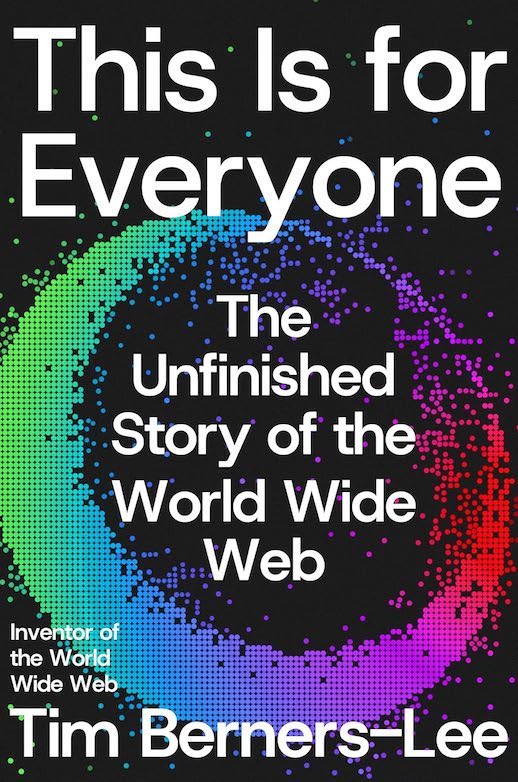 by Tim Berners-Lee
“I was thirty-four years old when I first presented the idea for the World Wide Web. At the time, I was working in Switzerland as a programmer at a particle accelerator. No one was asking for the web, and almost no one expected anything to come from it.”
All this is magic, of course.
That you are now staring into a digital screen and seeing my words at this very moment is, yes, all a bit of incredible magic. Not so long ago, even science-fiction writers struggled with how to convey what you are currently experiencing. This magic is the result of no end of algorithms that seem to be randomly floating about the ether.
Yet, here you are, right this moment, at a particular place in the ether eyeballing a particular item that is apparently residing at that place, which you found with relative ease. An action which certainly appears magical, and certainly beyond our ability to fully explain. Packet-switching? TCP/IP? If you say so.
Once upon a time, ARPA, the Advanced Research Projects Agency, now DARPA (Defense Advanced Research Projects Agency), conjured up a bit of magic that was dubbed, appropriately, ARPAnet. This bit of magic would lead to the internet, which would eventually morph into something only truly powerful wizards could invoke: the GIG, or Global Information Grid, now better known as, yes, The Cloud.
Wedged between the internet and the Cloud there is the World Wide Web, that system bringing a sense of order to what was something of an unruly bunch of algorithms bouncing around here and there in the primordial ether of, well, what exactly?
Dr. (also Sir) Timothy John Berners-Lee (b. 1955) is in that small, select pantheon of folks whose thinking actually did shift the paradigm. It was Berners-Lee who (take your choice of verbs) invented, created, conceived the World Wide Web, the “WWW” that is part of every URL—Universal Resource Locator—that assigns one unique, specific location for any particular resource on the internet. Basically, it is the Library of Congress Classification System (or Dewey Decimal System, better known to many of the Dewey Dismal System) or the Scientific Classification System for biological taxonomy that Carolus Linnaeus is credited with envisioning. All are essentially systems for bringing order (or a semblance of order) to, not to mince words, chaos.
In the world after the Second World War, science and its resulting technologies have become more and more magical. The innovation that was the punched card developed in the years during which the 19th century transitioned into the 20th; it aided in such tasks as census-taking and inventory control. Then came the advent of the algorithmic “computer” during the war, and the punch card—Do Not Fold, Bend or Spiral—was improved upon by the floppy disc.
Meanwhile, the transmission of material—information—through the ether had advanced from telegraph and even, in many respects, telephone to a “wireless” form, literally The Wireless aka the radio. Then, the advent of television which quickly went from being a novelty during the 1930s to exploding in the decades following World War II, then becoming ubiquitous in even the most humble of households. What was black-and-white one day become color the next. In the blink of the proverbial eye we went from cathode ray tube to QD-OLED flatscreen.
And the story, writes Berners-Lee, is not finished. See subtitle. It is not overstating things to suggest he is not exactly the happiest of campers with what the internet and the Web has become. Read Chapter 14 “The Contract for the Web” and that becomes crystal clear to even the untrained eye. A clarion call if there ever was one.
When I put the book down after reading the last of the names in the Acknowledgements, the thought entered my mind that the book is not just essential reading for, say, a graduate (or even undergraduate) seminar but perhaps even more for book clubs because just about everyone at every level interacts with the Web.
The book is well-written, very readable, and uses clear, accessible language of the sort that lends itself to doing exactly what Berners-Lee wishes it to do: shake things up a bit, and get a grip on a world for which paradigm shifts are taking place at a pace that warrants the attention of all of us. In other words: highly, highly recommended.
Copyright 2025, H. Donald Capps (speedreaders.info).









































 Phone / Mail / Email
 RSS Feed
 Facebook
 Twitter