
Alan Stacey: His Life and Lotus Career
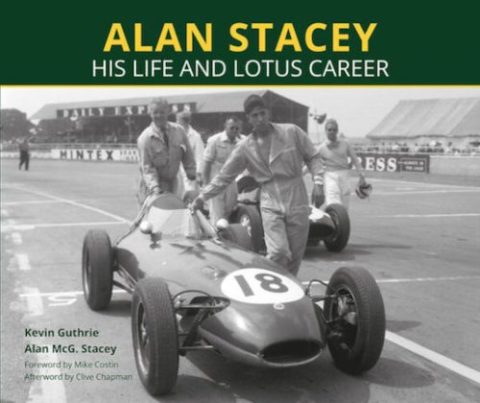 by Kevin Guthrie & Alan McGregor Stacey
“Alan’s story is one that transcends time and generations. The odds of him becoming a grand prix driver as he lay in hospital following the amputation of his lower right leg must have seemed incalculable. Yet, he made it—and in just a few short years. Alan’s story is one of triumph of the human spirit and relentless dedication.”
The 1960 Belgium Grand Prix was catastrophic for British entries, and Lotus in particular. Stirling Moss in his Rob Walker-entered Lotus broke both his legs and incurred other injuries when a wheel fell off due to a hub machining error. Privateer Mike Taylor entered a Lotus in his first and last Grand Prix. The steering broke and he crashed, ending his career. He subsequently successfully sued Lotus. Worst of all for Lotus was the death of Alan Stacey in the works car. There was no conclusive evidence as to the cause of the crash although the consensus was that he was hit in the face by a bird whilst at full speed. Also at the event, Chris Bristow died in a Cooper.
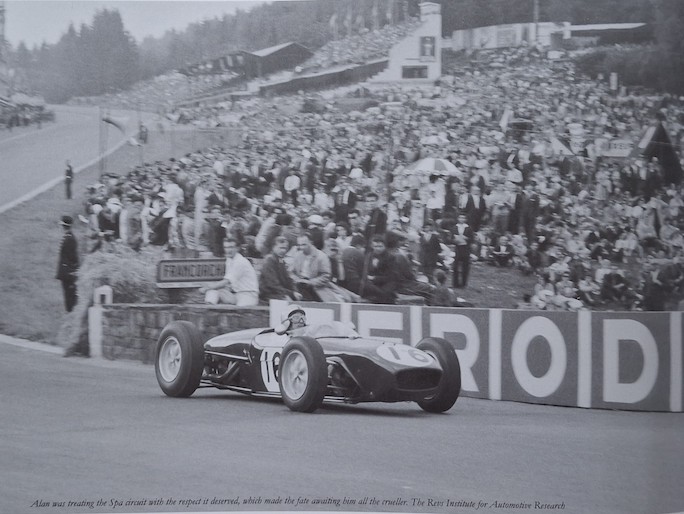
The final race.
Since then Stacey has mainly been remembered as a competent driver who overcame the handicap of racing with an artificial lower leg, and for his death at Spa. However, when BHP Publishing were preparing a book on six lost talents of motor racing (Forever Young) they were contacted by Stacey’s brother Philip who hoped that Alan would be included. Liaison with the Stacey family and Philip’s son Alan McGregor Stacey quickly revealed that with the material on hand at the Stacey family archives, a volume of its own was possible and merited.
Stacey was born into a farming family. Latent mechanical aptitude soon provided his first vehicle, the Speedwagon. Less impressive than it sounds, Stacey constructed it out of an old Morris chassis with the engine “possibly from a fire engine.” The desire for transportation nearly ended in tragedy when he crashed his 250 cc BSA, seriously injuring his right leg. Gangrene set in and his leg below the knee was amputated. This might have been the end of his motorsport ambitions. However the eventual insurance settlement of £5132 (approximately £180k $240k today) meant that he had the means to go motor racing seriously.
His first racing car was a new Lotus Mk VI, and the relationship with Lotus and Colin Chapman was to continue until the end. He was immediately competitive. His skilled mechanic/mentor was a WW2 RAF pilot, Bill Basson. Basson had had an arm amputated below the elbow but had multiple attachments he could screw in for workshop use.
During this time Stacey had become an apprentice at aircraft manufacturer de Havilland, but eventually abandoned this when it became clear that motor racing would be a full-time occupation. The Lotus Mk VI was replaced by the new Lotus Eleven and he was successfully competing again against more famous names. He became part of the Lotus “B” team which meant a free chassis, a retainer, and some prize money. Race preparation nearly 70 years ago was of course a different concept to today. At one track a spark plug was accidently dropped into the clutch housing. Solution? Turn the car over until it dropped out. Probably a technique not included in a WEC Hypercar manual.
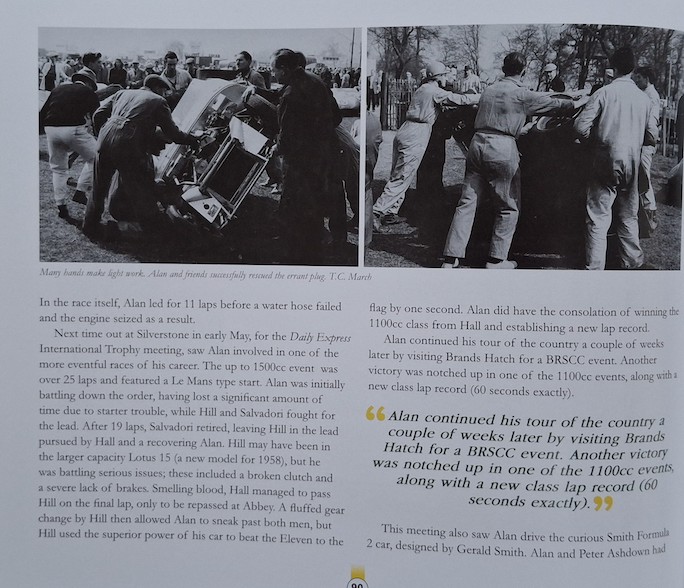
An unconventional way to remove an errant spark plug.
By 1958 he raced in his first F1 Grand Prix at Silverstone. He continued into 1959 with the front-engined Lotus 16 but it was becoming obvious that this was increasingly uncompetitive. Salvation arrived in the form of the Lotus 18. He again was a Lotus F1 driver going into 1960. Then came the Belgium Grand Prix, and the end.
When Stacey raced in F1 World Championship events, he did not have any worthwhile results. All too often the cars let him down. However during this time he was a lot more successful in sports cars and F2, at both the national and international level. And when you look at who else was in the Lotus team—Graham Hill, Innes Ireland, Jim Clark, and John Surtees—he certainly did not disgrace himself.
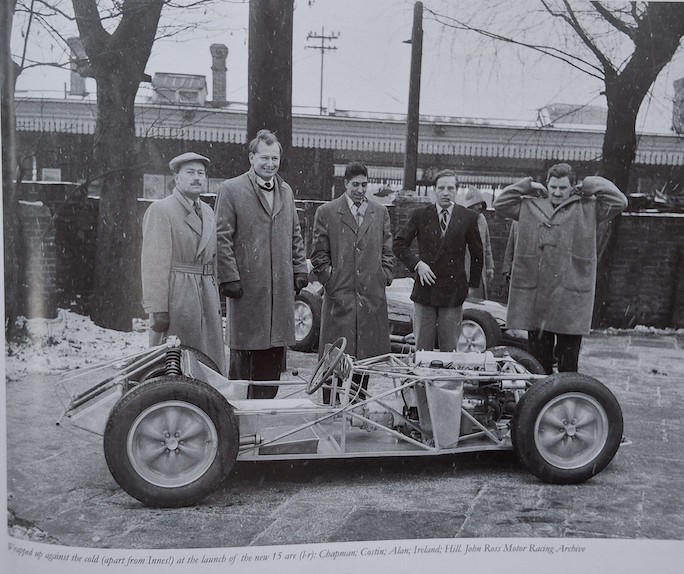
In august company. Colin Chapman, Mike Costin, Alan Stacey, Innes Ireland, and Graham Hill at the launch of the Lotus 15.
If it were not for the Stacey family photograph and document collections, there might have been a struggle in fleshing out a full book. Indeed the earlier BHP publication could well have become Seven Lost Talents. But the family archives take the book into an unusual design and direction. Many of the pages in the book look like leaves from a family photo album, and that is because they are. Stacey was a keen and talented photographer and his images bring this biography to life in a delightful way rarely seen elsewhere. There are also his captions to savor. One of the photos (see below) is captioned “Peter Collins chats with his wife. (Lovely bit of stuff).” Context: this is the 1950s. After he had retired in the 1959 US GP at Sebring, he snapped Jack Brabham pushing his out-of-fuel Cooper over the line to secure his first F1 World Championship.
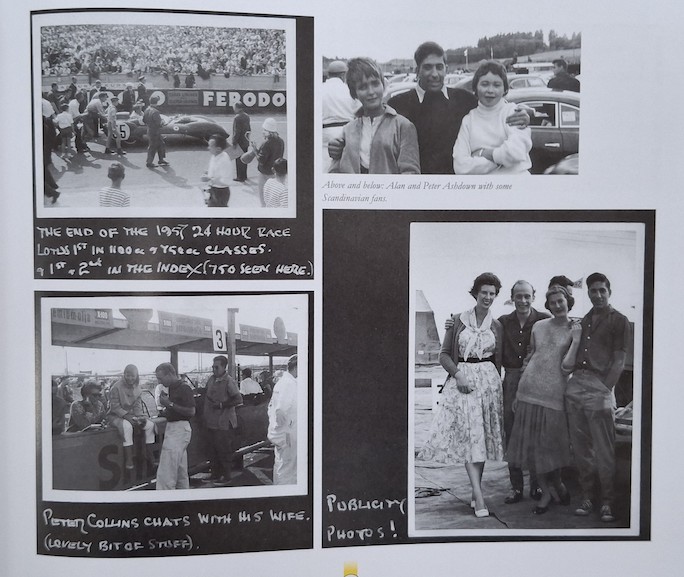
From the family album.
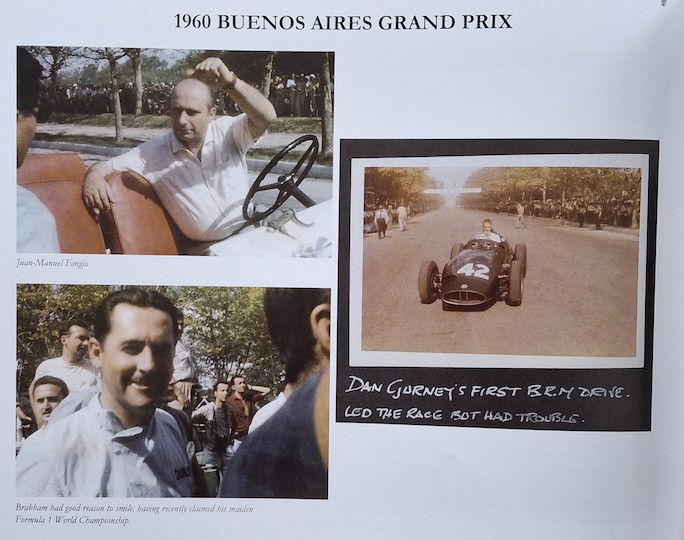
Stacey’s own photos record some racing greats.
All of the photographs merit close examination. At Goodwood he photographed Tommy Atkins’ Mercedes 300SL (VRM SLR 1) and John Coombs’ Jensen 541 (VRM BUY 1). Both these license plates would fetch stratospheric sums nowadays; BUY 1 migrated to Coombs’ Jaguar 3.8. There are also numerous charming photos of Stacey, his family and friends away from the track. With the memories as well of his brothers, sister and nephew, the book has deservedly brought back into focus a talented and engaging individual whose story has at last been properly told.
The book has an index but no bibliography.
Kevin Guthrie is a co-founder of BHP Publishing. Previous books include Jim Crawford: Lessons in Courage, and Roger Williamson (with Darren Banks). Alan McGregor Stacey is the nephew of Alan Stacey and has extensively researched the man he is named after.
Copyright 2026, Paul Lea (speedreaders.info)






 Phone / Mail / Email
 RSS Feed
 Facebook
 Twitter