

Titanic: The Ship Magnificent
by Bruce Beveridge, Scott Andrews, Steve Hall, Daniel Klistorner, Art Braunschweiger
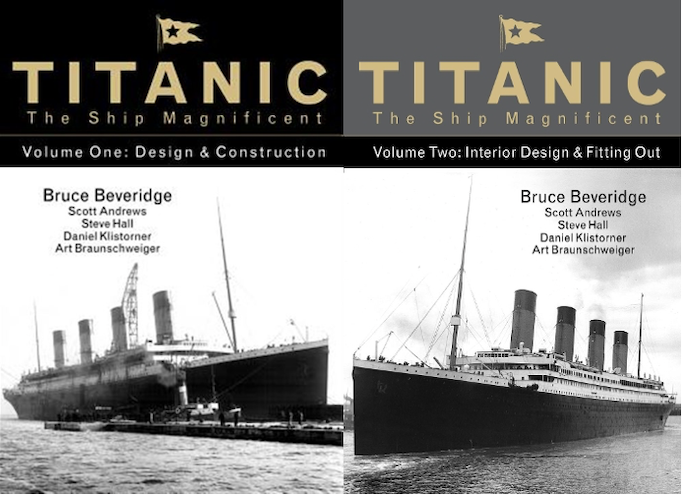
“Since the day Titanic passed into history, people have been writing books about the circumstances surrounding the loss of this great ship—who was to blame, who the passengers and crew were, how the ship sank and so on. And yet, little has been written about the great ship herself—the design, structural details and engineering of what is arguably the most famous ship ever built.”
Pretend you are a trillionaire whose accountants have advised to generate some serious tax write-offs. If so it’s time to play Fantasy Shipbuilding. You decide to build an exact replica of the Titanic, not a look-alike. You are allowed to use modern construction techniques—this is not Total Fantasy Shipbuilding—but you must use the original construction materials. How do you start? In the same way as eating an elephant: a small bite at a time. And the very first thing you will do is the easiest and the cheapest, you will buy these two books.
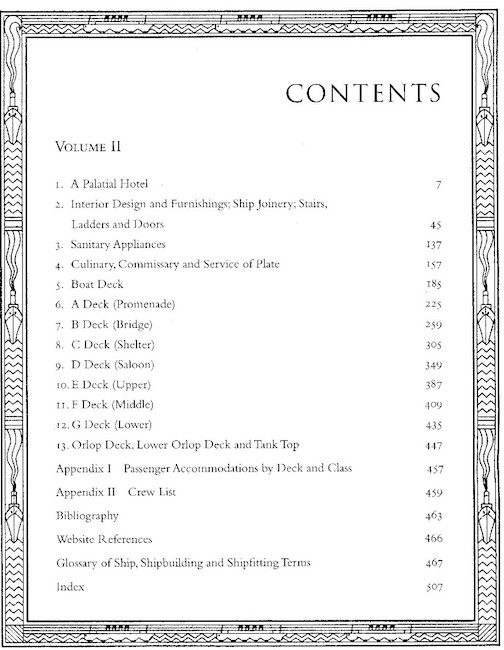
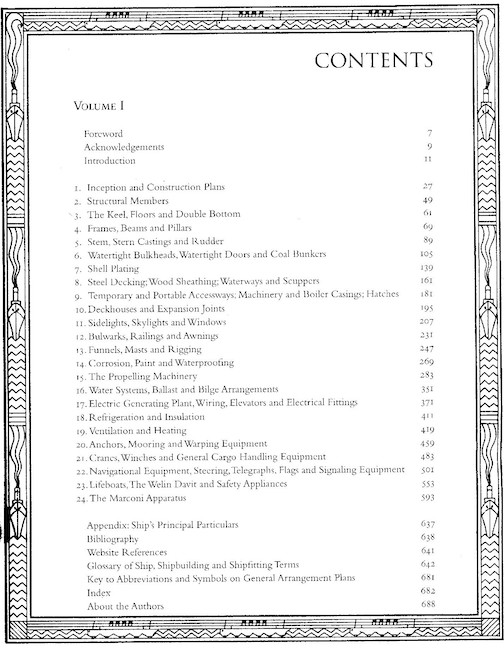 To say that the books contain everything necessary is an understatement. Vol. 1 covers Design and Construction with 688 pages, vol. 2 Interior Design and Fitting Out with 512 pages. Between them there are 1000s of illustrations. There are plans for everything that you will want to know, from the original inception onwards. Everything that is except an important issue we will get to. Curious about riveting? You will have 10 pages to peruse about the different types and how they are fixed. Like many of the detailed explanations throughout the book, not all of the sections are, well, that riveting but they are certainly informative. Do keel, floors and double bottom float your boat? You get your very own chapter.
 The Titanic was not designed and constructed in isolation. The aim was to use and improve on steel shipbuilding techniques stretching back many decades. An excellent read for this shipbuilding period is Ships for all Nations: John Brown & Company by Ian Johnston.
The Titanic was one of a trio of elite Olympic-class liners built by the Harland & Wolff shipyard in Belfast (the others were the Olympic and Britannic). The Olympic was in service from 1911 to 1935 so where no photos exist for elements of the Titanic, those of the near-identical Olympic are used as a stand-in. The Britannic served as a hospital ship in WW1 until it was sunk by a mine.
I confess that there were sections of the books that I skimmed over. But what is fascinating is that the books also explain why specific elements were designed in a particular way, and how the elements evolved to 1912 state of the art. Until these books, for example, I did not think I had an interest in reading about maritime corrosion, paint, and waterproofing. But the books detail the science behind what happens in a saltwater environment. The explanation as to why at this time some ships sailing in warmer waters needed recoating at the end of each voyage was informative and educational.
The issue alluded to earlier is that none of the pictures that survive of the Titanic are in true color, only greyscale. It is known what paint colous were used but the exact tones and shades will likely never be known with absolute certainty as no paint chips or paint formulas have survived. Ditto the furnishings and fittings in the passenger accommodation.
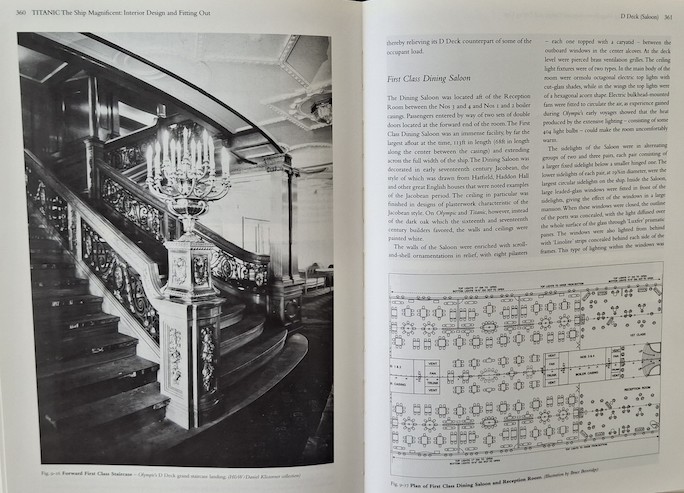
First class with dining and seating arrangements.
Perhaps of most interest to Speedreaders followers is the chapter on propulsion machinery. Maritime architects had (and continue) to wrestle with the conundrum of balancing speed, carrying capacity, and fuel economy. For the Olympicclass this came at a time when the steam turbine was starting to promise speed and economy improvements over the established steam reciprocating engine. The chapter explores in detail how the solution was arrived at. The Titanichedged its bets by using a steam turbine for the center propeller and reciprocating engine for the two outer ones. The stakes were high. The liners would need to pass the speed/economy criteria before being accepted and fully paid for by the customer. This was at a time when aviation and motoring technologies were also making similar giant strides.
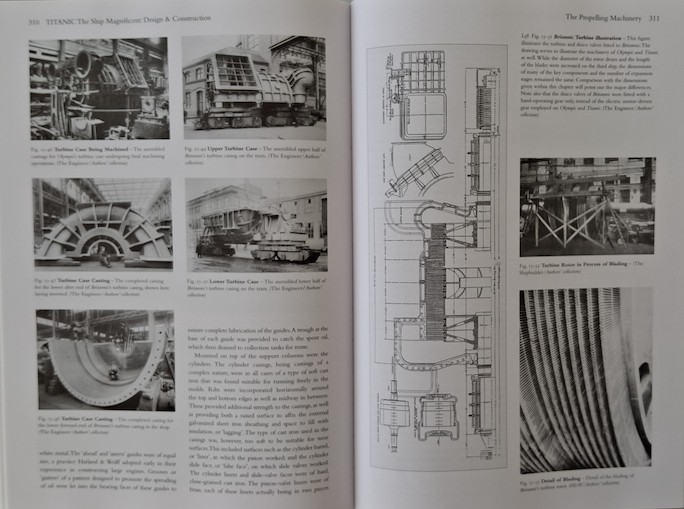
Propulsion details.
Occasionally the books step away from the white heat of technology and reminds us of the other side of Edwardian industry. The 15-ton central anchor, for instance, needed to be transported from the foundry to the local railway yard for the next stage of the journey to Belfast. The solution? Use a special transporter, and 14 tug horses, some weighing more than a ton, and pull the cargo slowly up an incline to the railway.
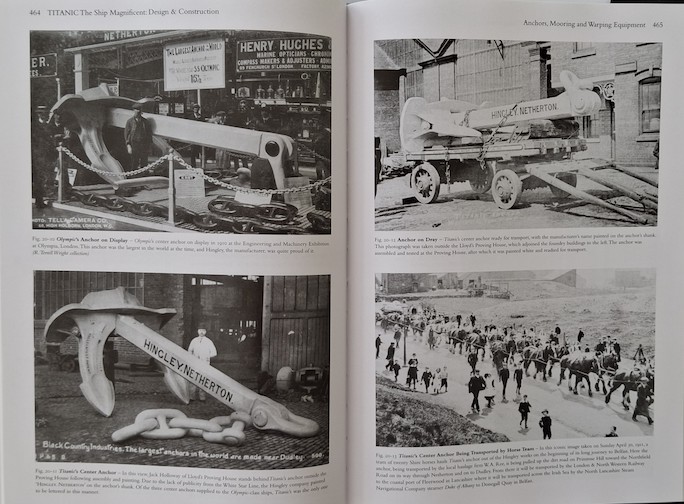
Moving the anchor.
Levity aside, these two books would not exist were it not for a combination of events that lead to the deaths of around 1500 people. Continued fascination with this catastrophe has resulted in well over 500 books being written, as well as numerous films produced. This fascination also led to another five unnecessary deaths on a wreck dive in 2023. The ongoing interest also supports continual travelling exhibitions showing Titanic memorabilia. My mother was born in 1907 on a farm in rural Ireland. She told us children that one of her earliest memories was being told the news of the disaster. It must have been the equivalent of JFK/Dallas or 9/11 for her generation.
The two books being reviewed are different from almost all others Titanically-themed in that they effectively stop before the actual start of the maiden voyage, and have no material human interest element. Even the launch itself is not covered in any detail. There are some photos of elements of the wreck for comparison purposes.
But what these books contain is a unique, detailed record of how Edwardian shipbuilding took place. If you read these books you will also be able to spice your conversation with terms such as fidley, flams, and joggled.
So, how’s Fantasy Shipbuilding progressing? There will be real challenges in sourcing and handling some materials ranging from asbestos for fireproofing to elephant ivory for the lounge piano keys. And you would never obtain safety certification to sail it. The solution would be to permanently house Titanic 2 in a dry dock, which would at least eliminate any maiden voyage risks.
In summary these books are not a light read but have something for everyone—from the more casual reader to those interested in the details of maritime architecture. Not forgetting the 1000s of illustrations.
A personal comment for Titanic aficionados: the Titanic Museum in Belfast is a must-visit if you have not done so already.
The joint authors have all previously published material on the Titanic.
Copyright 2026, Paul Lea (speedreaders.info)
Titanic: The Ship Magnificent
Volume One: Design & Construction
by Bruce Beveridge, Scott Andrews, Steve Hall, Daniel Klistorner, Art Braunschweiger
The History Press, 2008
688 pages, illustrations, hardcover
List Price: £50
ISBN 13: 978-0-7524-4606-6
 RSS Feed - Comments















































 Phone / Mail / Email
 RSS Feed
 Facebook
 Twitter