
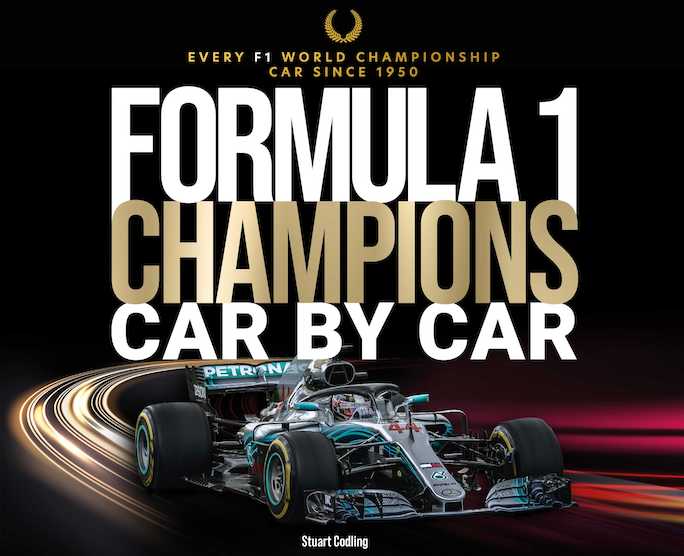
Formula 1 Champions Car by Car
Every F1 World Championship Car Since 1950
by Stuart Codling
“Put simply, it’s a truism that—all other factors being equal—the quickest driver in the best car will win. There are but a handful of examples of champions winning very much against the run of form; even so it would be churlish to accuse any of the individuals in this book of being unworthy champions. Sometimes being in the right place at the right time to capitalize on a rival’s misfortune is a skill in itself.
And how would you define the best car? A powerful sweet handling and slippery aerodynamics are worth little if the package can’t achieve that somewhat boring tick box—reliability. Many of the winners in this book overcome rivals whose machinery let them down, particularly in the early days.”
“It does what it says on the tin” is a common British idiom that arose as a result of an advertising campaign for wood stain and means something performs exactly as the label promises. This applies to the title of this book, a narrative of all the cars used by Formula 1 drivers in their Championship years, from 1950 up to 2025. The cars usually, but not always coincide with the winning Formula 1 Constructors Championship team. This started in 1958 and Constructors-winning cars such as Vanwall in 1958, Lotus in 1973, and Ferrari in 1982 do not appear here.
There is no shortage of similarly themed books on F1 history, such as 50 Years of Formula 1, 60 Years of Formula 1, and the author’s own recent Formula 1 75 Years. So what makes this book different and why would you buy it?
As to differences, not a lot as it covers similar ground to many other F1 histories. There are currently 76 years to cover, lots of quality pictures (many full page) and a useful Race Results Appendix. You are not going to get in-depth insight in 248 pages, especially where long sequential results for the same drivers (cf. Hamilton, Verstappen) only get a few pages more than single Championship years.
What you do get is a focus on the winning driver/car, and a handy single spot on your bookshelf to travel back to 1950 and understand the F1 evolution from Farina/Alfa Romeo to Norris/McLaren. The photos are in the main high quality (some exceptions in the early years) that merit closer examination; by 1959 color photos enter the picture. And perusing the Appendix gives a chance to invoke that well-known cliché “the past is a different country.” In 1954 Fangio won the World Championship using two different manufacturers —a Maserati 250F in winning the first two races, and when his Mercedes W196 was ready, four more. Fangio is the only driver to accomplish this. Not only that, three years later he won the 1957 Championship driving a Maserati 250F again.
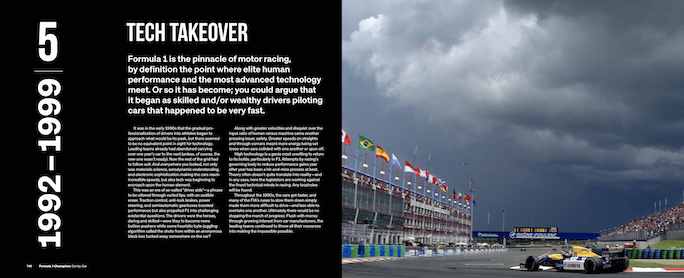
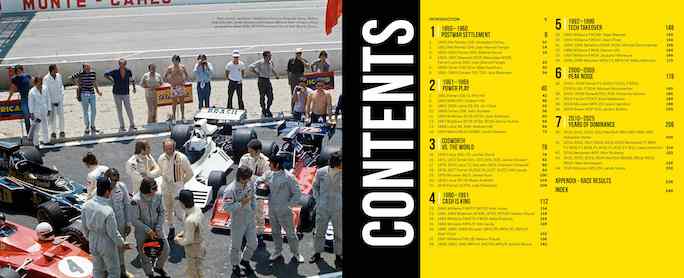
The author acknowledges that this work is aimed to take pride of place on a coffee table. Taken in this vein he succeeds with the book being potentially of interest to F1 newcomers as well as more seasoned readers. Non-technical readers may struggle to cope with terms such as desmodromic valves and bump steer but this is offset by pithy and informative summaries of 75 years of F1. The coverage is not just of the championship-winning drivers and their cars but also the competition and the technology advances. The current inter-team rivalry at Mercedes between Russell and Antonelli is just the latest in a long line of team tensions that date back to 1950. That was when Farina thought that he should be the undisputed #1 driver. Like some later drivers he too developed a reputation for ruthlessness. There are the occasional memorable phrases: “Motor racing is a sport where nobody really covets a level playing field unless they’re losing every weekend.” There are also enjoyable and intriguing off-piste excursions to describe other players. Jochen Rindt’s F2 team owner Roy Winkelmann was a former Cold War spy.
Time and again we are reminded that in some ways the past is not such a different country. There are numerous examples where FIA rule changes “brought unforeseen consequences.” Today’s uproar over energy management at the start of the 2026 season should have come as no surprise.
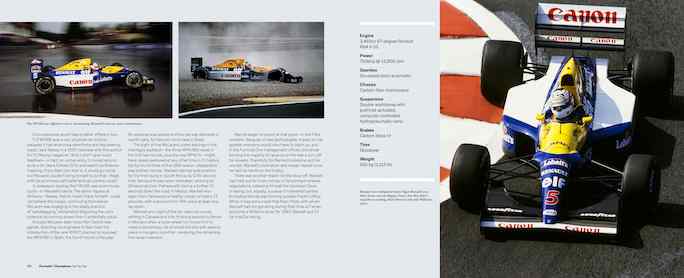
The author’s Ferrari book (see below) has just been released as a second edition so in the event this publication is reprinted too, some niggling errors could be corrected:
- Not all the photos have captions, particularly the “decade summaries’.”
- The picture of Fangio “by 1951 by now a star at Alfa Romeo” shows him seated in a 1952 BRM V16. There can’t be a shortage of suitable photos.
- 1961, “Moss took almost all of the 100 laps at qualifying pace”— but we are not told where. Monaco of course.
- Jim Clark didn’t make his race debut in June 1965; he was already well on his way to his second F1 World title by then.
- In the 2009 season with Brawn ahead in both Championships, I suspect that having lost Honda’s financial clout Brawn had to make cutbacks as opposed to comebacks.
- In the car technical summaries, the engine manufactures names don’t appear consistently before 1985; Cosworth (Ford) being a notable omission.
Despite these quibbles, a book worth considering.
Stuart Codling is a motorsport journalist and broadcaster who has written a number of motorsport books including Ferrari Formula 1 Car by Car and McLaren Formula 1 Car by Car (you can probably spot a theme here).
Copyright 2026, Paul Lea (speedreaders.info)



 Phone / Mail / Email
 RSS Feed
 Facebook
 Twitter