
Midnight Flyboys
The American Bomber Crews and Allied Secret Agents Who Aided the French Resistance in World War II
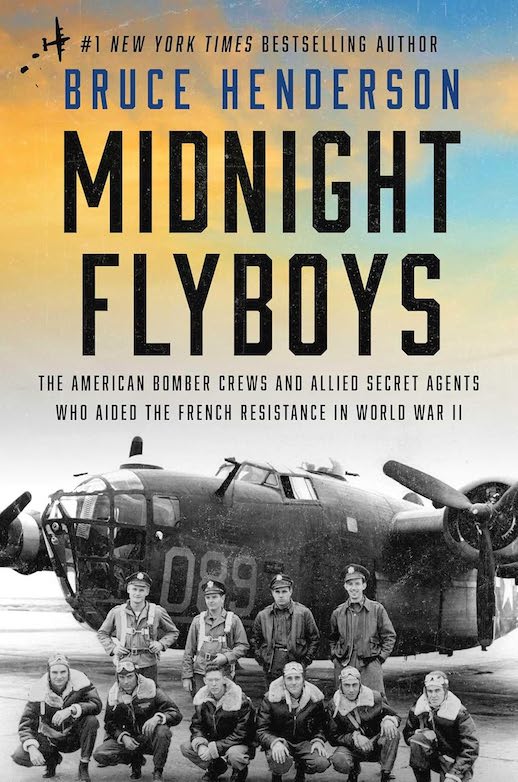 by Bruce Henderson
“The American airmen were ordered to ‘forget everything you saw and did’ in the war. Not until the 1990s was the veil of secrecy lifted as the wartime efforts . . . were declassified.”
What’s it like to fly a fully loaded, thus heavy, bomber with a maximum service ceiling of 30,000 feet that normally cruises at 215 mph; yet you are “flying” it—on purpose—at just barely above its 95 mph stall speed and are only 300 to 400 feet above the surface? Add to that that it is an aircraft described as “a bear to fly under the best conditions” that “performed poorly at slow speeds, with stiff and heavy controls.”
The men who Bruce Henderson writes of in this, his newest book, could have told you but, as the opening quote indicates, they were sworn to keep their experiences to themselves and their stories were not declassified until 50 years after they had taken place. Yet, as Henderson writes in the Acknowledgements, he did get to talk with a few still surviving as well as family members of those airmen while researching thus enabling him to tell the story of the Carpetbaggers as their mission was codenamed.
At its height, the Carpetbaggers consisted of four squadrons, each with sixteen to nineteen Consolidated-built B-24 Liberator aircraft, thus approaching 3,000 men and around 75 aircraft. Each Carpetbagger B-24 was repainted all black. Other modifications included removing oxygen equipment and the waist gunner position in order to be able to carry more cargo. The belly turret was replaced with a “joe” hole from which a person could parachute for not only did Carpetbagger missions carry supplies from Britain into France to support the resistance fighters but also specially trained people—Joes and Josephines as the secret agents were called—to assist the French partisans.
As each partisan group placed its order/request for supplies, their requests were packed tightly and carefully into torpedo-shaped steel containers so they—and their contents—would survive being pushed from the cargo bay through the open bomb bay doors while the plane was several hundred feet above ground. Each container had a chute strapped to it but with only a few hundred feet altitude when they were pushed out, the chute could do only a minimal amount to slow a container’s fall.
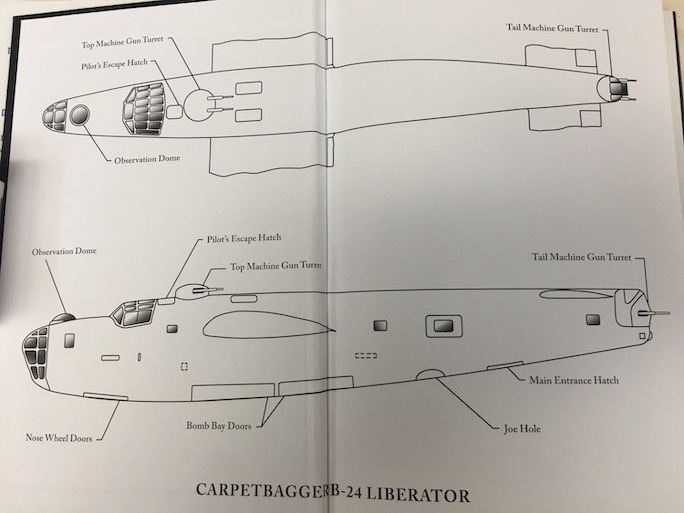
Readers unfamiliar with the details of B-24 Liberator bombers made by Consolidated Aircraft will find these drawings on the front endpapers helpful to understanding a bit of what each aircraft’s crew members’ “home aloft” was like.
The 64-foot long Carpetbagger B-24’s power was provided by four 1,200 hp Pratt & Whitney air-cooled, turbo-charged radial engines, each whirling its three-bladed prop. Without being fully loaded a B-24 could easily become airborne at 100 mph. “But weighed down with two tons of supplies . . . [it] used up 4,000 feet of the 5,000 foot runway” before reaching 130+ mph and gradually becoming airborne.
While Henderson incorporates all the details of the B-24s and flying in the book, it’s really the people he most wants to honor and pay tribute to by telling of them describing their backgrounds, training, flying, and sometimes hair-raising service experiences. At the book’s conclusion he brings their stories full circle noting how many of them spent their years after the war and returned home following their honorable discharges.
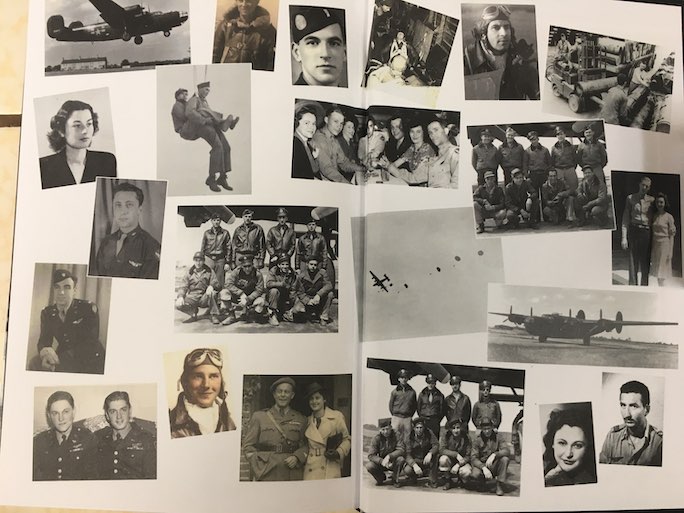
None of the 50 interior photos are printed very large so this montage on the rear endpapers is a good representation of them.
Henderson’s Midnight Flyboys reads like one of the best-conceived and -penned by John le Carré, Ken Follett, or Robert Ludlum. The big difference, of course, is these ordinary people all lived and really accomplished the stunningly brave feats just as Henderson relates them and as his Bibliography and other Sources affirm.
Note: there is a 2018 film documnetary that offers useful visuals but is not specifically relevant to this book, Operation Carpetbagger: The True Story of Henry D. MacMillan Jr. and the Pilot Robert L. William’s Crew (dir. Jerry Simmons).
Copyright 2026 Helen V Hutchings (speedreaders.info)
 RSS Feed - Comments

















 Phone / Mail / Email
 RSS Feed
 Facebook
 Twitter