
The SAE Story, One Hundred Years of Mobility
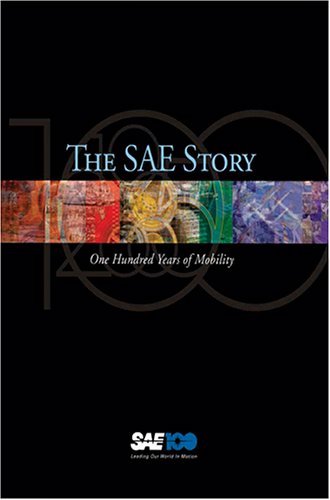 by Robert C. Post
“The SAE serves no selfish interest. It encourages the interchange of engineering knowledge. … It is organized and operated for the express purpose of service to the automotive engineer, the automotive industry and the American people. … The ‘automotive age’ came the earlier because men and corporations, endowed with good will, respecting each other’s achievements, recognized that exchange of technical information is essential to mutual progress. Impelled by urges of their own choosing, voluntarily they made SAE their center for cooperation.”
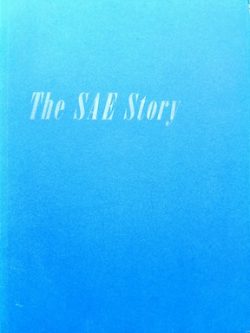
Cover of the first The SAE Story published in 1955.
Two books with the exact same main title. All similarities end there for one is softbound, the other hardbound with dust jacket. One gives the name of its author, the other does not recognize writers or contributors by name. One has an ISBN, the other was published before such existed. (ISBN began early in the 1970s.) We tell you about both in this one commentary because each is the history of the same organization albeit 50 years apart.
SAE is the acronym for the Society of Automotive Engineers. It traced its establishment and founding to 1905. Fifty years later it published its Story as a softbound book of just under 100 pages featuring nearly 50 photos of those who had headed the organization as president during that first half century of its existence.
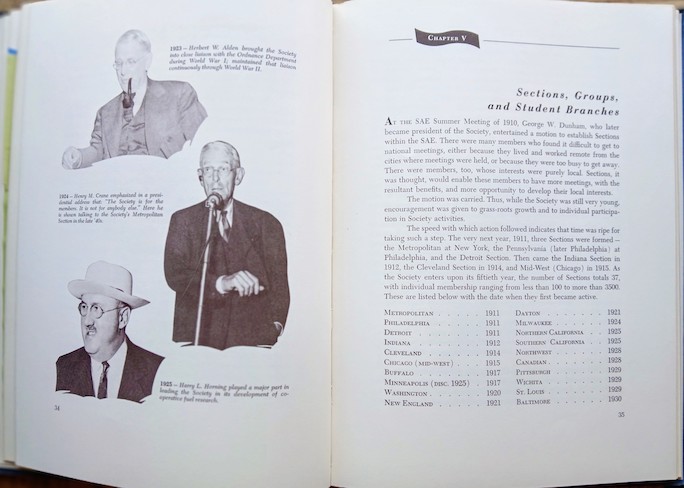
Three SAE presidents shown in that 1955-published book. From top, Herbert Alden, 1923; Henry Crane, 1924; and Harry Horning, 1925.
Key to SAE’s longevity has been and is its philosophical and organizational flexibility, always open and welcoming to new engineering disciplines as new technologies have come along. SAE set the tone preparatory for such growth when a mere five years old it instituted its Standards work and began establishing departments focused on other issues and functions such as Meetings, Research, Technical Boards and geographically-defined Sections and, later, Groups.
Additional engineering disciplines were incorporated and welcomed beyond automotive such as tractors and farming equipment, truck, buses, railway and, when aircraft took to the air, aeronautics too. [1] The SAE is described/characterized “as a unified living organism” with the ability to respond to the engineering needs of a wide number of diversified “family members.”
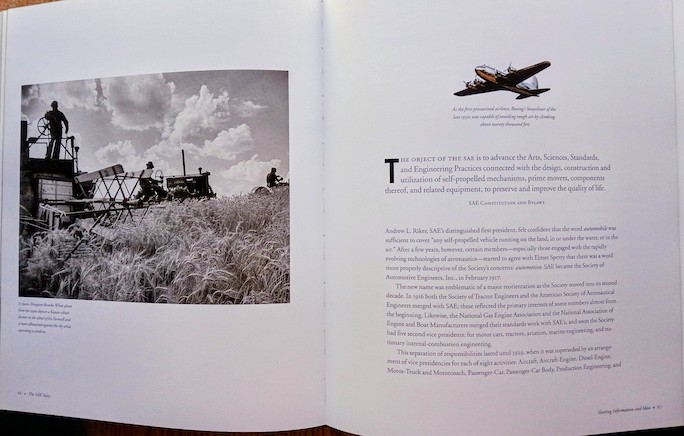
Two very different forms of SAE’s “automotive”— per the definition of the word assigned it by SAE’s first president, Andrew Riker. [1]
By the time the first softcover The SAE Story was published, membership had grown to 10,000 and included students and associates. Fifty years on, the time of the second book’s publication, membership stood at 85,000 and continues to grow. That second SAE Story opens by reproducing SAE’s statement of purpose which clearly shows the thoughtfulness and wisdom of the organization’s founders.
“Promote the Arts and Sciences connected with Engineering and the Mechanical Construction of Automobile vehicles, to hold meetings for the reading and discussion of papers relating to the construction and improvement of automobiles and to promote social intercourse among members … to publish and distribute papers and literature relating to the construction of automobiles and to maintain an Engineering Library.”
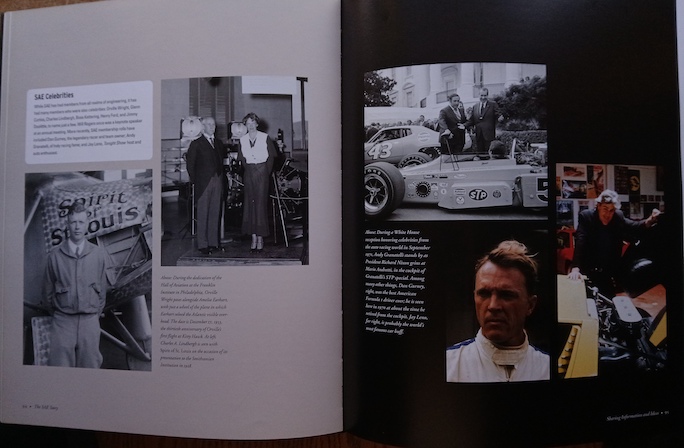
Some SAE members were more widely known and recognized. And, yes, membership was open to women too commencing in 1920.
It became clear reading those mini biographies of each and every president in the 100 year anniversary book that each was or is a person of great talents—and not just related to their engineering skills but administratively as well—and each with a clear understanding of how best to encourage the good health and welcoming attitudes of the organization. Female members were welcome in 1920 and by 1960 SAE was welcoming members in countries well beyond US borders.
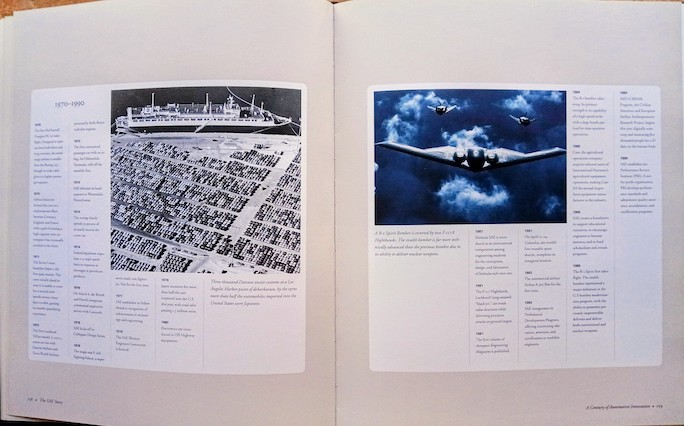
The next to last chapter features historic highpoint timelines by decades. Pages shown cover 1970–1990.
While, as noted in the resources below, no names are associated with the 50 year retrospective, either as writers or an editor, the same is not true of the 100 year The SAE Story. And it’s clear why SAE tapped Robert C (Charles) Post to author the book celebrating its centennial for there’s scarcely a technological arena in which Post isn’t versed beginning with earning his Ph.D in the history of science and technology.
Post had spent a year as a pre-doctoral resident fellow at the Smithsonian Institution’s National Museum of History and Technology (NMHT). Once degreed, he spent the next 23 years at a succession of jobs at the Smithsonian. During this time he also was a contributing editor for the stellar magazine, American Heritage’s Invention and Technology. (That magazine has had a challenging publishing history despite the excellence of its content and writing.) Post has also edited Railroad History, the biannual sponsored by the Railway and Locomotive Historical Society (R&LHS) and was its publisher from 1989 until 2000.
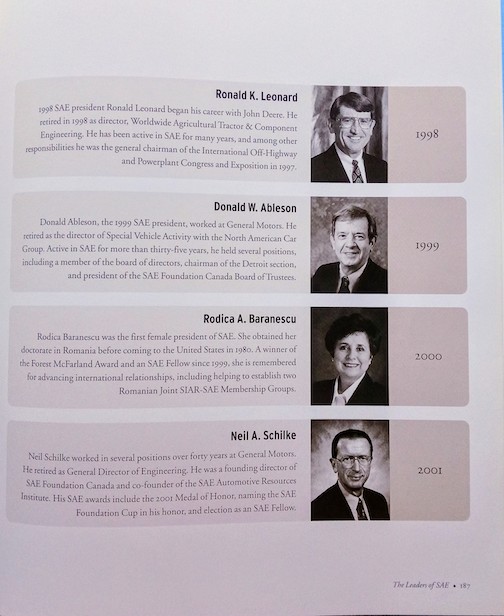
The final chapter presents mini bios of each SAE president since 1905. The page shown includes the first woman elected to head SAE, Rodica Baranescu. “She is remembered for advancing international relationships.”
In his spare time Post has authored approximately 150 articles, essays, and reviews, and has written or edited 15 books. And, since 2000, he has been co-editor of Historical Perspectives on Technology, Society, and Culture, a booklet series published jointly by the Society for the History of Technology (SHOT) and the American Historical Association.
With all that, is it any wonder that this book covering SAE’s first hundred years is compellingly interesting and a comprehensive overview of the century of technological growth and development? Although both SAE Story books are out-of-print, they are worthy of your time to find and add to library shelves, especially the version covering the greatest number of years, for the insights offered on the pages of how the societies around the globe have advanced and supported growing and expanding technologies.
- The SAE’s first president, Andrew L Riker even redefined the word “automotive” to better suit his organization’s position. “The word covered any self-propelled vehicle running on the land, in or under the water, or in the air.”
Copyright 2026 Helen V Hutchings (speedreaders.info)
The SAE Story, One Hundred Years of Mobility
by Robert C. Post
Tehabi Books, 2005
190 pages, 204 b/w & 59 color images, hardcover
Index, photo credits
Original List Price: $30
ISBN 13: 978 0 7680 1489 1
and


















 Phone / Mail / Email
 RSS Feed
 Facebook
 Twitter