
Neon Rides: Cars and Culture of the ’80s and ’90s
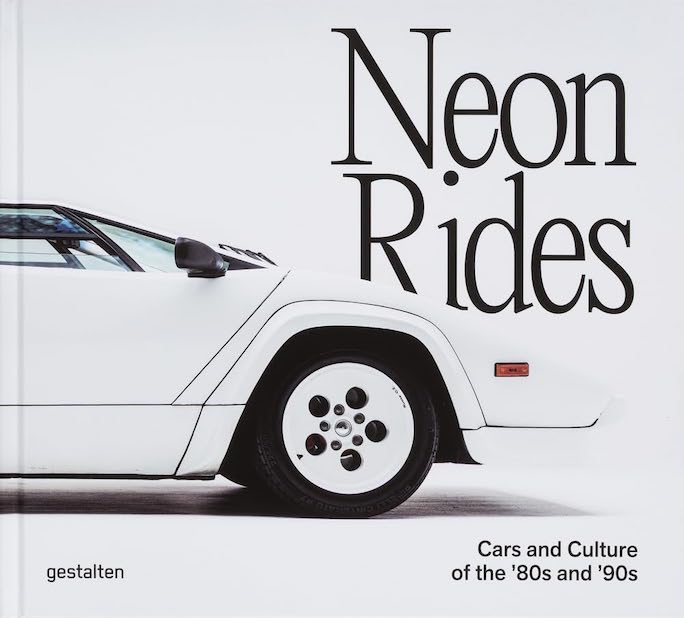
“In an era of three network TV channels, a few watchable cable channels, a handful of major record labels, and the bare rudiments of the internet, nearly everyone could be expected to watch the same shows, love the same Billboard Top 40 songs, and generally engage with the same tastes and trends across culture—including cars. Today our world is fundamentally different.”
Can’t argue with those words from the Foreword, written by freelance lifestyle and culture commentator Sean Paul Lorentzen.
You’ll have to turn the book over, to its back cover, to see the rest of that car and to see the rest of the thought that contextualizes the subtitle: “… revisits the bold and often-overlooked cars of the 1980s and ‘90s—an era once dismissed by collectors, now ripe for rediscovery.”
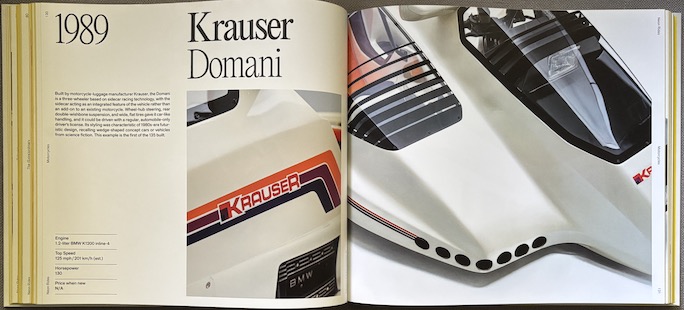
We won’t even tell you what you’re being shown here. If you know you know (there’s a BMW logo if it helps), if you don’t, there’s a book for that.
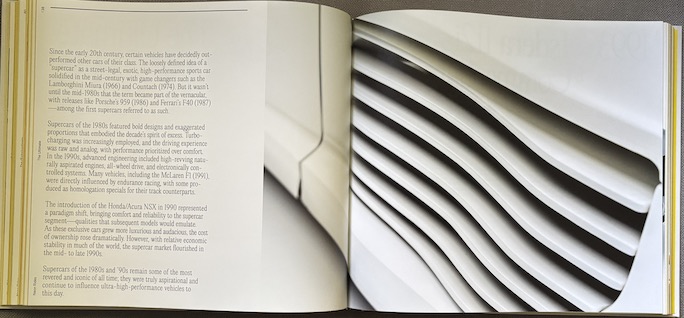
This should be an easy ID.
Also, can you spot a page number on this spread?? It’s that tiny speck printed sideways at the top of the outside margin, in this case the left page.
It’s not just the people behind this book who think objects of that era are ripe for rediscovery but the venerable Petersen Automotive Museum in Los Angeles. Actually, they are the same because this book is done “in collaboration” with the museum which is given a specific “texts by” credit. And that is because the museum just wrapped up an almost year-long (June 7, 2025 –April 19, 2026) well-attended exhibit called “Totally Awesome: Cars and Culture of the 80s and 90s.” Many of the items on display are now showcased in this book, with all of them (i.e. not just the ones in the book) being listed in its Index.
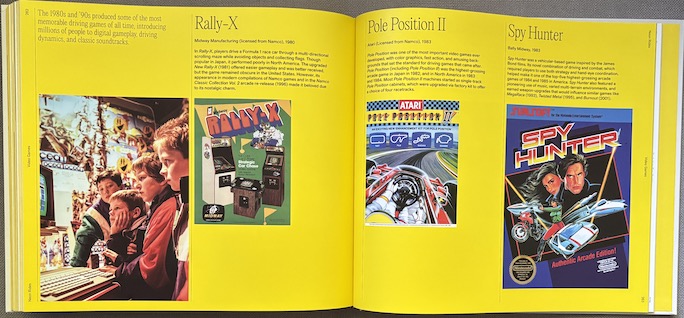
Are we still in the same book?
If the title and design of the book hadn’t already clued you in (or the name of the publisher, German house gestalten) the briefest of perusals of the Table of Contents will tell you that surprises are awaiting:
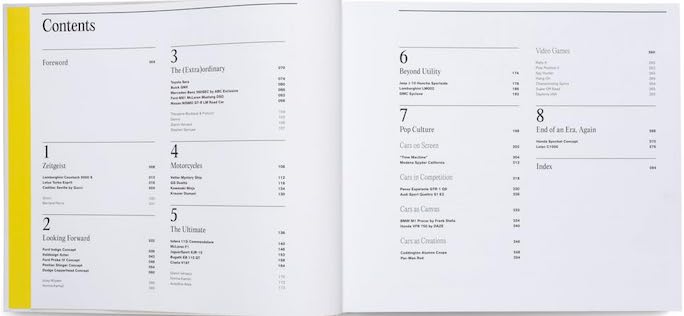
Observe that the cars are in bold, fashion topics (and then the arcade games) in roman.
No book, no museum show can exhaust the fulness of all that begs to be considered so don’t waste any grey matter on moaning about the selections. That motorcycles are included as a relevant expression of transportation culture is a given. The Inclusion of (transportation-themed) movies and arcade games, as well as fashion, each culture-shaping in its way, also makes sense. If there is something that is not self-evident it is the criteria by which someone decided to allocate certain cars to certain chapters, but even that is not worth second-guessing: a Countach in “Zeitgeist” (ch 1), a Buick GNX in “The (Extra)ordinary” (ch 3). It matters not.
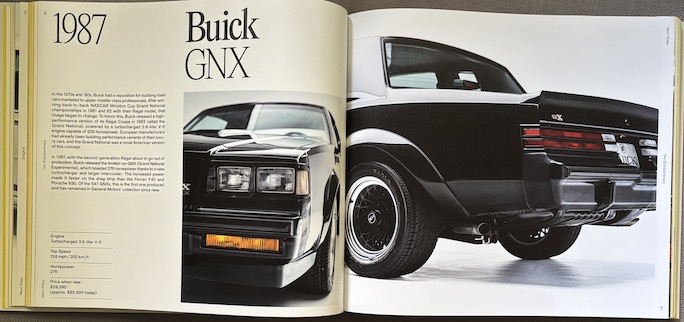
You’d have to live under a rock not to have noticed that the GNX has been commanding silly money for some time already. The book says $85,500 in current money, and that’s no typo.
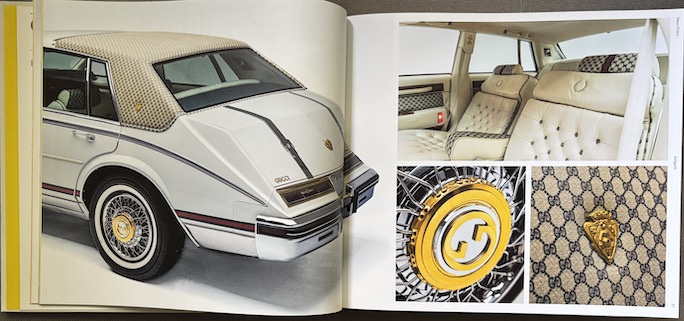
The bustle-back of the 2nd-Gen Cadillac Seville was polarizing already when new (1980–1985) but the Gucci edition will set some teeth on edge even now. Definitely a car of its time.
Each chapter has its own introductory remarks, preceded by a song lyric just to jog the ole memory box. That text discusses many more things than are shown. In case it has been forgotten already, the point of the book and the museum show is to explore the intersection of automobiles and popular culture, and specifically in regards to the cars to think about “a misunderstood chapter in automotive history.”
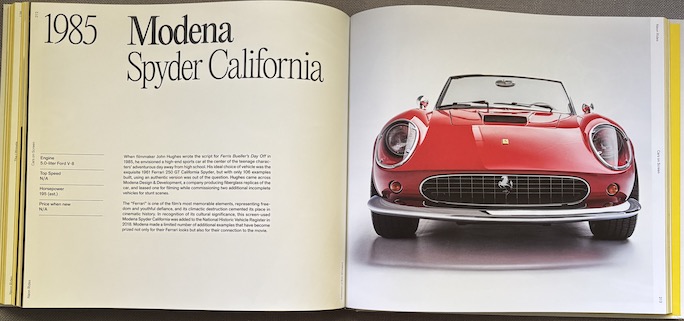
Ferrari never made a Spyder California but a California Spyder. Remember the movie “Ferris Bueller’s Day Off”? Instead of the ultra-expensive 1961 Ferrari 250 GT they used a fiberglass version made by Modena Design & Development.
This is not a sociology or design textbook so don’t fault the book for not digging deep/er. There are enough bread crumbs provided to make those who were alive then retrace their own steps, the one caveat being that the context is very US-centric. That so many of the cars are white (and shot against a white background), and all the non-car material printed on an intense yellow background is … a deliberate choice, that will prompt a gut reaction. Kind of exactly what the book is about!
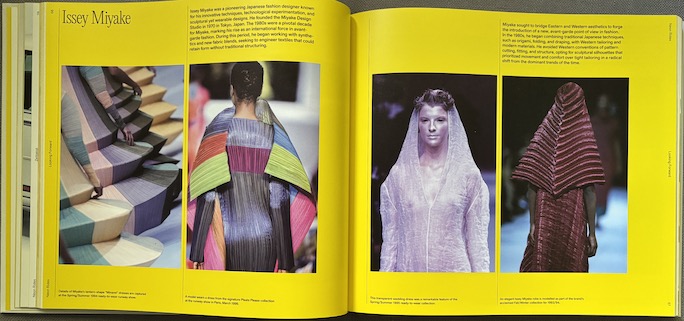
Something the book doesn’t say is that Japanese fashion house Issey Miyake had a specific automotive connection in the 1980s in the form of various wristwatches and also the collaboration with Nissan on an apparel line to promote the Skyline.
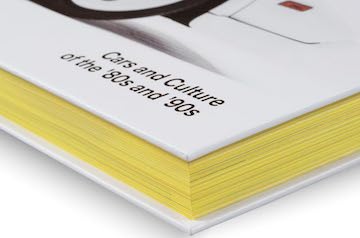
Quick sidebar: If you like to be the first person to open a book, and if you like to KNOW that you are, this book has a tell: it will crackle when you turn/separate the pages because of the (neon-) colored edges on all three sides. But it will only do that once!
Copyright 2026, Sabu Advani (speedreaders.info).






















 Phone / Mail / Email
 RSS Feed
 Facebook
 Twitter