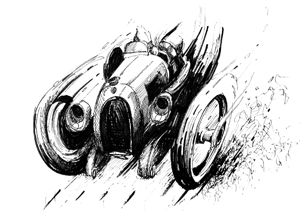

Audi’s Historic Fleet: Horch, DKW, NSU, Wanderer, Auto Union, Audi AG
by Audi Tradition
“It is by no means a given that this multitude of exhibits from almost 125 years of company history exists today. Unlike some other car manufacturers, neither Auto Union GmbH nor the later Audi AG had any ambition to document their product history of two- or four-wheelers and preserve it for posterity. At best, a few well-hidden mementos were preserved by chance in storerooms or in the catacombs of the old factory facilities.”
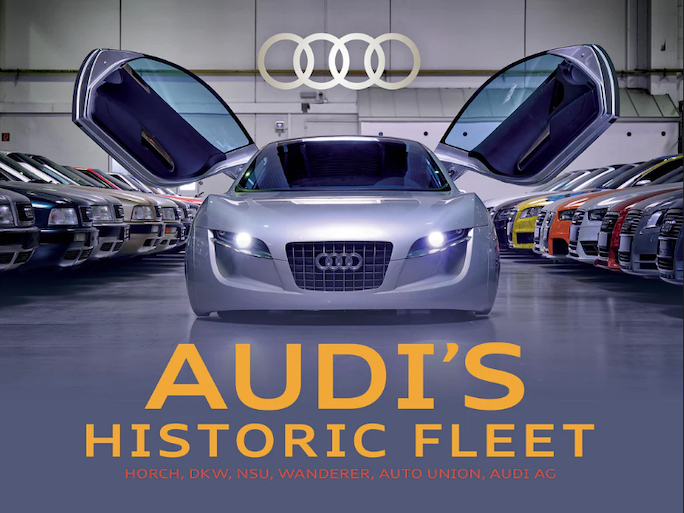
That cover car has butterfly doors! Big deal, you say. But they’re rear-hinged, so, yes, big deal. You’ve never seen one, you say. But you probably have, if you watch movies (I, Robot in 2004).
If you’re wise to the fact that Audi is entering Formula 1 racing in 2026 you’d not be surprised by a book celebrating their illustrious history just about now. That’s not what’s happening here. This book is from 2022, originally in German (Einblicke: Die Fahrzeugsammlung der AUDI AG, ISBN 978-3667125293) but only now available in an English version. Oddly, it is not published by the original house, Delius Klasing, even though they have a solid history of bringing out English-language versions of their own books but instead by US publisher Schiffer.
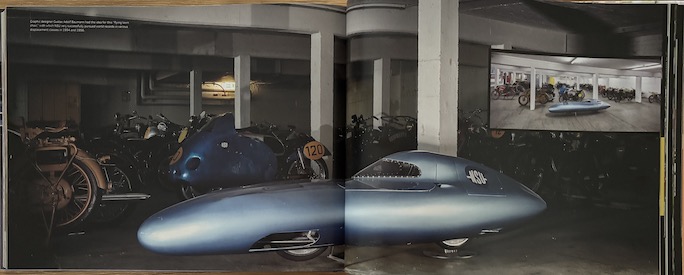
The nickname “flying lawn chair” belies this streamlined motorcycle’s role as a record-setter. NSU bikes set eight world records in 1951 alone.
Motorsports, be it two- or four-wheel, actually do not dominate this book, nor do the firm’s historic predecessors called out in the subtitle. What this book does do is offer a mostly phtographic look behind otherwise closed doors at the Historic Fleet of nearly 1000 vehicles housed in several buildings administered by Audi Tradition, the Audi department formed in 1998 and tasked with tending to the brand’s history. Even if you went to the firm’s Museum Mobile at the Ingolstadt headquarters you’d not see everything that is in this book.
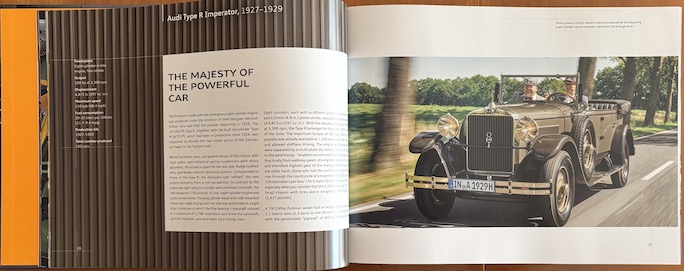
A typical layout: specs and intro followed by several pages of photos. This is an Audi Type R nicknamed Imperator due to its majestic size (1927–29).
If it’s news to you that the four rings that make up the Audi logo represent four separate marques—Horch, DKW, NSU, and Wanderer—that constitute some of the oldest automobile and motorcycle brands in the world then this is exactly the book you want for getting a quick immersion. Together they formed Auto Union AG as the second-largest German motor-vehicle manufacturer.
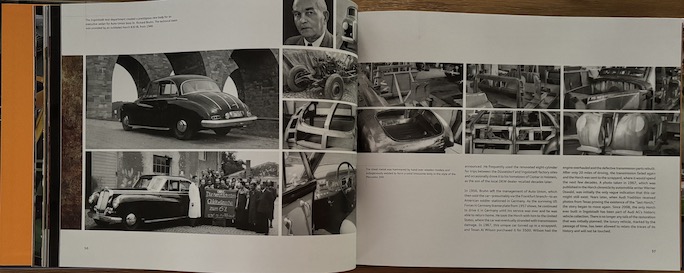
A one-off Horch repatriated from the US where it had languished for five decades in a scrapyard. Audi will leave it in as-found condition. The brand is named after company founder August Horch who didn’t want to use that name for the new company. If you know German you know “horch” means listen or hark which is . . . audi in Latin.
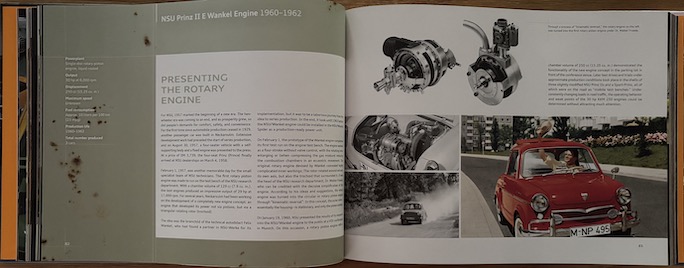
Clever graphic design. Left page—that’s not smudges in the paper but a close-up of rust on the body of the model that introduced “a completely new engine concept” to the world, the Wankel.
Both the photographer, Stefan Warter, and the writer of the body copy and captions, Ralf Friese, have been commissioned by Audi. Friese already has several Audi books under his belt. Presented in landscape format the book is profusely illustrated and smartly designed. Too often, books of large collections depict the vehicles in situ, meaning lined up in rows which does not lend itself to the sort of photo that captures the whole of the car nor reveal the detail and close-ups that specific features call for.
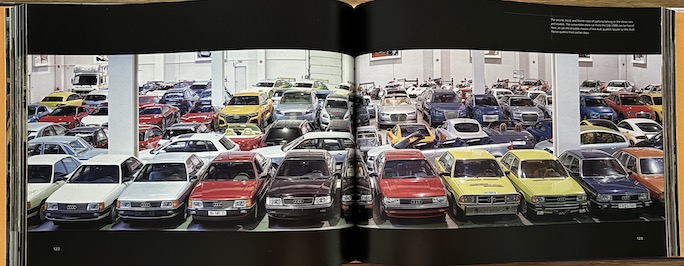
The primary purpose here is clearly storage not public display. Some of the cars are parked so close that moving one would rip off the mirrors of its neighbor.
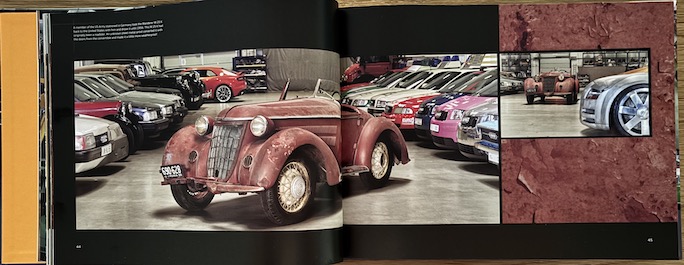
There certainly are some of the former here but that’s mainly to bring home the sheer vastness of the collection. The models the text singles out are pulled out of their rows and photographed individually, then in most cases juxtaposed with period imagery from Audi’s archive as well as restoration photos or close-ups if applicable. The write-ups are well conceived and thorough, not to mention really well translated.
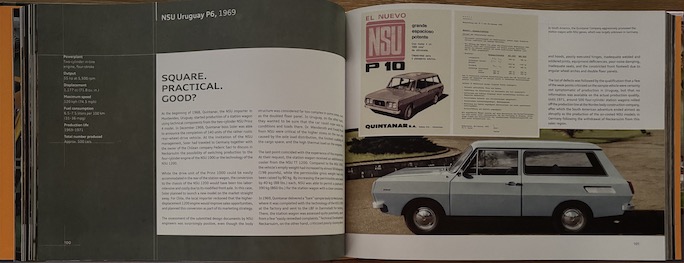
Americans often complain that European wagons/estates don’t make it to the US. In this case even the Germans didn’t get this wagon—it’s a Uruguayan model.
Copyright 2026, Sabu Advani (speedreaders.info).
 RSS Feed - Comments


















































 Phone / Mail / Email
 RSS Feed
 Facebook
 Twitter