
U-2 Over the Soviet Union
America’s Famous Cold War Spy Plane from a Soviet Perspective
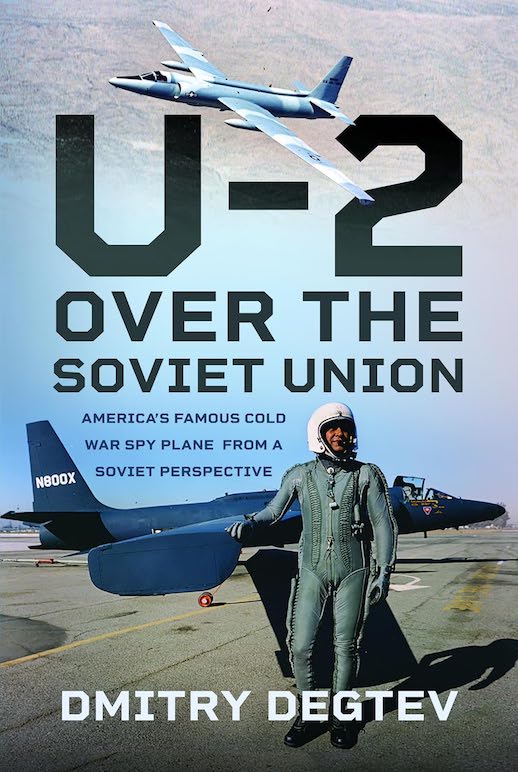 by Dmitry Degtev
“Of course, people were horrified to hear these details. With not enough atomic bombs, nor enough napalm and phosphorous bombs, they had already switched to spiders, fleas, bedbugs, rats and rat droppings.”
Would it help to know that the time is Spring 1952 and the place Korea?
Newspapers reported that on March 6, 1952 around 9 AM “a paper bag with spiders” was thrown out of an “enemy jet”! Would it help to know that “the enemy” is labelled “insidious” and “interventionists”? The latter is almost always the clue that it is Americans that are being talked about.
Still, what is happening here?? We won’t preempt the book because this excerpt has nothing specifically to do with the core subject except that it vividly establishes that misunderstandings and misinformation—on all sides—played a key role in the existence of what the focus of the book is on, the aircraft that is probably one of the most significant symbols of the Cold War.
Specifically, it describes the preparation and implementation as well as the consequences of reconnaissance flights 1956–62 over the Soviet Union and Cuba. A key assessment the book makes is that they increased the risk of nuclear war, and not just in period: of US President Ronald Reagan’s reelection, decades later, Russian author Dmitry Degtev writes that he “cried with fear” because the Doomsday Clock had advanced another few clicks. (If you’re wondering, it presently stands at just over a minute from midnight aka The End.)
What makes this book different from other books is right in the subtitle: it is written from a Soviet perspective, by a Russian researcher specializing in the history of the Second World War. Degtev draws on archival CIA material, declassified USSR and mass media records, and memoirs by principals often quoted verbatim.
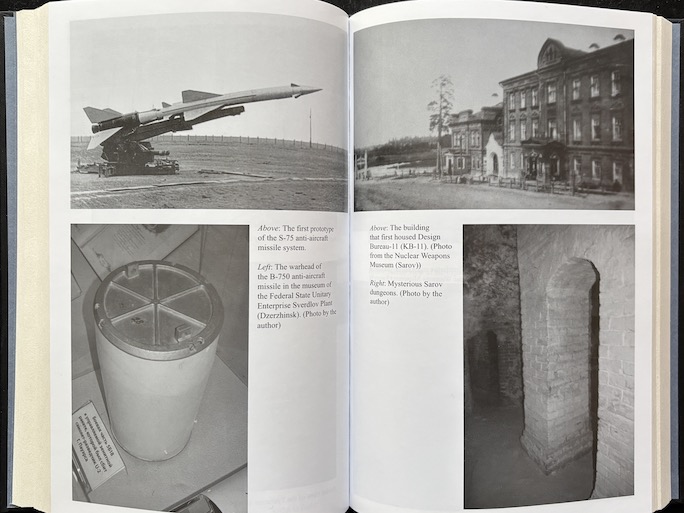
Many photos are from the author’s collection.
All this new material is a mixed blessing because the book lists no sources and has no apparatus or even an introduction that lays out the methodology. The skeptical reader will have a recurring impulse to look for corroboration in sources outside of this book but will first have to puzzle things out that a subject-matter editor ought to have resolved preemptively. Examples: calling the Focke Wulf FW 189 “Rana” when its German name was really Uhu (eagle owl) and the Russian “Rana” (Frame) merely a nickname derived from the type’s distinctive twin-boom fuselage. Even the aforementioned reference to Reagan is a concern because it puts “1980” and “reelection” into the same context but neither fits: Reagan’s first term was 1981–85, the second 1985–89. Or the reference to “Air Group Commando Lechfeld” as the operator of the first Me 262 jet fighters; Degtev probably means Kommando Nowotny, named after its CO, which did indeed operate from the Lechfeld air base. Such irregularities instill no confidence when the discussion shifts to matters in which, absent any leads to source material, the author’s accuracy must be unimpeachable.
That aside, and also disregarding the occasional odd word choice that can’t disguise Russian authorship, the book does give a good sense of the strategic picture from the Soviet side. To thread that needle the book picks up the story a decade before the U-2, in 1942 with the first recorded sightings over Moscow of intruding high-altitude aircraft, thought to be German Ju 88, which the Russians knew how to shoot down. But these aircraft operated at such a high altitude that the Russian interceptors most of the time couldn’t even visually mark the enemy or agree on the shape and configuration of what their radar crews told them was above them. This experience of helplessness is why the Soviets would later feel so provoked, violated even when the US and UK began in 1949 a secret program of reconnaissance overflights, decrying them as “gross violations of international law.” Additional groundwork is laid by introducing into the discussion the aerodynamic lessons learned from the F-104 Starfighter, all this leaving the reader with an appreciation of the difficulties of achieving high speed, high altitude, and long range.
U-2 technical details are mostly skipped as they have been covered in the literature already. The focus is instead on operational matters, presented in chronological order of specific missions, sort of like action reports. Degtev offers insight into what the Soviets thought the U-2s had found, had missed, or wouldn’t have recognized. Having access to Soviet sources obviously enables him to comment on countermeasures and military plans (also such matters as pilot training, command structure, aircraft build quality, concurrent efforts in missile development etc.) that will not have been in Western files at the time (or, according to the book, ever). It is surprising to learn that the name of downed US pilot Francis Gary Powers is “as widely known in Russia as that of the cosmonaut Yuri Gagarin.” All this is embedded into a context of political commentary which often comes across as polemic.
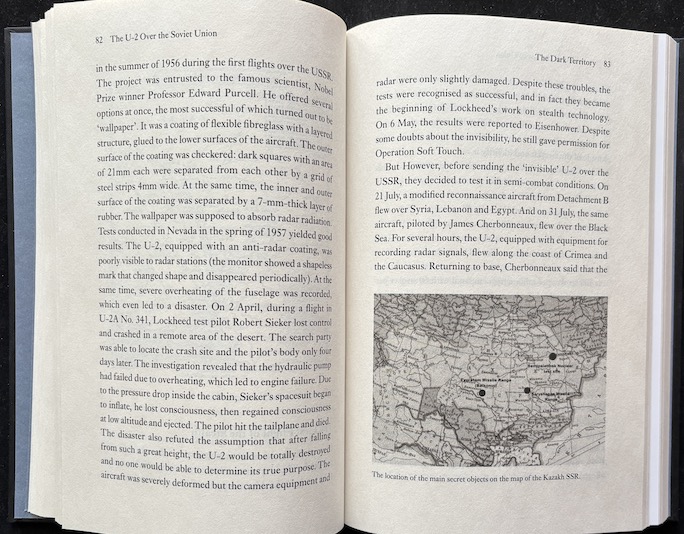
There are quite a few maps but all are small so you will want to have an atlas handy, maybe even a topographical map because no book can really convey how different the world looks from on high. Also, all units of measure are metric.
A quick return to that opening quote and the possibly world-ending implications of misunderstandings: it has to be remembered that the political dynamic during the U-2 era is colored by Prime Minister of the Soviet Union Nikita Khrushchev reading US President Eisenhower as a “real peacemaker and a naïve person,” a pawn to his aggressive military men and without knowledge that these overflights were taking place. Glass half full/half empty. Also, pause for introspection: just how likely is that scenario?
It’s now a good 60 years since the events in this book. Are we all playing nice now? We leave you with a quote from July 1959 which you may recall was when Nixon visited Khrushchev in Moscow for the famous “kitchen debate.” Can you guess which of them is speaking here?
“We want to live in peace and friendship with the _ _ _ _, because we are the two most powerful powers, and if we live in friendship, then other countries will also live together. But if there is a country that is too prone to war, we will slightly box its ears and say: ‘Don’t you dare! You can’t fight now. These are the times of nuclear weapons, some fool can start a war and then even wise people will not be able to stop it.’ Therefore, we are guided by this idea in our foreign and domestic policy.”
It may take a moment to warm up to this book but there’s lots to think about here, ergo it does what a book is supposed to do.
Copyright 2026, Sabu Advani (speedreaders.info).









 Phone / Mail / Email
 RSS Feed
 Facebook
 Twitter