
Massey-Ferguson Tractors
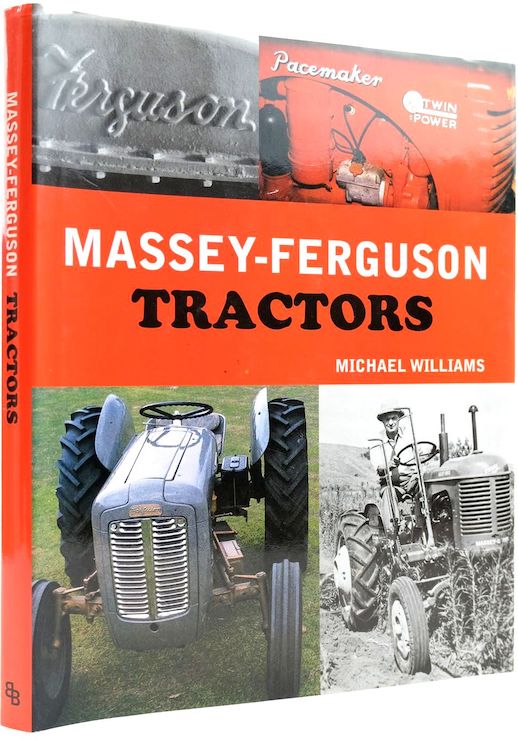 by Michael Williams
“The sale of the Ferguson tractor interests to Massey-Harris was one of the most important commercial developments in the history of the tractor industry, and it was followed by a series of additional purchases . . . which consolidated and extended the Massey-Ferguson company’s tractor business.”
Some companies are destined to have long existences, albeit not without their share of challenges to overcome. Consider when this book about Massey-Ferguson was first published the company that traced its beginnings to 1891 was already nearly a century old. This year of 2026 as we’re telling you about the book that tells the company’s story, that company is still going strong as its website attests.
The Massey-Ferguson story is that of several families and their respective companies in several lands all coming together over time through mergers, takeovers, and buyouts. Too, that story is about more than just tractors for it encompasses equipment and implements for working the land, planting, and then harvesting. Moreover, the business philosophy was (and remains) international in scope for production and marketing alike.
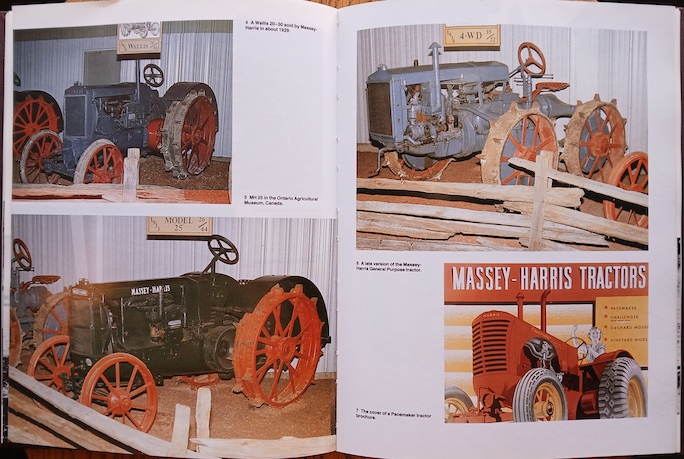
Museum displays of a Wallis and Massey-Harris tractors and the cover of a sales brochure.
The story commences with the Canadian families Massey and Harris. As they joined forces and their eponymous company grew, it acquired the rights to Wallis tractors. This was significant in that Wallis had been the very first to develop and make a tractor that fully protected the gearing, drive chains and engine, an advancement the rest of the industry would eventually adopt. By 1938 Massey-Harris advertisements touted that it was the first to offer a self-starter as standard equipment.
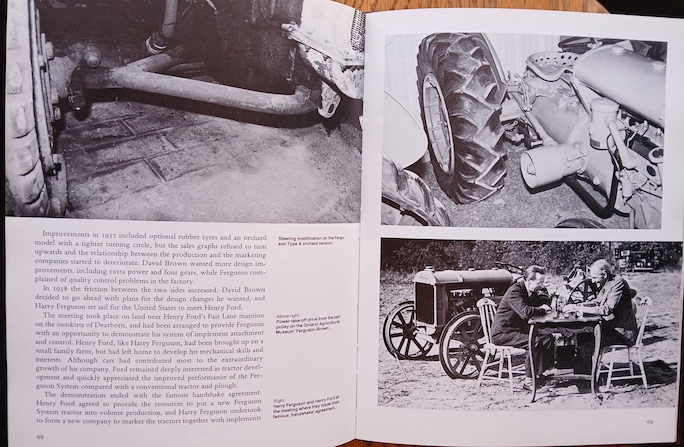
Top left, a steering modification on a Ferguson. Top right, an early Ferguson power-take-off drive from belt pulley. Bottom, “Harry Ferguson and Henry Ford at the meeting where they made their famous ‘handshake’ agreement.”
Before that, however, falls a truly significant development in tractors which we already referred to in our review of Old Farm Tractors. It would have an eventual significant relationship with Massey-Harris so Michael Williams devotes his entire fifth chapter to Harry Ferguson (1884–1960) and “The Ferguson System.” The nearly dozen patents awarded Harry Ferguson from 1917 to 1937 are listed in this book’s first appendix. (The second appendix is five pages of M-H/M-F production numbers 1912 to 1954.) Short of reading the book that is Harry Ferguson’s biography, Williams does a very nice job relating how Ferguson met Ford and the strong, literally handshake, relationship they formed, one of total trust and respect.
Williams details the legal actions that followed Henry Ford II’s actions to end that handshake agreement between his grandfather and Ferguson. Those legal tusslings finally ended after four long years. In the process they upheld the Ferguson patents following “a most thorough and searching examination” and further were “generally favorable to Ferguson and was of positive value to his business interests.”
This directly led to Harry Ferguson a year later, by now in his 70s, selling outright his entire company following being courted by Massey-Harris.
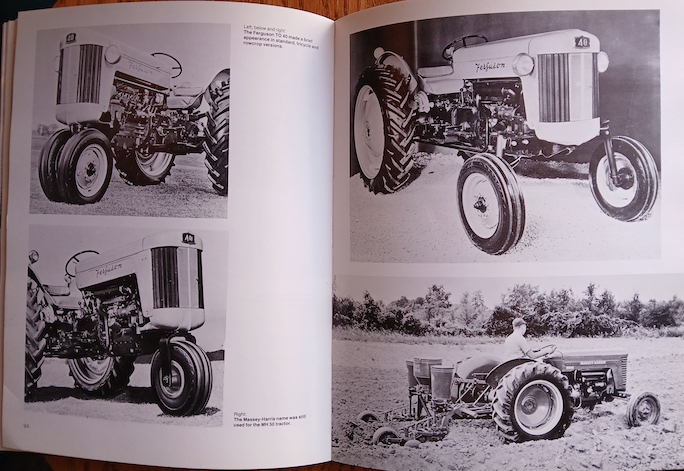
Three views of a Ferguson TO 40 and a Massey-Harris MH 50 at work.
Massey-Harris, now Massey-Ferguson, still was a company with an international presence. Following dealing with blending the two companies—never an easy task—it moved on both consolidating and extending its business by acquiring additional companies. One was Perkins Ltd in UK as it was a leader in diesel engine technology. Another company sold its tractor-making assets to M-F. And third was the purchase of an Italian tractor maker named Landini which gave M-F manufacturing facilities in that country.
So, if you’ve not done so already, now is the time to go back up to that first paragraph of this commentary and actually click on that link to see what a company approaching its 150-year anniversary looks like. For as this book’s author wrote in his closing, it is important to note that the company continues to honor by its name “the men who have made important contributions to the history of the biggest tractor company.”
Copyright 2026 Helen V Hutchings (speedreaders.info)





















 Phone / Mail / Email
 RSS Feed
 Facebook
 Twitter