
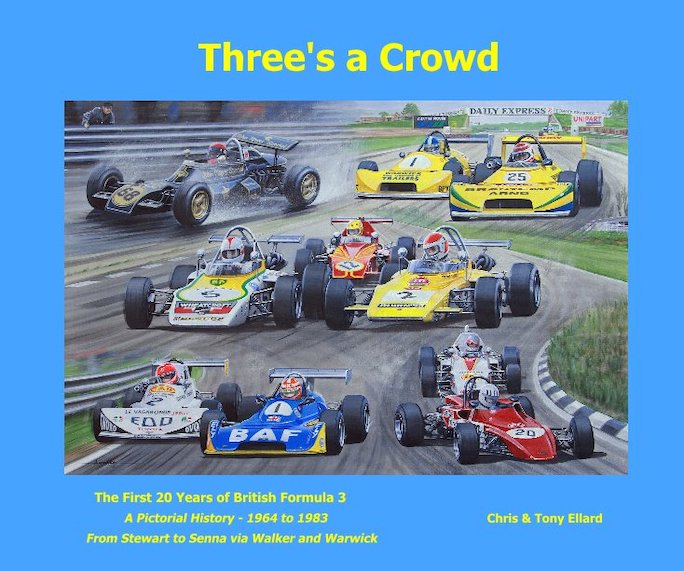
Three’s a Crowd: The First 20 Years of British Formula 3
A Pictorial History 1964–1983 from Stewart to Senna via Walker and Warwick
by Chris & Tony Ellard
“From its humble beginnings in 1964, the brilliant little 1-litre formula went through many changes during the next two decades as outside commercial sponsorship and new regulations took root and challengers from America threatened to usurp its pre-eminence. On more than one occasion the category came close to extinction as costs threatened to escalate out of control and the very home of F3 was buffeted by the turbulence of industrial unrest and sky-high inflation.”
To be pedantic, the title/subtitle of the book is incorrect inasmuch as “1964–1983” does not represent “The First 20 Years” because British Formula 3 with 500 cc capacity engines actually started much earlier, from 1948 to 1962, throwing up talents such as Stirling Moss and Peter Collins, plus Ken Tyrrell and a certain Bernie Ecclestone. Nit picking of course.
Also, realize that the description as “a pictorial history” mustn’t be mistaken for “the pictorial history” in the sense of a definitive, exhaustive, final account, something the authors themselves readily admit is not possible.
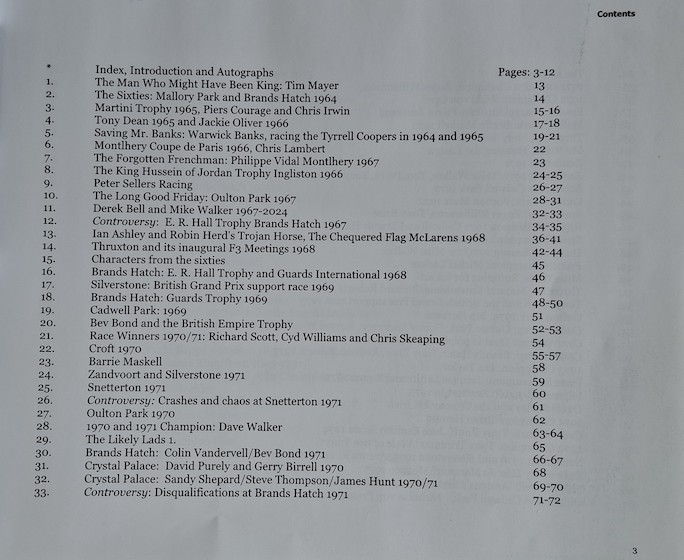
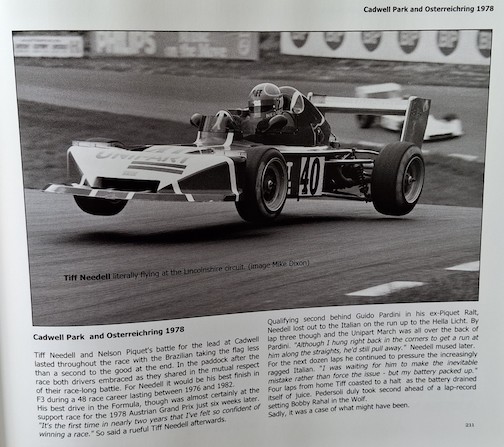
What you do get are 134 “chapters” in (roughly) chronological order, each ranging from one to eight pages. Some are solely captioned photographs, others more detailed text and narrative—including Mike Walker’s handwritten summary of his 1972 season with the works Ensign. The overwhelming emphasis is on the races and the drivers, with technical details of the cars not getting much of a look.
 The book starts with the 1964 season. This was when Jackie Stewart started his first full / professional season of motor racing. He won the F3 championship in a Tyrrell Cooper, got signed for BRM in 1965, winning the Italian GP and subsequently three F1 World Championships. But in this book’s idiosyncratic way, we only get to read about his F3 successes via the diary of Warwick Banks, Stewart’s Tyrrell team mate. As was all too usual during racing in the 1960s and 1970s, Banks got the drive because Tyrrell’s first choice Tim Mayer had been killed in the Tasman series.
Having attended numerous F3 races in the 1960s and 1970s, I thought I had a fairly extensive knowledge of the racing. But King Hussein of Jordan attending a meeting at Ingliston? And him presenting the winner’s trophy to Peter Gethin?? And Peter Sellers and Britt Ekland accompanying Chris Irwin on a Crystal Palace F3 victory lap?? (I need to dig out my copy of Autosport to see if there was a photo taken. I was actually there so you’d think a 15-year-old would remember something this unusual.) These are just a few of the anecdotes to enjoy here.
Looking at the driver portraits alone would tell us these were the 1960s/70s. Long hair, plenty of facial sideburn adornments (step forward Emerson Fittipaldi and Reine Wissell). Unlike the majority of today’s F3/F2 drivers, and some F1 drivers, who look as if they haven’t started shaving yet. Competitors then did not arrive in the sport by starting karting as soon as they were out of nappies. Tony Trimmer, Howden Ganley, and Geoff Lees all started as mechanics. Derek Warwick began work in the family trailer construction business and entered racing via UK stock cars. Bev Bond actually did start out in karts but was a martial arts black belt, known for his “press-on” style of driving. He obtained an apology from a motoring magazine who suggested he was prone to “brain-fade.”
 Most of this volume covers the 1970s, albeit with an extension into the 1983 season, won by Ayrton Senna after a close contest with Martin Brundle. So the twenty years are neatly book-ended by Jackie Stewart and Senna, both of whom would probably appear in any Best 10 Racing Drivers of All Time, certainly of the post WW2 period.
In between you get World Champions Emerson Fittipaldi, James Hunt, Jody Scheckter, Nelson Piquet, Alan Jones and Nigel Mansell, as well as Grand Prix winners Ronnie Peterson, Jochen Mass, Carlos Pace, Gunnar Nilsson, Riccardo Patrese, Elio De Angelis, Jacques Lafitte, and Didier Pironi. Plus World Sports Car Champions, an Indy 500 winner, and numerous F1 World Championship points (and non-points) scorers. Nikki Lauda raced twice in F3 at Brands Hatch in 1970 but is not in this volume.
For every F3 graduate who reached the very top there were others who looked to have glistening careers but fell suddenly from the heights. Australian David Walker was 1971 F3 champion with 25 wins from 32 starts. He joined Emerson Fittipaldi (who himself had been in F3 only three years before) in Team Lotus and the highly successful Lotus 72. His season was a disaster with a best finish of 9th—his teammate winning the World Championship. And in 1973 having been dropped by Lotus, his racing career effectively finished after two serious road accidents.
There usually were more than one F3 Championships per year in Britain, so drivers investing in a car could usually find somewhere to race during the season. And in the 1960s at least drivers could readily obtain a chassis from the likes of Brabham, Lotus, Chevron and Tecno (mainly non-UK drivers), and mate it with a Holbay, Novamotor, or Lucas engine and go racing. There were numerous smaller chassis and engine concerns as well.
In 1971, the engine regulations changed from the 997 cc “screamer” motors to 1600 cc. March and Ensign also joined the scene. Engines changed in 1975 to 2000c and remained mostly unchanged after that.
Throughout the 1970s as costs rose, success became even more important. An unsuccessful car design could actually lead to a manufacturer going out of business. By the early 1980s only Ralt was effectively left, with the default choice of Toyota engine.
By its very nature racing was close and competitive. And as the seasons progressed F3 was seen to be the most important stepping stone to F2 and F1. Costs were dramatically increasing—sponsorship was mandatory—which made success (sometimes at almost any cost) vital. Collisions at championship deciders, and protests of “illegal” engines were not uncommon. The F3 races supporting the British Grand Prix became as important as winning championships as all the F1 bosses would be watching.
These days of course are long gone, as are many of the circuits. Crystal Palace corners had less than a meter of grass runoff, followed by a vertical barrier of railway sleepers, backed by earth banks. One of the incidents described is of a career-ending crash hitting a tree head-on at Oulton Park; it is somewhat safer now.
1960s F3 car racing continues today and is a popular event at the Goodwood April Members Meeting. Inspecting the cars in the paddock shows that they now have seat belts, fire extinguishers, and roll hoops actually capable of doing the job. But looking at the robustness of the chassis/frames, you would not want to go off at speed in one.
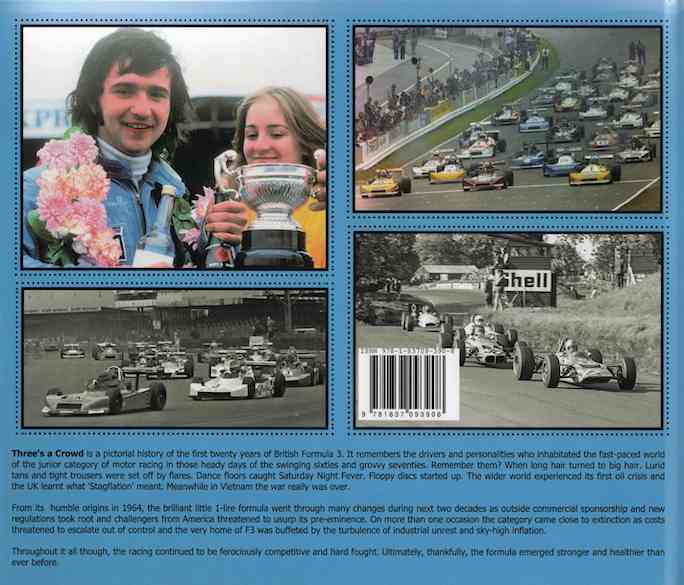
I have resisted the urge to deduct points for misspelling “groovy” on the back cover.
Is this book worth purchasing? At £45 it is not exactly cheap (and over $120 in the US). It is however professionally printed and published with excellent photographs. In my opinion the answer is an unqualified “Yes.” It will primarily appeal to chose who saw the races and looked forward to the reports in Autosport and Motoring News of the weekly shenanigans of the F3 brigade. But younger followers of the sport will likely enjoy the stories of the characters who raced hard but did not reach the top—and some, particularly in the 1960s, who did not particularly want to.
This a companion volume to The Likely Lads which is the saga of F3 racing in the UK and Europe in the 1960s, and has a lot more text and less photos than Three’s a Crowd. Chris Ellard states his earlier book had “a somewhat mixed response.” Luminaries including Peter Windsor, Tony Trimmer, David Tremayne, and Warwick Banks had a very positive response and I agree with them
No Index but a surprising inclusion of a CD ROM containing F3 results for British, French, and major international races 1964–1983. Individual year records are in MS Word as well as PDF formats. Although I’m not sure how many customers have computer CD drives nowadays.
Chris Ellard has also published books on non-Championship F1 races, 1954–1965 and 1966–1983. Both long out of print and with eye-watering asking prices on eBay and Abebooks.
Copyright 2026, Paul Lea (speedreaders.info)
 RSS Feed - Comments





 Phone / Mail / Email
 RSS Feed
 Facebook
 Twitter