
Deadliest Decade: How Speed, Money, and Technology Transformed Auto Racing
 by Preston Lerner
“Thanks to a half-century of advances … fatal accidents have largely been eliminated from racing. … These days, racing seems closer to video games than bullfighting and mountain climbing. … [Yet] never has racing been more competitive than it is today. Never have drivers consistently come closer to the limit.”
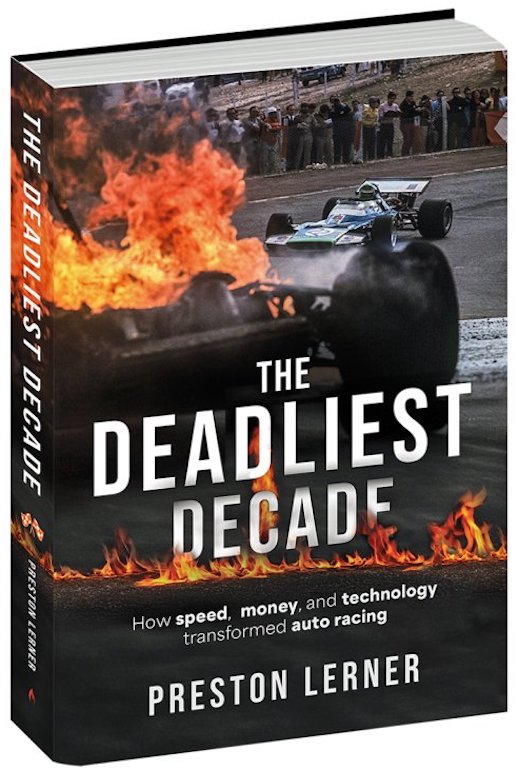
A publisher’s marketing staff usually has a hand in titling a book. In this case, while the book’s title and dust jacket are likely to attract a browsing shopper’s attention, it doesn’t do justice to what this book really is about for the story told is of far more than a single decade. Not to mention that the entirety of it is the very finest motor-racing-history writing.
Author Preston Lerner’s book is better reflected in the subtitle: How Speed, Money, and Technology Transformed Auto Racing. Even then it doesn’t indicate that the book really tells the history of motorcar racing from its earliest days right up to current times. And not in any particular country or on just one continent for it points up global differences. Moreover, virtually ever series or type of race car; open wheel, Indy to F1, stockers, drag racers, Can-Am, midgets; you name it, all are part of this comprehensive history which is why what’s between the covers is just four shy of 500 pages.
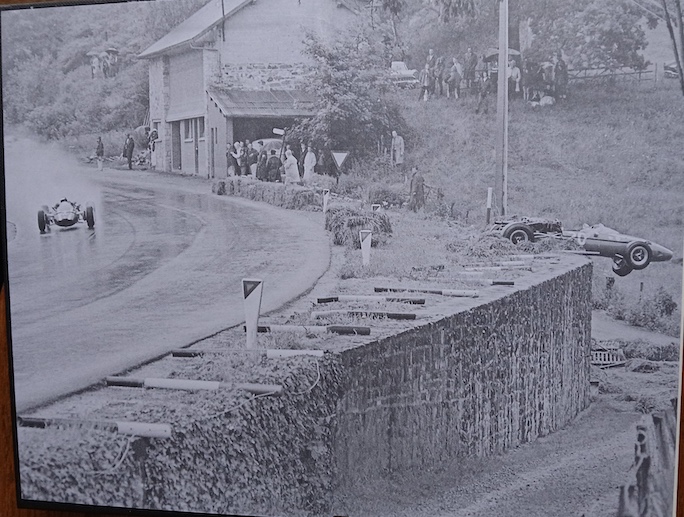
The drama of this photo illustrating chapter eight led to it also being used for the front of the book’s endpaper. That’s Jo Bonnier’s Cooper-Maserati teetering over the precipice. Jo managed to crawl, inching his way over the back, to safety.
Reading will not become bogged down coping with mind-numbing statistics. You won’t read of race results or car or series specs, or finishing places. Rather Lerner writes of the bigger history for he interviewed all he could. An informal tally of those he interviewed, as listed in his endnotes and acknowledgements, nets at least an astounding hundred and a quarter racing personalities and participants.
Lerner tells of the culture of racing/racers and the fans/racing enthusiasts those people and activities generate. Put another way, he describes the much bigger story of how the sport in all its variety grew and was transformed by television, tobacco, perceptions as those changed with passage of time, and more. His writing is so good and storytelling so well developed, it’s a compelling page turner. After all, he’s been honing his craft and following his own personal racing interests, studying and analyzing the topic for something approaching half a century. Applying his inquisitive, thoughtful and perceptive mind to telling racing’s history and its messy, irregular, often baffling and decidedly uneven transformation turns his resulting book into a motorsports master class.
 Don Capps, a fellow reviewer on this site and one with whom Lerner consulted during his writing of the book observed, “It is Lerner’s holistic approach to telling how each element plays its role in how the transformation proceeded, even if rather slowly at moments, that is one of the strengths of his book.”
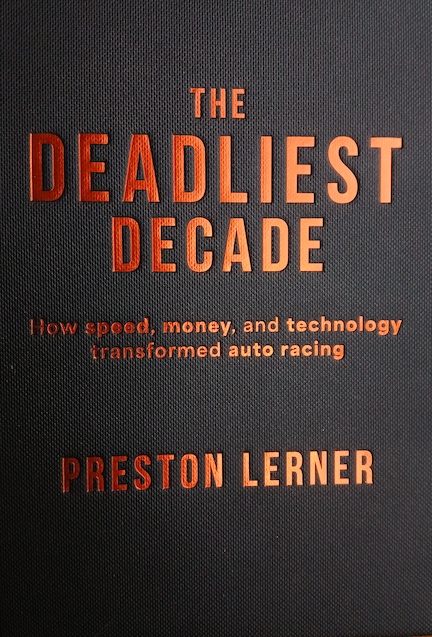
Doing justice to its content is the book’s design and presentation. It’s a comfortable size (6″ x 9″) to hold and read. Presuming you remove the dust jacket while reading (as I do) exposes the deeply embossed and foiled cover and spine. The thoughtfully included marker ribbon is the same impossible-not-to-notice international orange matching the foil. Too, some more subtle design techniques we cannot show you as they won’t photograph are included. As a reader, you will notice.
Part of those “good old days” was the free spirited yet “camaraderic” competition amongst racers with some expressing sorrow at racing becoming “big business.” Preston’s book has tempered such sentiments more along the line of a sentence publisher Octane included on the back of the dust jacket: “A powerful and unflinching account of how racing confronted its own mortality—and how growing emphasis on safety helped transform the dangerous, low-budget sport of the ‘60s into today’s lucrative business-entertainment leviathan.”
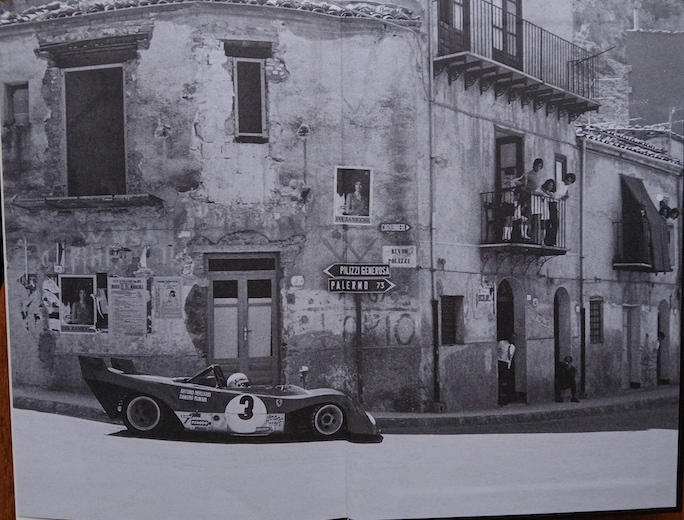
Another notable photo used in the book was deemed special so became the rear endpaper. Pete Lyons captured the image so graphically contrasting new and old during the 1972 Targa Florio, it prompted a caption noting the juxtaposition “suggests the image is a clever Photoshop mash-up.” No fear, it’s real—no AI, no Photoshop.
Ever hear the name Larry LoPatin? As with so much (or many) these days, you can find out about him on the internet. But it’s ever so much nicer to let Preston Lerner describe and tell of LoPatin’s ill-advised foray into the racing world. “LoPatin was a prosperous … real estate developer who had no particular interest in motorsports other than what he could get out of it. … To him, racing was a business and he was a businessman. What could go wrong?” As you’ll read, quite a lot!
“Accidents prompted a flurry of soul-search along with exhaustive rethinking of car design, track design and fundamental meaning and purpose of racing.” Then nothing seemingly would change. “They sat back and thought, ‘Well, if a driver dies, a driver dies. So what?’ That was part of the sport. Well, Jackie Stewart didn’t want to die. So he railed against that philosophy, and he made himself unpopular in certain circles. But gradually, gradually, changes were made.”
By the time the newest generation of purely professional race drivers came along, it wasn’t just Stewart’s attitude that changed but that of all of the racers. They looked at their jobs as careers from which they wanted to retire. Thus, “today, virtually every form of racing has a zero-tolerance attitude regarding death, and no avenues are left unexplored in the effort to eradicate risk.”
As Don Capps observed to me, “It’s an excellent book and highly recommended.” I wholeheartedly agree although I would add what Preston Lerner has written and Octane published has all the elements of becoming an influential, core motorsport history reference.
Copyright 2026 Helen V Hutchings (speedreaders.info)




























 Phone / Mail / Email
 RSS Feed
 Facebook
 Twitter