
Ferrari Milestones
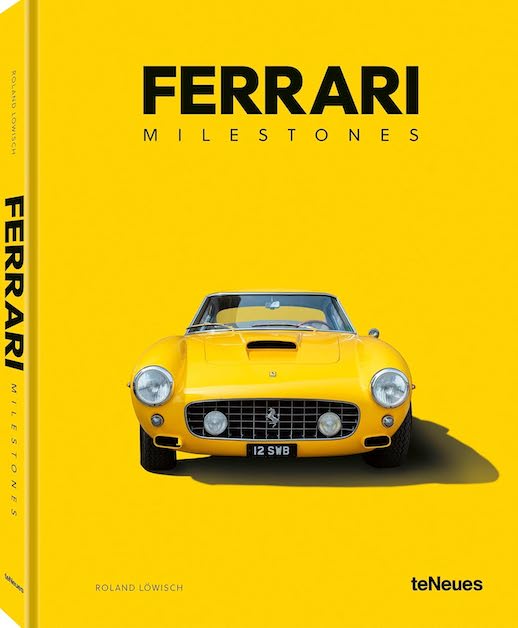 by Roland Löwisch
“Pasta, wine, and a certain idea of the sports car are categorically Italian. The world’s most valuable car manufacturer today resides in Maranello. Ferrari is far smaller than many competitors in terms of revenue, yet its profitability tells a different story. In late 2025, the company’s market capitalization stood at roughly €74 billion. But figures only tell part of the story.”
(English / German) Another part of the story is told by photos, and they certainly do in this book. What figures there are pertain to basic specs, and even words are relatively sparse.
A year is not complete without a new Ferrari pictorial, which is good and proper because, in view of the quote above, there are always new people coming into the fold. One hurdle needs to be cleared first lest anyone’s expectations end up being unmet because of some verbiage in the promo copy that will end up being passed off as “reviews” by lazy commentators. In soccer terms it could be described as an “own goal” for the PR folks to have described this book as “combining in-depth background information with compelling stories from the worlds of racing, design, and engineering.” It’s a fine book, but, no, in-depth it is not.
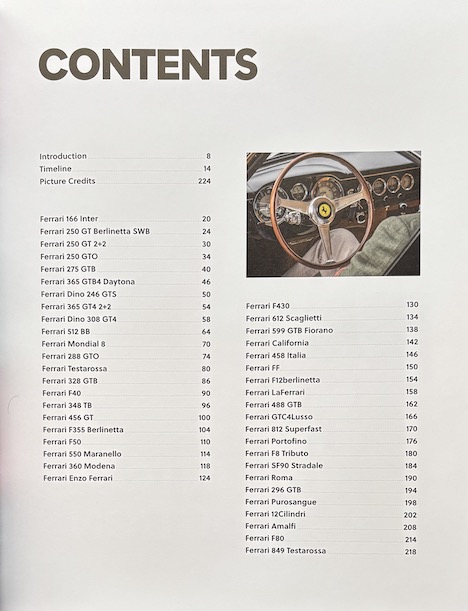 And it doesn’t have to because nowhere in it does it say it wants to be that kind of a book; it is a highlight reel of 43 milestone models from 1948 to 2025 that are discussed on 4–6 pages with minimal text half of which is in a language you may not speak (more on language later).
A look at the Table of Contents shows that everything one would expect from a high-level survey is here. But Löwisch does better than that, and it may not be apparent to new enthusiasts: in real life not all Ferraris are created equal. Which is a polite way of saying that an F40 owner may give the cold shoulder to a Mondial owner. No kidding. Löwisch displays no such bias and treats all models with the same level of magnification and value-neutral verbiage. This trait is well-practiced in his many publications in the car and lifestyle spheres.
The book is a quick read in terms of model history and specs but still provides enough detail to grasp not only what makes Ferrari special but also different from other makes. The excerpt above, for instance, takes a quick stab at delineating the genus “Italian Supercar” but it is self-limiting in that it ties the personality of Enzo Ferrari to his eponymous cars which then leaves no room for explaining the essence of other Italian makes except as antagonists to Ferrari. But, again, this sort of rumination is not the book’s purpose!
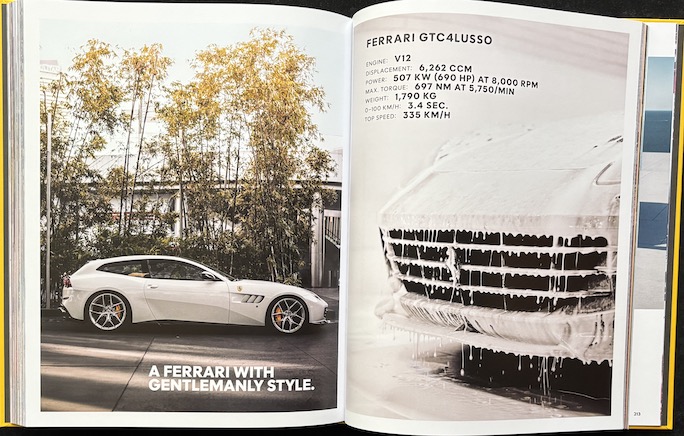
(r) From the photo credit it is not possible to tell if this is a factory shot of a cold-soak test or someone using a Ferrari with abandon.
Since it is the photos that do the heavy lifting here it should be noted that while photo credits are given, at the back of the book, they are typeset in a format that does not lend itself to quick reference. Needless to say the cars are not identified by chassis number (relevant as there are several well-known cars shown, some with auction trails).
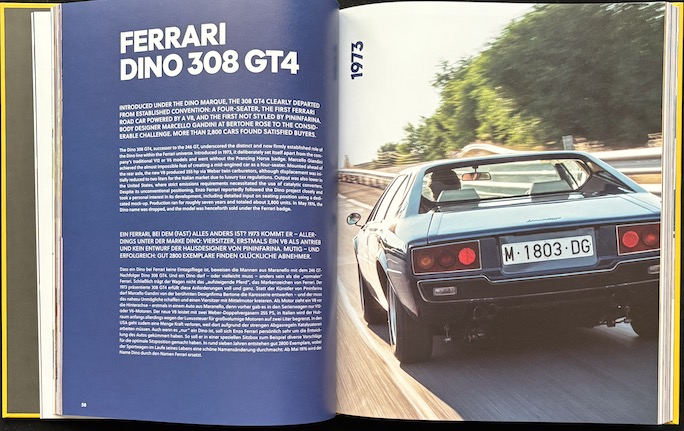
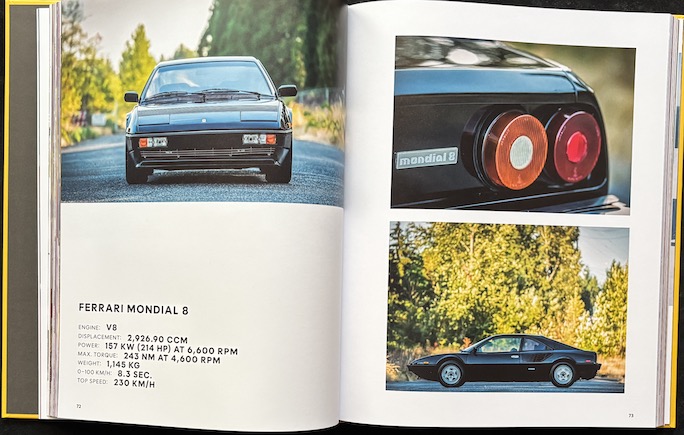
This is the extent of the text coverage, and only half of it is in one language.
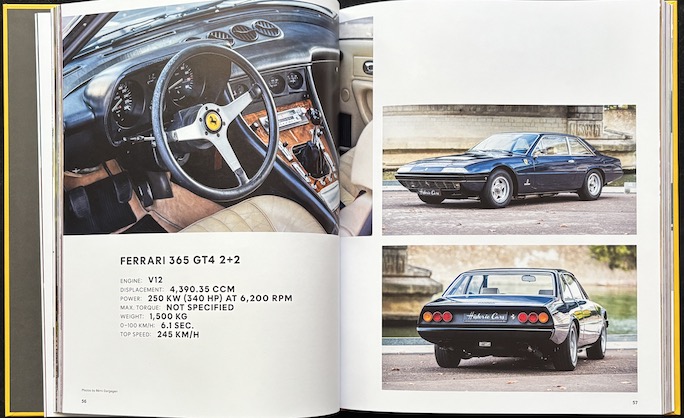
And this is the extent of the data panels.
The cars are presented in chronological order but, if you are new to the marque, you wouldn’t know that from the Table of Contents because it gives no years—you’ll have to turn a couple more pages to get to a timeline. Printed on heavy, satin paper and generously laid out this book, at “only” 9.5 x 11.8 inches, is positively small for this publisher of oversize coffee table beauties.
To return to the subject of language. The book is bilingual, German being the original, and “works” in either language, something that is not easily achieved when the translator’s brief is to follow the source language slavishly. In this case he was given the liberty to do what translators call “localization” which, for maximum effect, may mean comprehensive reshuffling of phrases and substitution of words, an outcome aided in this specific case by the fact that he is himself a copyeditor. If you do read German you will find that it conveys just a bit … more.
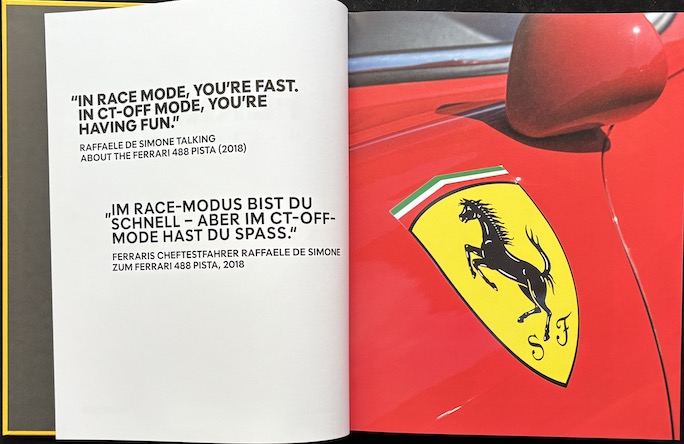
Only the German text tells you that de Simone was Ferrari’s lead test (and development) driver. And if you’re uncertain about “CT” mode, reverse the two letters: TC = traction control.
This book all about photos, and this is the first one so you might think glitz and glamor will be employed to make a good first impression. Notice the blems on the paint and edges of the shield?
Copyright 2026, Sabu Advani (speedreaders.info).




 Phone / Mail / Email
 RSS Feed
 Facebook
 Twitter