
Maico: The American History of a German Motorcycle, 1955–1983
 by David Wayne Russell
“Besides pride of ownership, what did the Maico mean to Americans? First, the bike’s appearance was hard to ignore. Had the machine not been a good one, the looks might have become the object of laughter. MZ, a contemporary East German motorcycle with a similar rough and outward appearance (but lacking Maico’s performance), never attracted American buyers and was something of a joke.”
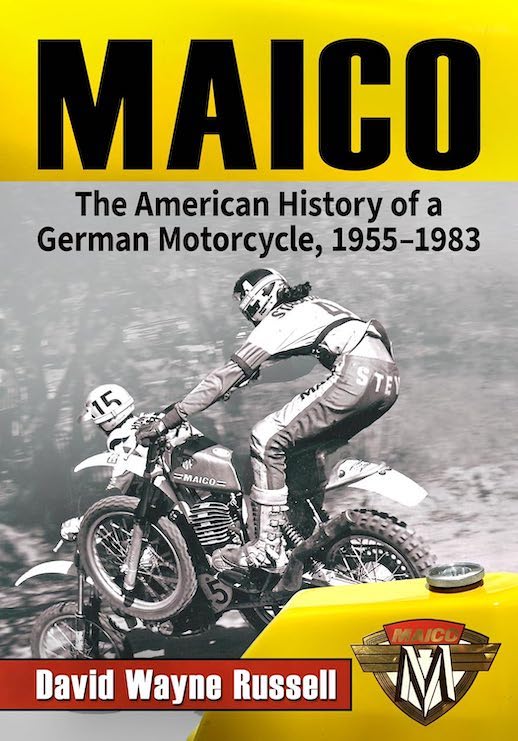
If you don’t recall ever seeing a Maico and wonder how you’d know if you did, just make a mental note of an item on the book cover you probably hadn’t even noticed: that blocky yellow shape on the bottom corner. This is a fuel tank, and its angular lines, especially the back, became a symbol of the brand. Now that you know what it is it’ll stand out in the main photo as well, and that photo also yields a clue as to a Maico’s raison d’être—motocross.
How is it that a small family-owned German company made and exported the world’s best off-road motorcycles of the 1960s and ‘70s only to end in bankruptcy? And how is it that this story has not already been told in great detail? There’s not a single book in English, until now!
A look at the wide-ranging Bibliography reveals that even in German there are only a few and most of those are manuals. Ergo this book fills a void in motorcycle history, and how. So often such well-intended efforts don’t fully exhaust the subject but the mere fact of their existence often “exhausts” the market thereby getting in the way of follow-on, better books. Russell’s book is a quite extraordinary effort in terms of methodology and tone. It may well make Maico ownership aspirational! They’re expensive enough as it is, though . . .
Everything in the author’s CV points to a disciplined mind: military officer, pilot, PhD-level historian. You can tell this right from the extraordinarily specific Table of Contents, and it carries through to the Appendices and Index. How’s this? Chapter 1 is, unsurprisingly, called “Beginnings” but Section 1.1 sharpens the point: “Introduction: Definitions and the Maico as Material Culture.” And this is not a fluke— Section 1.2 delves into “Motorcycles and Americans: A Social History.” Even if you had no specific, exclusive interest in Maicos this book will present you with a fully fleshed-out survey of the motorcycle as a transportation tool and phenomenon vis-à-vis the American rider, or, for that matter, critic of motorcycling.
The author professes to a “lifetime love of motorcycling” but in his early days had to be content with Japanese enduros, eyeing exotica such as Maico as “mystical” and unattainable except in the pages of magazines. When, much later in life, he realized that there was no comprehensive marque history and set out to write it, he learned what every researcher learns—and what his deep dive will save you from—that oral histories, recollections of fact, and interpretations don’t usually align neatly. Russell has done the heavy lifting. Everything that is even remotely relevant to the Maico story is considered, ending with notes on preservation/restoration and a section on identification and dating. And the book is well written to boot and a joy to read.
Note that at 7 x 10″ this is one of the larger-format books by this publisher and it even has a few color photos among its many images.
Copyright 2026, Sabu Advani (speedreaders.info).
Another Look
(Because we can)
“Working on the machine may be the best way to fully understand the motorcycle and extract its meaning. … This restorer relives and imagines the machine’s functioning and history to the fullest, deepest extent. While most enthusiasts aren’t capable of doing all work, their oversight of the process, passed on to professionals, is the equivalent of doing it. … The understanding gained during a … restoration exceeds any other means of learning about a motorcycle!”
The word missing from the subtitle—and adding it in no way would constitute even the slightest exaggeration—is “comprehensive.”
The author’s enthusiasm for his subject, the motorbikes and the company that made them, exudes off the pages from the very first few of his Preface to the book’s conclusion 400 pages later. That energy and enthusiasm kept this reader glued to the pages until eyelids grew heavy with need for sleep even as I was eager to keep reading.
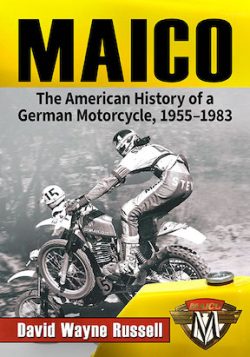 It’s obvious author Russell is a member/participant (not merely an on the sidelines spectator) of motocross and the culture its participants and followers created and are part of. For those not familiar with motocross, it “became the premier motorcycle sport with American participants and spectators by the early 1970s.” It is extremely physically demanding of its human participant/competitors and their machines as the image on this book’s cover graphically shows. The rider is standing on his Maico’s pegs, his hand-controlled throttle wide open and the machine isn’t touching terra firma with either wheel as Steve Stackable leaps his bike in order to overtake another rider.
The opening chapter offers an overview setting the reader up for the dissection and piece-by-piece analysis of a Maico motorbike’s mechanical and frame components provided by the chapter that follows. Next is a chapter showing and explaining some of the modifications owners who were racers made to more personalize their Maicos and enhance performance.
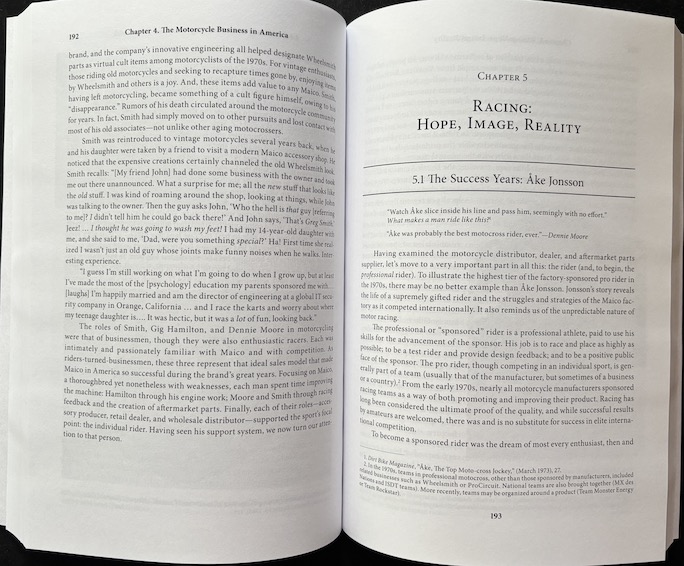
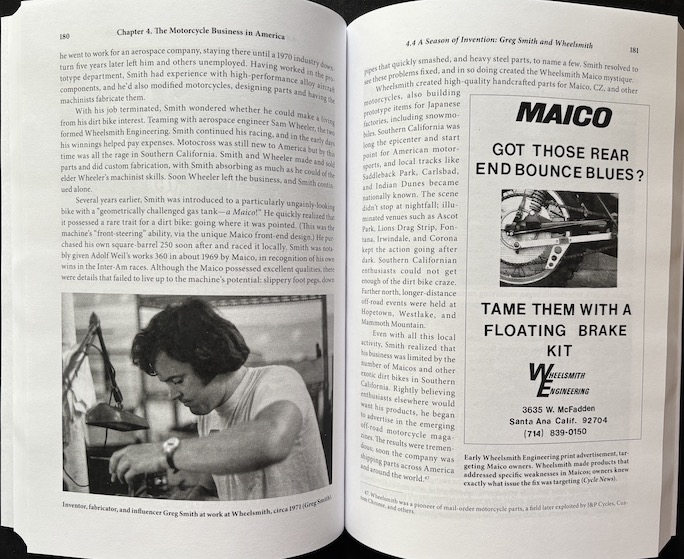
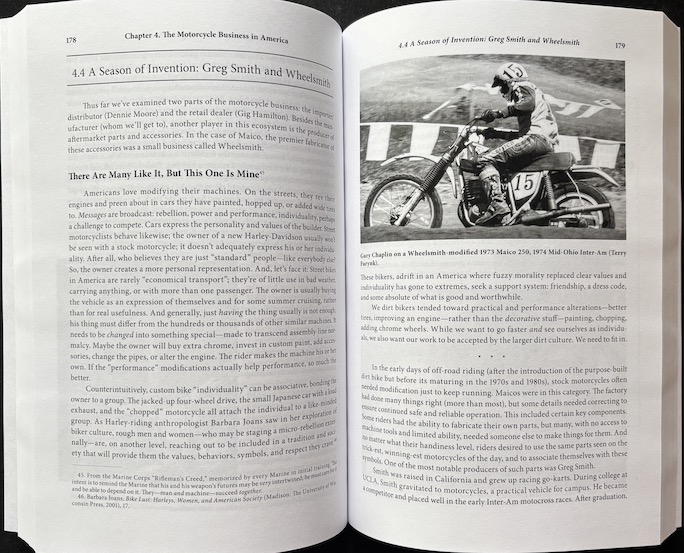
Then the narrative shifts its focus recounting how this made-in-Germany motorcycle became very much an American business. It’s a convoluted story and perhaps no surprise that as US successes accumulated, the dealings between the owners of Maico Fahrzeugfabrik GmbH in Germany and those selling and servicing them in America where sales were consistently the very best became not merely challenged but actually contentious. Detailing “the roles of [Dave] Smith, Gig Hamilton, and Dennie Moor . . . businessmen, [who] were also enthusiastic racers . . . riders-turned-businessmen, [and] ideal sales models that made Maico in America so successful” puts the reader in their shoes.
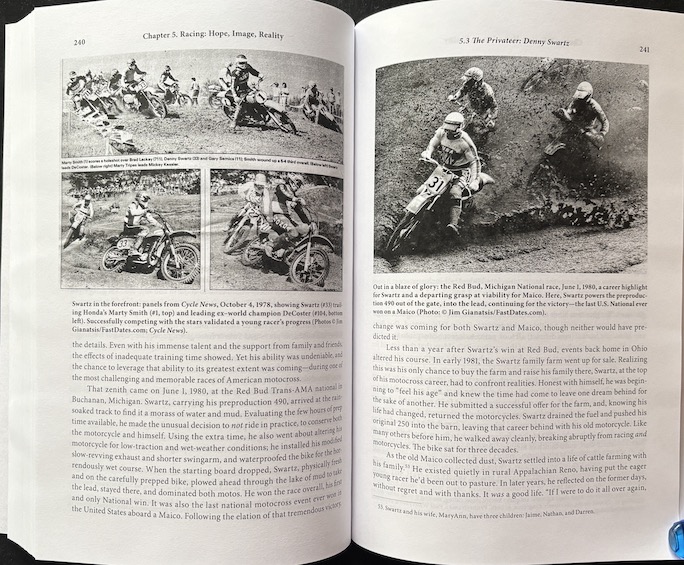
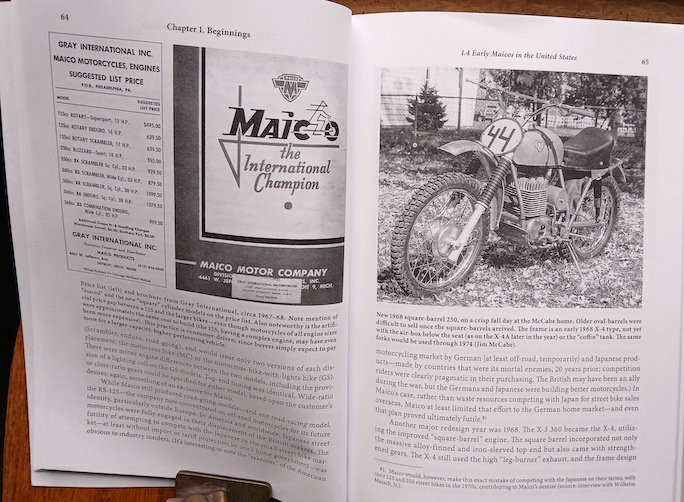 The American competitor/rider most widely recognized and admired back in the day as the motocross world champion he was is Jim McCabe. He rode exclusively Maicos and wasn’t shy to sing their praises. Above is a photo (on right page) of his then-new 1968 square-barrel 250 Maico. Lower left on the color page pair is Jim, no longer in motocross fighting trim but, as caption says, “never too old for a little gentlemanly racin’” for his buildings still house Maicos such as the two 1960s Scramblers seen beside and behind him in the photo.
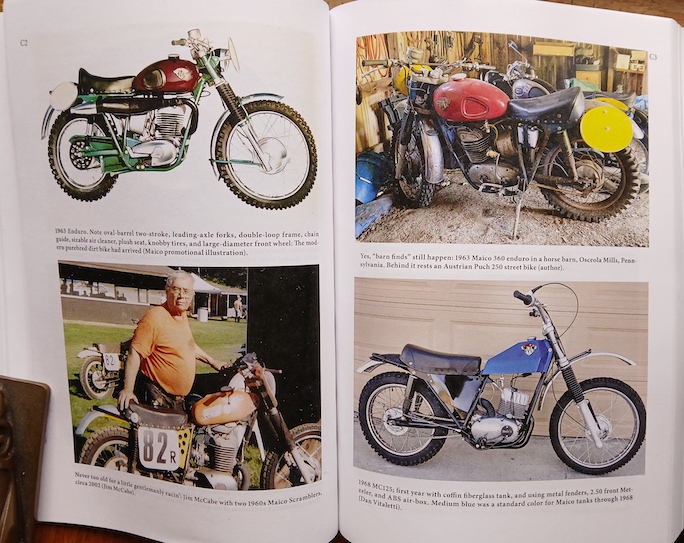 Russell notes that “at this writing, Maico is the most expensively traded of the vintage production dirt bikes among collectors, and it will always account for one of the most fascinating stories in motorcycling.” Its story shows “how a relatively unknown commodity from a distant German town became a standout in international competition.”
Yet, while making a superior motorbike, internally the company was in disarray and that finally caught up with it and brought it to a rather abrupt and certainly sad and sordid end that was precipitated by greed, dishonesty, and deceit, pitting blood relations against one another. Those chapters read like a soap opera with one exception; there are court cases and rulings documenting all that transpired.
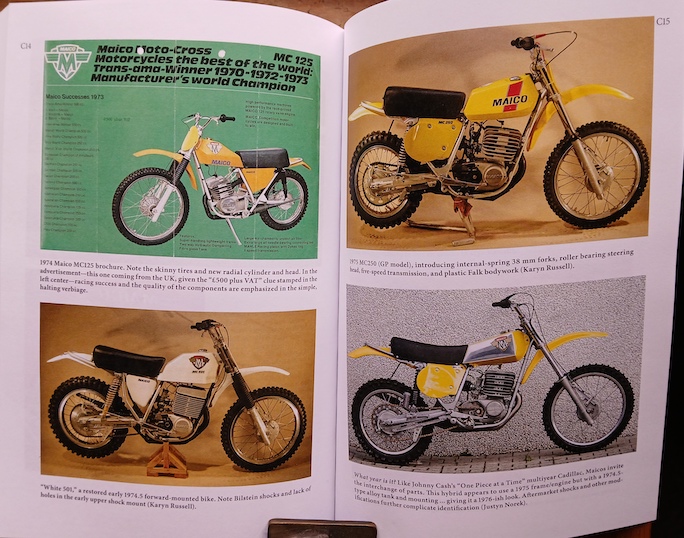
Clockwise from upper left: 1974 UK brochure for Maico MC125, next photo of 1975 MC250’s GP model, below a “Johnny Cash” Maico built of components from several different years, and lastly a restored early 1974 forward-mounted bike.
Thankfully chapter notes are in the most convenient place possible—at bottom of page whereon the footnoted text is—thus saving a reader from flipping pages back and forth. A glance to the bottom of the page shares that footnote information. The Appendices present the sales data and racing records as well as production records organized by engine and frame numbers
The breadth and depth of author Russell’s education and interests are readily discernable. While, as observed at the outset, comprehensively telling Maicos full history he also affords himself of the opportunity to discuss motorcycling and the motorcycling culture in America. To quote Russell’s first sentence of his concluding chapter, “Throughout this journey, we’ve used the Maico as the lens through which we viewed a slice of American culture.”
Copyright 2026 Helen V Hutchings (speedreaders.info)





 Phone / Mail / Email
 RSS Feed
 Facebook
 Twitter