
Elgin Park, An Ideal American Town
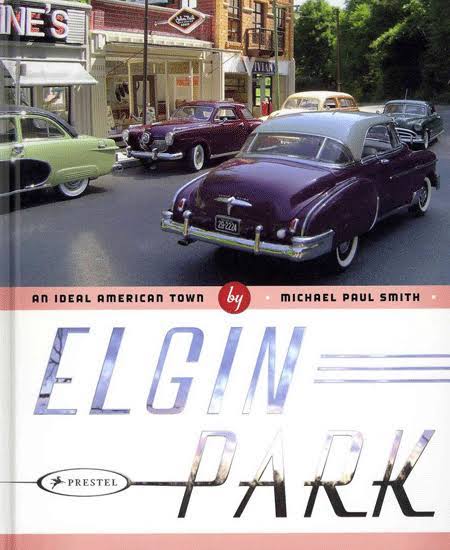 by Michael Paul Smith
Normal Rockwell’s Saturday Evening Post covers. Santa Mira, California before the Pod People took over. The Leave It to Beaver sitcom. Happy Days. The movie Pleasantville. And for downhome tastes, the Andy Griffith Show and Merle Haggard’s Okie From Muskogee. There also exists a real version of the post-World War II middleclass America, with the usual warfare, political shenanigans, social ills, and hard times for far too many.
The idyllic suburban version—The American Dream. Small Town, USA—as presented through mass entertainment is, however, not altogether false. The GI Bill had given millions of families the good life, although it helped considerably if one were of European extraction. Michael Paul Smith (1950–2018) has birthed yet another chapter in this saga. The various dioramas of his fictional small town of Elgin Park contribute yet one more nostalgic look backwards into the rearview mirror of an era. Elgin Park, the book, has a glowing introductory essay, by collaborator Gail K. Ellison, describing Smith’s creations, their history, and comments from Smith himself. But the heart of the book is the snapshots taken in various locations around the town of Elgin Park. Of the book’s 144 pages, 134 have no text, only captioned photos.
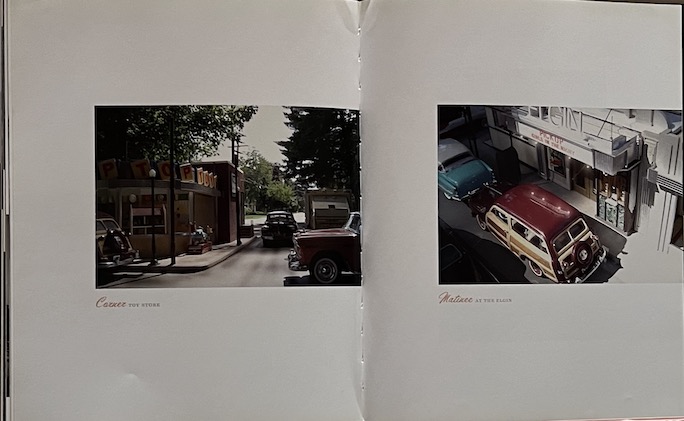
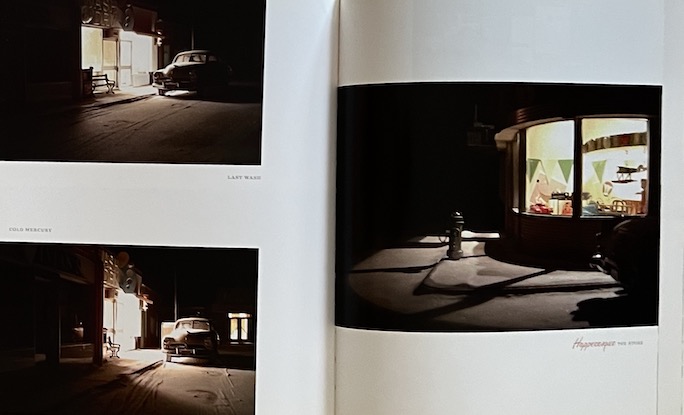
Elgin Park, the display, is unlike most model railroad displays. It is not a single, holistic creation of people, scenery, buildings and roadways, but rather it exists in photographs that were taken at places both inside and outside of Smith’s home. Smith would work en plein air, taking his buildings and his diecast cars and placing them atop the roof of an actual car or a tabletop so that the background would be of real surrounding houses, lawns and trees. Inside his house he would build and arrange independent scenes, and, devising various lighting effects and using only a six-megapixel Sony Cyber-Shot or similar camera, he would construct his photographs. It is not wrong to say that the town of Elgin Park, in essence, exists only in the combinations and juxtapositions of the multitude of images that have found their way into YouTube, newscasts, magazine articles—and this book.
Some points of interest: except for some images on scaled billboards and signage, there are no people in Elgin Park. No one is sitting at the soda fountain counter. No one is driving any of the cars. Although Smith has an eye for minutia, the buildings and street architecture are not super-detailed. Smith believes that “the brain/eye/emotions will fill in the details, even when there is a minimum of information.” What are very finely detailed are the cars. There are lots of cars. Lots. A 1936 Hudson. A bullet-nosed Studebaker. An Oldsmobile Rocket 88. An Edsel station wagon. 1959 Chevrolets: an El Camino, a panel truck, and a coupe. (A welcome addition to the book would be a detailed list of the models used.) Automobiles are the glue that holds Elgin Park together. Smith holds an enviable collection, numbering in the hundreds, of 1:24 scale diecast cars.
Although not to denigrate, not at all, Smith’s skills in creating scale buildings or his photographic dexterity and aptitude, it must be said that it is the excellence of the models coming out of the Danbury Mint and the Franklin Mint that contributes greatly to the verisimilitude of Smith’s world. If the models were not as good as they are, Smith’s Elgin Park would not be nearly as intriguing as it is. Motorheads of all stripes will appreciate the fidelity to detail of these models, and Smith uses this to his advantage.
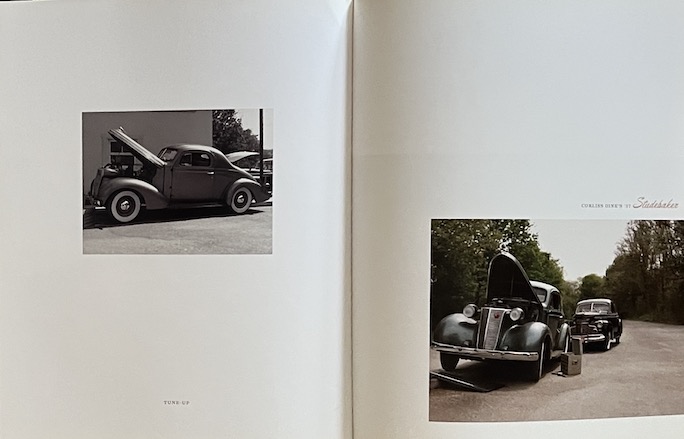
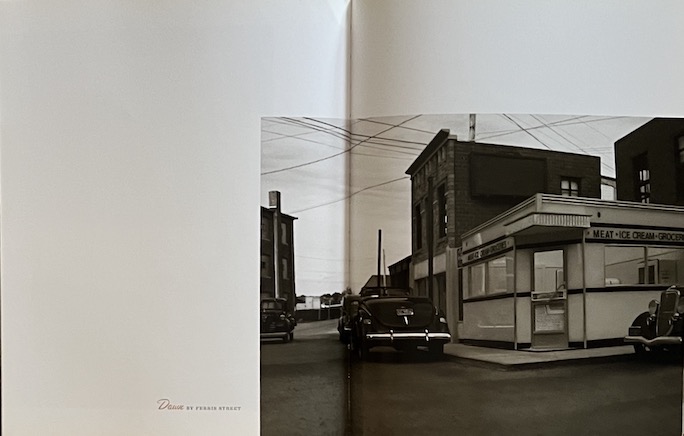
By now you may be asking: “Ok. Ok. But what about the book?” (I can just picture our esteemed editor asking this question about a paragraph or two ago.) As mentioned, the core of the book is the collection of pictures. Smith is talented, and, page after page, we find a consistent high quality of the photographs themselves. The layout of the pages is commendable. Lots of white space surrounds each photo—and, occasionally, for some of the noir images, black space. The noir scenes are especially striking. It is to Smith’s credit that he has kept his photoshopping to a bare minimum, and that he has not resorted to AI. There is one nit, however. Some of the photos are spread over two pages, and this rarely, if ever, really works. The book, at only 8 x 9 ¾ inches, is sized just right. A larger, coffee-table book would be too much; the intimacy of Elgin Park, the town and the book, would be lost. The front cover, although a bit too busy, works well enough. The back cover, with Smith’s head hovering over a Lilliputian scene, is clever and cute. Perhaps the best design element is the endpapers. A representation of the front page of the Friday, August 17, 1951, edition of The Elgin Park News spreads over two pages. We find that Orbit Ice Cream is celebrating its tenth year and that “Auto Dealerships See Super Summer”. The newsprint has faded to gray. It really looks like an old newspaper, another of Smith’s artifices.
Car gal? Car guy? Fond of diecast? Interested in the various techniques used in photography? Watch reruns of Happy Days regularly? Get this book.
Copyright 2026, Bill Wolf (speedreaders.info).

















 Phone / Mail / Email
 RSS Feed
 Facebook
 Twitter