
Men, Steam and The Driven Wheel
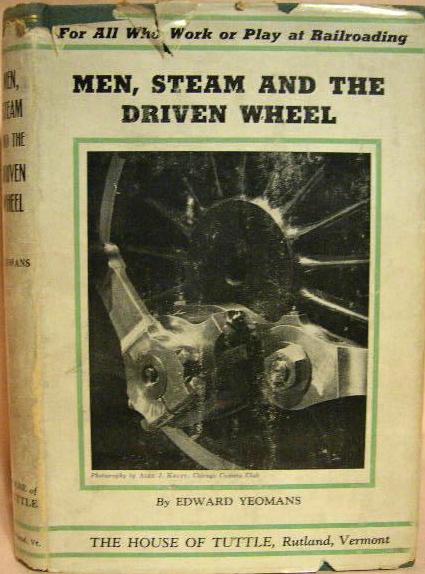 by Edward Yeomans
“As a self-contained power plant, to operate out of doors in any weather and travel over mountain and desert, hill and dale, and to drag immense loads after it on a rigid schedule, the locomotive is a subject for profound respect.”
Author Edward Yeomans further expresses his “profound respect” with the following: “There is a ‘deus ex machina,’ a god behind the machine. That god is revealed in the designer, the pattern maker, the molder, the caster, the forger, the driller and riveter, the machiner, the assembler and the operator.
“They all work in a sort of sleep, somnambulists, unconscious of their divinity, unaware of the dramatic picture they produce, aware only of the responsibilities of their craft for producing maximum results. They have a great pride, even if tragically obscured by the weary routines, in doing their best and validating their names as competent people, reasonable, trustworthy, intelligent. To such men I dedicate these pages.”
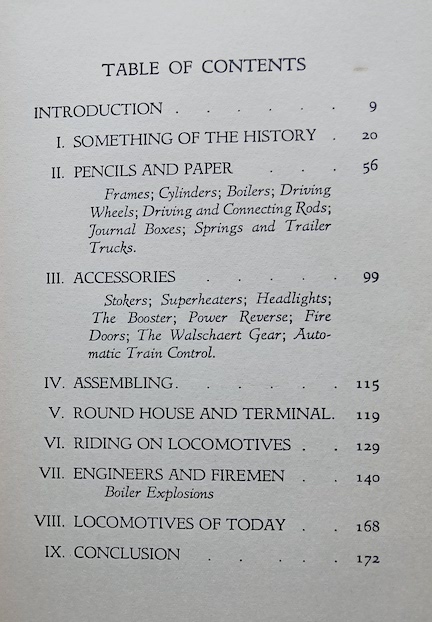 As you can see from the Table of Contents those are precisely the people Yeomans has written about describing the jobs and surroundings of each in turn in detail. Because it is a different age, his writing is charming even as it imparts and tells of mechanical and technical matters and compares academia’s students with the workmen who possess the knowledge and abilities to cast steel, make boiler plate, and other hard labor craftsmen in a way not often expressed in print—especially in current times.
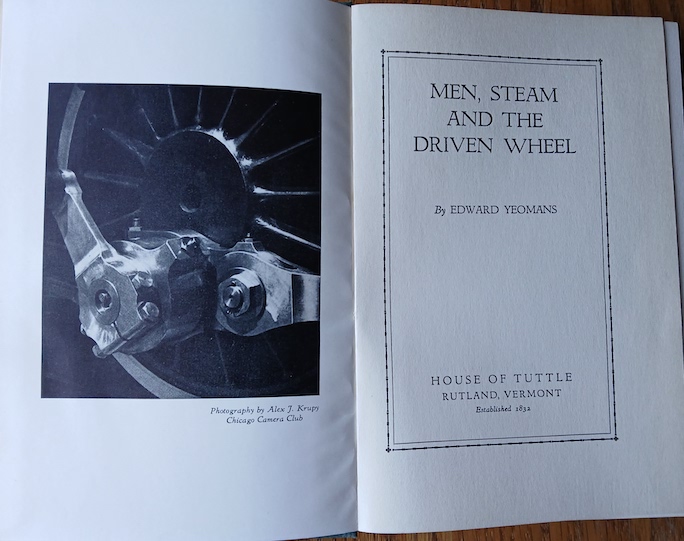
There are no photos or images in the book other than the lovely frontispiece. That shot, as its credit tells us, was taken by a member of the Chicago Camera Club. That which is shown is described in the book’s text later on with these words: “The crosshead is the elbow at the end of the upper arm, the lower arm is the connecting rod, and the fist, with a terrible grip on the driving wheel is at the end of the connecting rod. All together, it is an arm turning a crank.”
 No specific engine is ever mentioned so what Yeomans writes is generally applicable to any American steam locomotive of that era. That said, his example may very well have been a Pacific 4-6-2 for, as a bit of sleuthing turned up, Yeomans frequently contributed articles to The Atlantic magazine; in the magazine’s digital archives is an article written by Yeomans and published a few years prior to this book that is about a Pacific 4-6-2.
Tom Morrison confirms in his much lauded The American Steam Locomotive in the Twentieth Century that Baldwin not only built a number of these locomotives it was actually the source that applied the name Pacific to this 4-6-2 wheel arrangement as it had been the first to make a commercial success of them. Morrison explained that it “gave ample scope for big boilers and fireboxes” thus enabling them to meet the demands of fast, heavy passenger trains no matter the terrain to be traversed.
Morrison indicates that as the focus of his book is making locomotives go, he hasn’t written much about braking. On the other hand, Yeomans has much laudatory to say about young George Westinghouse and his monumental contribution to railroading safety—of crew, passengers, cargo and the entire consist. As William “Bill” Huber documents in his excellent Westinghouse biography Westinghouse was all of 22 years old when he introduced his first air braking system. Later he would refine it adding an automatic function for greater safety still.
In every way, the book is a notable and worthwhile read. And Yeomans’ habit of inserting pithy comments often in unexpected places only enhances that reading experience. One example is a parenthetical comment he apparently couldn’t resist including after telling of the new eccentric called the Walschaerts [1] gear, the creation of a man with that surname. That parenthetical comment is “An idea once superseded and repudiated in mechanical society is not ‘dolled up’ and forced upon us again, the way ideas in statecraft are.”
Men, Steam and The Driven Wheel is a book to read as much for the pleasure of the prose as for the subject it discusses.
- Sometimes [cf. in this book] spelled without the “s” at the end because it was incorrectly patented with that typo; the man’s name is Egide Walschaerts, a Belgian railway engineer.
Copyright 2026 Helen V Hutchings (speedreaders.info)
























 Phone / Mail / Email
 RSS Feed
 Facebook
 Twitter