
America’s Fire Engine, The American-LaFrance 700 Series, 1947–1959
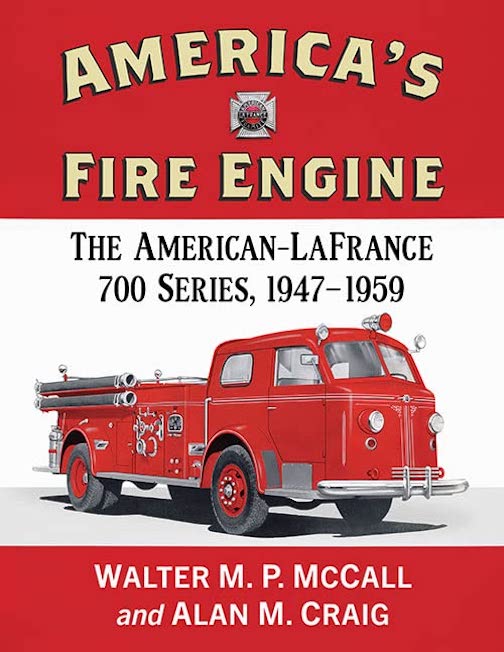 by Walter M. McCall and Alan M. Craig
“In just over a decade, the 700 Series’ radical design—moving a fire truck’s cab and engine out ahead of the front axle—completely redefined the ‘standard’ for fire engines, sweeping the market and capturing the imagination of a nation starving for innovation in the post-war world.”
Walt McCall and Alan Craig, McCall’s writing partner for this book, spared no effort compiling the material for this, McCall’s 22nd book. Appropriately it was released during the year marking the 75th anniversary of the delivery of the very first 700 series American-LaFrance fire engine.
Both men have been smitten with fire trucks, and firemen and their halls from very young ages admitting “although all fire apparatus caught our attention, as we got older it was the American-LaFrance 700 Series to which we returned and around which we developed our specialized shared expertise.” A bit further on they add, “It was natural—perhaps inevitable—that both of us would eventually own 700 Series fire engines ourselves.”
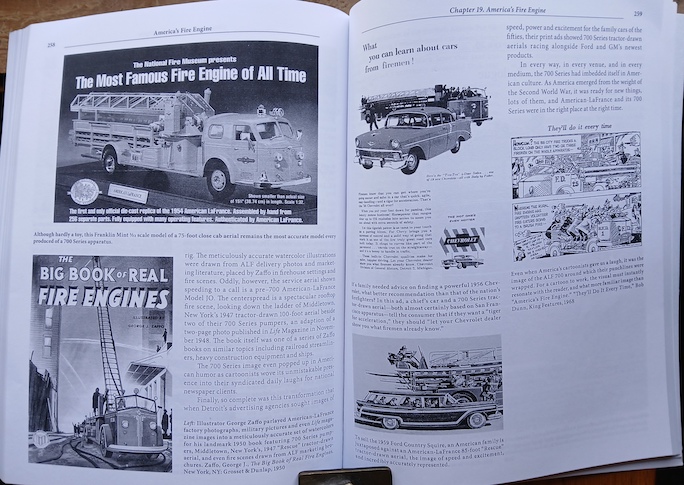
Those 700 Series American-LaFrance fire trucks would make the cover of popular mass-media magazines of the day such as Life and Look, be featured in kids’ coloring books, and on boxes of cereal. Franklin Mint even produced a 1/32 scale model.
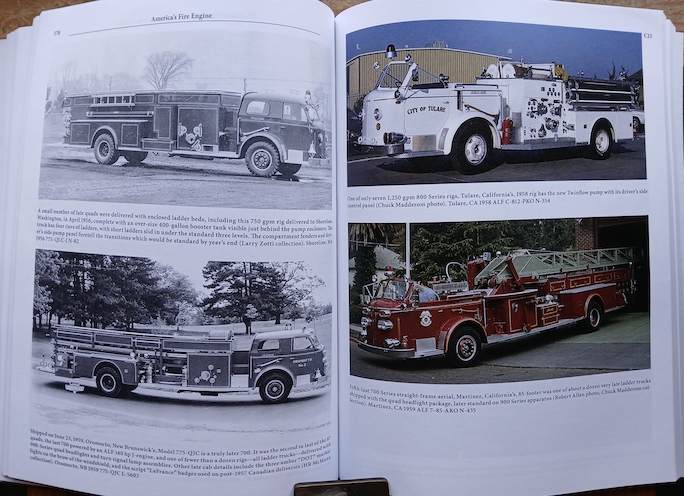
A sampling of pumpers and an 85-foot aerial on bottom right begins the color insert pages. All four are circa the latter part of the ‘50s.
McCall and Craig have poured their combined accumulated knowledge and information into this true compendium. It’s an eminently readable history supported with delivery lists, production tables, specifications, spotter’s guide, and more with all illustrated by a richness of clear, sharp, well-captioned photographs. The book is “laid out in thematic chapters, first addressing the eight principal types of apparatus from pumpers to tractor-drawn aerials to rescue squads, followed by technical chapters.”
Whatever your reason for coming to this book you’ll find much to hold your interest. In 1947 American-LaFrance was already “an undisputed leader in fire apparatus. Founded in 1904 with ancestral roots extending back to 1832, the company dominated the North American motor fire apparatus” market. In 1938 it started developing its next generation which, of course, couldn’t come to market until post WW II. But when it did, what an impact this flat-faced firetruck—with driver situated ahead of the front axle and engine—would have on the entire industry.
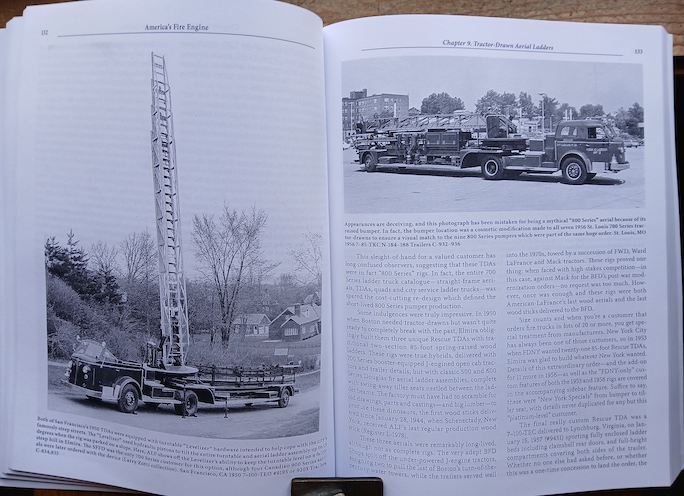
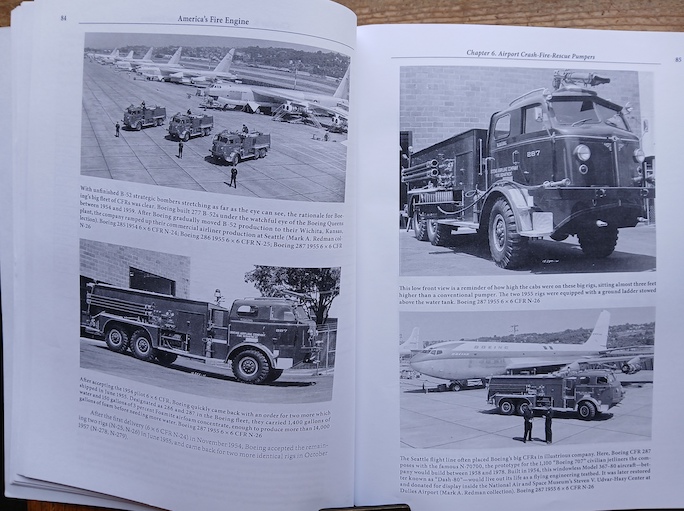
The two most ubiquitous types of fire trucks; pumpers and aerial ladders. These pumpers have both foam and water tanks as they protect aviation facilities. With its aerial ladder deployed, the outriggers are also out in order to stabilize the truck, even on slopes.
In addition to fire industry history and information, the reader will also be treated to some Canadian history. While “home” for American-LaFrance was Elmira, New York and a sprawling 375,000 square foot factory and offices situated on 16 acres, in order to accommodate Canadian purchasers it “formed a subsidiary company in 1914 . . . to avoid onerous customs and import duties.” Located in Toronto, it was first named American-LaFrance Fire Engine Company of Canada Ltd, then changed to American-LaFrance & Foamite Corp and later still to LaFrance & Foamite Ltd. No matter the name, it “offered Canadian fire departments the same comprehensive product line as the parent company did . . . ranging from industrial hose and chemical carts and commercial chassis pumpers up to the largest custom chassis pumpers, aerial ladder trucks, quadruple combinations and city service ladder trucks . . . and a complete line of fire department sundries and supplies.”
So comprehensive and complete is McCall and Craig’s understanding not just of American-LaFrance history but advances in the art and science of firefighting that, coupled with their well-honed communication skills, the entire book is compelling reading that simultaneously informs, educates, and entertains.
As remarkable as the entire book is, the number of 700 Series trucks MaCall and Craig have noted are extant, “perhaps as much as 10 percent” remain of the total production run of 3,534 trucks produced in 272 distinct model types over a dozen-year span. Some are still in service, some in the hands of collectors, and some are preserved or restored by fire departments, and a few are pristine originals.
Highly recommended!
Copyright 2025 Helen V Hutchings (speedreaders.info)
 RSS Feed - Comments

























 Phone / Mail / Email
 RSS Feed
 Facebook
 Twitter