
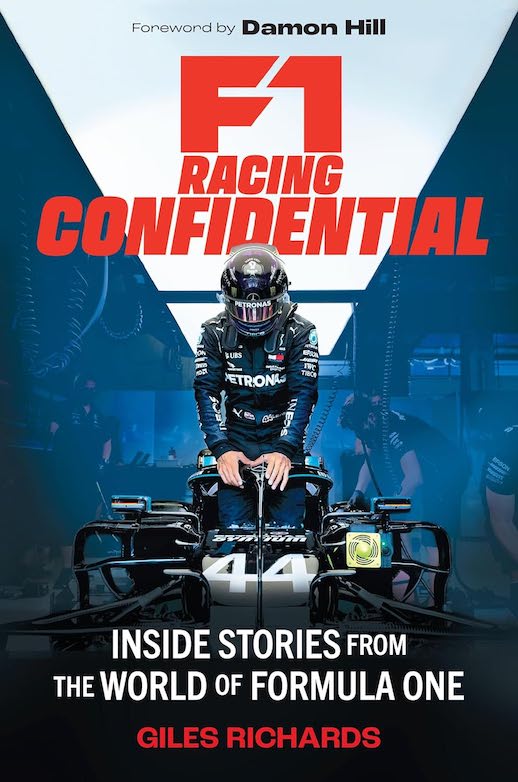
F1 Racing Confidential: Inside Stories from the World of Formula One
by Giles Richards
“One of the things people outside elite sport don’t understand is that generally people competing at the very top of sport want everyone else to really hurt.”
—Tom Stallard, race engineer, McLaren (and one-time Olympic rower)
This chunky softback enables Formula One fans, especially newer converts, to obtain an insight into the diversity of personnel involved in getting an F1 car on the grid. Nineteen personal profiles make for 300 pages of well-written text in the sort of fit-for-purpose prose you’d expect from a journalist who knows his way around the F1 paddock.
The choice of subjects ranges from the stars, such as Lando Norris and Toto Wolff, to the backroom specialist—race strategist Ruth Boscombe—and (in a relative sense) the spear carriers, such as marketing director Victoria Johnson and machinist Neil Ambrose. There are also some roles you might not expect, such as ESport driver Lucas Blakeley, and there is also one role whose absence would have been incomprehensible a generation ago, and I’ll talk about that later.
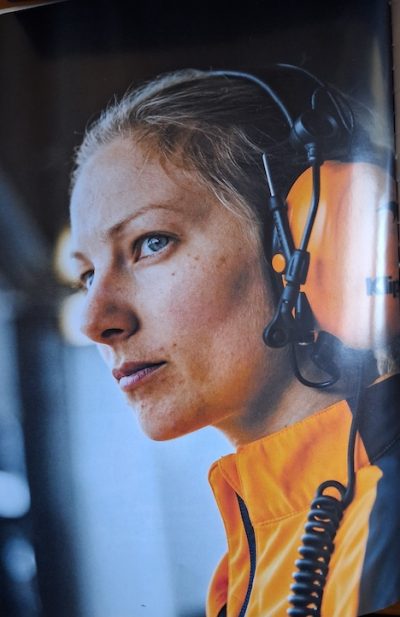
Sarah Lacy-Smith, Logistics Coordinator, McLaren.
Formula One is a curious sport in that most of its followers regard it as a mano a mano contest between gladiators riding the highest of hi-tech steeds. In contrast, most of its participants take pains to emphasize how much it is a team sport. Do you remember how often (at least in his Mercedes years) Lewis Hamilton would insist that “we win together and we lose together”? To which I say, baloney, because the public knows it’s the driver who wins a Grand Prix, regardless of the 800-strong team and gazillion dollar budget. Not convinced? I bet you know who was WDC in 1976, 1982, and 2008—but who took the constructors’ championship in those years? *
But for every Scarlett Johansson or Brad Pitt there’s a legion of “other ranks,” from the location scout to the gaffer and the best boy, without whose efforts the show doesn’t go on. And, since Drive to Survive,cameras are ubiquitous, on track and off, making everyone the star of their own soap opera. Not convinced? Then just watch the performative fist pumping in the pit garage that punctuates every overtake, the macho swaggering and the synchronized hands-on-head despair at every misfortune. Bear that in mind, as one senses the dead hand of the PR team in some of the responses given here.
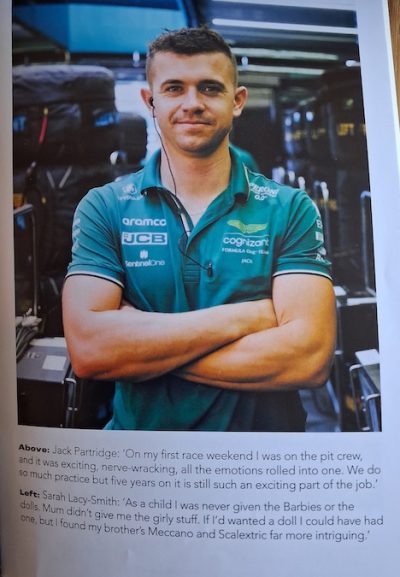
Jack Partridge, Aston Martin technician.
The higher the interviewee’s position in the team hierarchy, the less interesting they are. Toto Wolff sounds like he’s on a management team away day: “I have never felt pressure . . . I take calculated risks that mean I can cope with the worst outcome.” This, from the guy who smashed his headphones into the furniture as the chaos of Abu Dhabi 2021 reached its ignominious climax. Wolff’s nemesis, the currently unemployed Christian Horner, plays his usual pantomime villain role to perfection.
But what makes this book worth reading are the life stories of the less well-known members of the F1 community. People like Ruth Buscombe, who overcame a traumatic cycle crash while studying aerodynamic engineering at the University of Cambridge and went on to work for Ferrari and Haas before moving to the position as head of race strategy at Alfa Romeo. “I realised that [race strategy] was really rather cool, and it was the same maths as poker or high-speed chess.”Mercedes technical director James Allison shrewdly describes how the pursuit of “every single thing you work on hardly seems worth it, but if . . . you work on hoovering up those milliseconds . . . they accumulate into something that is worth it, but the degree of anal retentiveness necessary to do that is unusual.”
Had this book been written last century, it’s possible that the only women involved in the sport would have been a handful of journalists and a bevy of the grid girls whose absence is still mourned by the occasional dinosaur. But 20% of the interviewees in this 2025 book are women, and I was especially impressed with the tough, no-nonsense Mercedes marketing director Victoria Johnson, who leaves her drivers in no doubt about who is paying their wages. “When I say to Lewis [Hamilton] and George [Russell] we are going to Malaysia, for Petronas, they don’t make a face and go: ‘Oh why?’. They know they are title sponsors.”
I found Matt Bishop the most interesting and entertaining interviewee. Many readers will be familiar with his writing from his tenure at F1 Racing magazine and, more recently, as co-presenter with Richard Williams of the excellent And Colossally, That’s History** podcast. Bishop’s public persona has always seemed benign, almost avuncular, but the account of his time as Head of Comms at McLaren reveals an extremely smart, hard-as-nails mensch whose guile and PR savvy helped McLaren navigate the Spygate tempest. As he puts it, “A successful comms director knows it’s not what you say about something, it’s what you actually do.”
I mentioned at the beginning of this review that there was a surprising omission. Think back to the olden days, when whole articles would be written on the latest engine that was going to upset the status quo—from the Cosworth DFV and the BMW M12 turbo to the howling banshee V10 in the Toyota TF105. But in 2026, all most of us know is that the 2026 F1 engine is a single-turbo V6 1.5L hybrid with a damned great battery; is it NDAs that prevent us learning anything more from insiders?
The inescapable message of this book is that Formula 1 is a sport in its own right, with only the flimsiest connection with the wider world of motorsport. Formula 1 was at the top of the motorsport pyramid for decades but, in the Liberty Media era, it has become a billion-dollar ecosystem in its own right. Just read the interview with Red Bull Academy head Guillaume Rocquelin for proof. I watched my first Grand Prix in the early 1970s, and the transformation of F1 from a sport enjoyed only by the aficionado to a 24/7 reality TV show riven by tribal bickering has been good for profit margins, but, I dunno, how much have we lost on the way?
Enough of my musing. If you enjoy Formula 1 already but want to understand its inner workings better, then this book will help you do so. And at half the price of the last Grand Prix program I bought too!
*Ferrari – every year . . .
**And Colossally, That’s History was Murray Walker’s breathless reaction to Nigel Mansell’s left rear tire exploding at Adelaide, 1986.
Copyright 2025, John Aston (speedreaders.info)







 Phone / Mail / Email
 RSS Feed
 Facebook
 Twitter