
Formula 1’s Unsung Pioneers
The Story of the British Racing Partnership and How it Launched Motorsport into the Modern Era
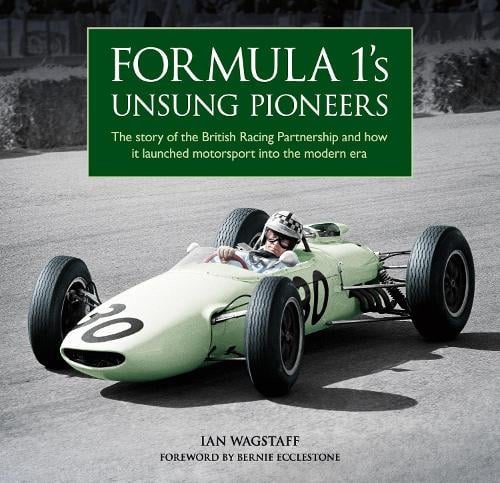 by Ian Wagstaff
“For over half-a-century, Formula 1 has been controlled by sponsors, evolving from a mainly amateur sport into a big business. It was the British Racing Partnership, or BRP as it was known, that paved the way as the first Formula 1 team to be fully sponsored by an outside commercial concern. Although BRP never fully benefited from the explosion in sponsorship that was to take over Grand Prix racing from the late 1960s, it was the trailblazer and deserves recognition for that.”
If you look closely at the vast majority of photos in this book—many of which are high-quality—you will notice something. Or rather not notice something. All the cars have no advertising whatsoever. You might spot a tire manufacturer’s name embroidered onto a driver’s breast pocket, but only when he was not actually driving the car.
Until 1968 advertising on cars in European motorsport was banned. Suppliers for oil, tires, brakes, spark plugs etc would pay teams to use their products, but could only promote successes in advertising. Unless you had a team owner with deep pockets, you would be reliant on suppliers, and starting and prize monies to fund your season. Most works teams also relied on selling customer cars. In the US at the same time, advertising on cars was already widespread in NASCAR and Indy cars, albeit still banned under the amateur ethos of SCCA racing.
Towards the end of the 1950s, things started to change slowly. Stirling Moss is acknowledged as being one of the first-ever professional race drivers. His manager Ken Gregory was a key factor in making this happen and arranged for his client to make all sorts of endorsements. Moss advertised Craven “A” cigarettes: “When I smoke I’m choosey.”
Gregory reasoned that if a team was set up and run properly, with appropriate backing, it could run at a profit. In conjunction with Moss’ father Alfred and a former Moss mechanic Tony Robinson, he founded British Racing Partnership (BRP). The inaugural 1958 season in F2 using a Cooper was operated out of a building on Alfred Moss’ pig farm. Unfortunately their star driver Stuart Lewis-Evans died in a Vanwall in the F1 season finale.
1959 brought an entry into F1 with a BRM, Stirling Moss getting 2nd place in the British GP. This was tempered alas with the death of Ivor Bueb in a F2 Cooper. But towards the end of the season, Yeoman Credit, specializing in car hire purchase (instalment plan in the US) agreed to sponsor the BRP F1 team in 1960. Dipping a toe in the water, a Cooper was freighted to the US for a well-paying Formula Libre event. Despite missing practice (he was watching television), Moss worked his way to the front and won.
So 1960 held great promise. It turned out to be a disaster. Aside from a 2nd place in the French GP courtesy of Olivier Gendebien and some sports car success with Stirling Moss, there were few results to crow about. Infinitely worse, drivers Harry Schell and Chris Bristow were both killed. And to round off the year Yeoman Credit moved their sponsorship to another team. This was accompanied by disconcerting financial issues and accompanying marital infidelities. So unlike today’s F1.
It is to their credit that BRP immediately bounced back with a sponsorship deal from a major Yeoman Credit rival—United Dominions Trust (UDT), the team being rebranded as UDT—Laystall. In F1 at least, BRP were midfield contestants at best, the main impetus now being to finish ahead of the rival Yeoman Credit team.
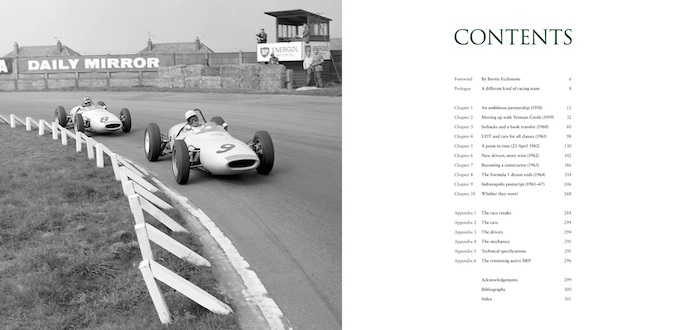
Contents and another optimistic start. Masten Gregory and Innes Ireland at Aintree.
1962, another year starting with optimism. The F1 team leader was Innes Ireland, winner of the previous year’s US GP. And Stirling Moss was making occasional guest appearances to raise the profile of the team. Then, at the Goodwood Easter Monday F1 meeting came a disaster that over time, heralded the demise of BRP. Stirling Moss crashed badly which effectively ended his professional career. The repercussions included a subsequent ending of the Moss / Gregory personal and professional relationships which in turn lead to Gregory starting to lose interest in the team. The “Moss magic” that attracted publicity and sponsorship was gone forever. The season however continued. A Ferrari 250 GTO (3505GT) was purchased for £5000 by BRP and registered in Moss’ name. He never got to race it but Ireland won what was perhaps BRP’s most well known victory in the Goodwood RAC Tourist Trophy. 58 years later it hit the then highest price for a historic car at $35m. The team continued to suffer from having to buy chassis and engines from suppliers. Two of the “very latest” Lotus 24s were purchased. BRP turned up at the Dutch GP with them only to find Lotus debuting the brand-new revolutionary Lotus 25. Lotus boss Colin Chapman insisted the 25 was actually the 1963 car—this was in May 1962. BRP also had to wait in the queue for their allocation of Coventry Climax and BRM engines.
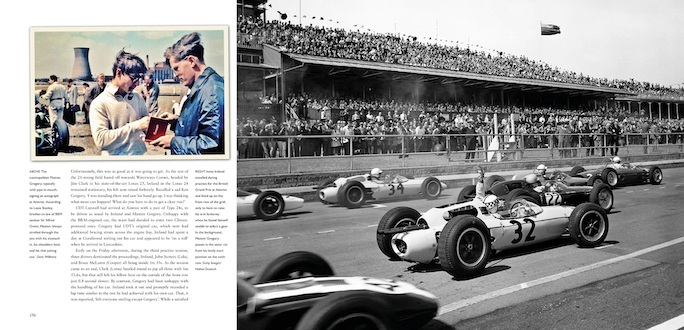
Aintree again. Innes Ireland (#32) qualified on the front row of the British GP only to find himself unable to select a gear at the start.
So in 1963 BRP decided to construct their own monocoque. Well constructed and admired, it still made little difference to F1 results. And the team had lost the UDT sponsorship.
1964 was to be the make or break year, with the focus solely on F1. The outcome was break. Early in the year Cooper, Lotus, Brabham and BRM formed The Formula 1 Constructors’ Association (F1CA, the forerunner of FOCA). Ferrari declined to join. F1CA was created to control most of the starting money paid by organisers. Being monocoque constructors, BRP applied to join but were rebuffed. The book does a deep dive into the background as to why but a fundamental reason seems to be that Ken Gregory had rubbed too many people the wrong way. With even less money coming in, the team folded at the end of the season.
There was a coda. Former BRP F1 driver Masten Gregory approached BRP to build two cars for the 1965 Indianapolis 500. Despite BRP never having been there or designed a car with that much power it was agreed. After the usual last minute dramas, both cars qualified at the back of the field. In an impressive show of the potential however, Gregory worked his way up to 5th before retiring. The cars competed at Indianapolis for another two years but after that it really was the end of the story.
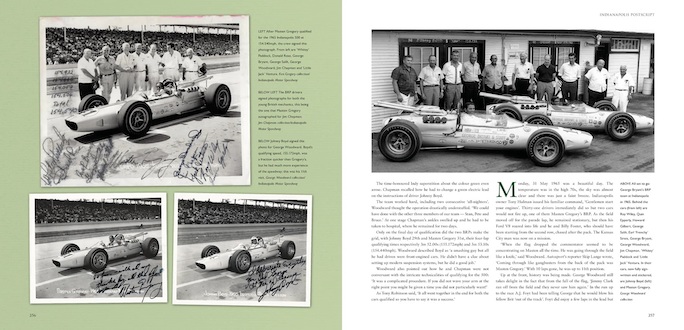
Advertising at last, only on the wrong continent and too late.
Was BRP a trailblazer? The answer is yes but the trail didn’t lead anywhere. It wasn’t until the 1968 season that F1’s governing body relaxed the rules on cars carrying sponsorship material—not because of BRP’s pioneering attempts but because the rapidly increasing costs threatened to put F1 out of business. The results we see today.
Over the years the roll call of BRP drivers is impressive. Stirling Moss, Innes Ireland, Masten Gregory, Graham Hill, Jim Hall, Tony Brooks, Roger Penske, Jo Bonnier, Dan Gurney, Phil Hill, Richie Ginther, and Chris Amon all drove Partnership cars. Despite this, it never won a World Championship F1 round, although it did win some non-Championship events and races in other formulae. During the period that BRP ran in F1 (1959–1964), all races were won by the manufacturers—Cooper, Ferrari, BRM, Lotus, Brabham, and Porsche (with a single victory). The notable exception was the Rob Walker team whose driver was a certain S. Moss. BRP were perhaps “the best of the rest.”
There are myriad books on winning F1 drivers, cars, and teams. A well-written, well-researched book such as this deserves attention.
According to the advertising blurb this is “the previously untold story of a very special British racing team.” Well not quite. Ian Wagstaff—the author of a number of motorsport books—has also written Tony Robinson: The Biography of a Race Mechanic (Veloce 2012). This covers all of Robinson’s career, but a substantial element is the BRP era from start to finish. So you will find some of the photographs and elements of text repeated in the new book. The Evro book has a lot more background and the photos are up to the usual high Evro standard. Both books are informative and entertaining. I enjoyed them both.
The Foreword is by Bernie Ecclestone. Don’t let this put you off.
Copyright 2026, Paul Lea (speedreaders.info)


 Phone / Mail / Email
 RSS Feed
 Facebook
 Twitter