
The Ferrari 250 GTO Spotting Guide
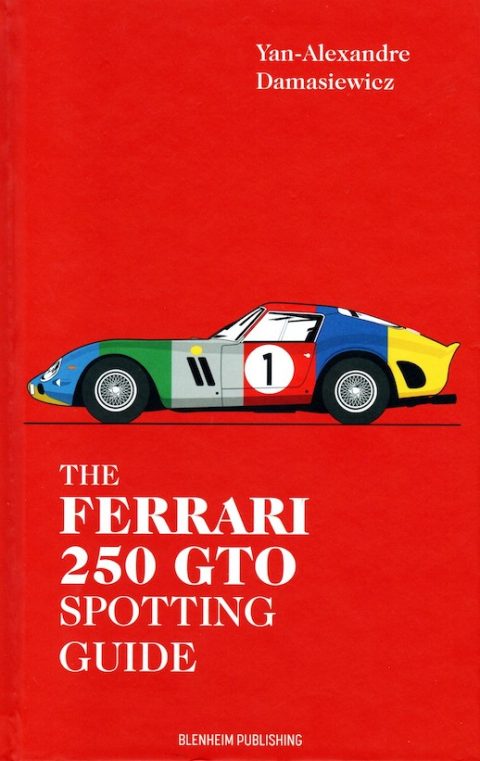 by Yan-Alexandre Damasiewicz
“Take this book to concours d’elegance and historic races, and you’ll soon become a 250 GTO expert. Will you manage to spot all thirty-six? It’s up to you!”
From the 1950s in the UK, a series of I-SPY books have been published on a range of different topics., including I-SPY Cars, I-SPY On a Train Journey, I-SPY Churches etc. Before mobile phones, e-books and other necessities of the modern age, these small-size books were an important way of keeping children from getting bored on long journeys.
As children spotted the objects listed, they recorded the sighting in the book and gained points, varying in amount according to how unusual the sight. The author’s childhood references also included The Observer’s Book of Automobiles. I still have my 1963 edition (bought new). Although I was living in London at the time, rare beasts such as Facel Vegas and Tatras were hard to spot, a deficiency remedied only by a crafty visit to London’s annual Earls Court Motor Show.
The author (b. 1980) of this GTO book has taken the I-Spy principle to the nth degree. I don’t recall ever having spotted a 250 on the road so if this book required checkmarks made for points gained, it would remain woefully blank. Thankfully it has more realistic “spotting boundaries.”
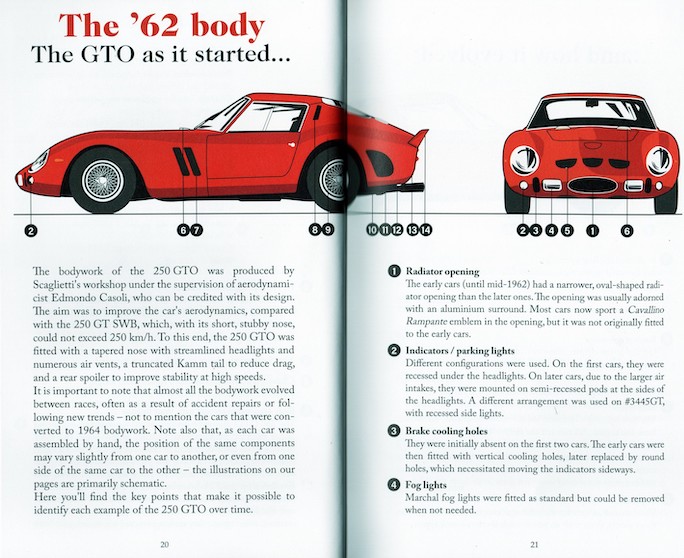
Ding-ding-ding! Bonus round! I spy with my little eye that this car is left-hand-drive. How? There’s no steering wheel visible but look at the orientation of the inside rearview mirror; even at this small size you can see it is angled to the left ever so slightly. There were only eight rhd cars anyway so this is a minor issue but it shows the author, who is also the illustrator (he started in graphic design), thought about fidelity.
The book is actually a great deal more than just spotting GTOs. It starts with a very brief potted history of Ferrari up to the advent of the 250 GT then it’s straight into GTO forerunners. No photos (here) but color line drawings and commentary on appearance. The last in this sequence is the GTO prototype #1791.
There are left-hand side and front views in all the drawings. I suppose we can trust that the right-hand sides look pretty similar to the left as racing cars rarely sported, for instance, outside rearview mirrors. Rear views are entirely omitted because in terms of design or fitments nothing much happened there. Realize that the author consulted several thousand period photographs, and then experimented with many, many drawing styles.
Following is more information and diagrams on the 250 GTO “under the skin,” how the body evolved through to 1964, which then leads into the main part of the book, the chassis records.
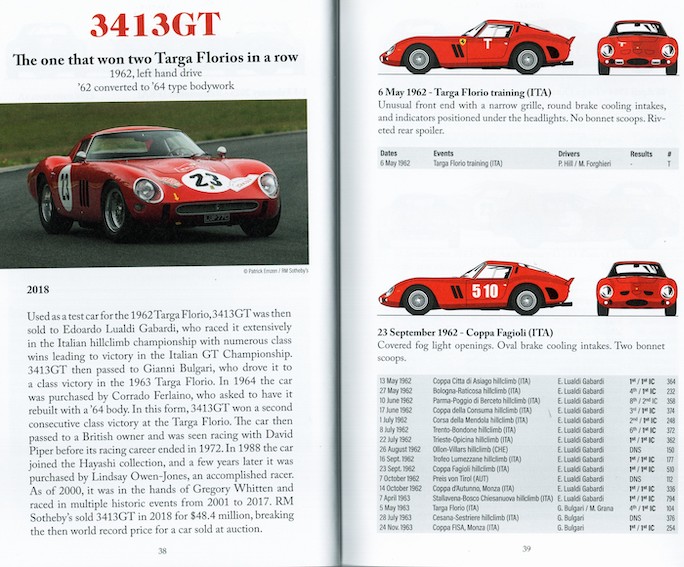
Each chassis section contains a color photo of the car, and initial history. This is followed by a history to date including bodywork and color changes, completion history, concours appearances, as well as owner’s lists. And after the most recent appearance there is empty space provided to add your own sightings. Interspersed amongst the entries is trivia such as 250 GTO prices at auction (again with space for you to add subsequent ones), GTOs in movies and TV, and Ferrari collector (and 250 GTO owner) Brandon Wang’s Garden Party car list.
The competition histories reveal just how hard some of these cars were raced in period. Each event records date, venue, driver, finishing result and, helpful for identifying cars in period photos, the race number.
As brief as the car histories are, there are plenty of gems sprinkled around to elevate this book from the ordinary. For instance, 5095GT was used for a driving school—and fitted with Ford Cortina rear lights. 3589GT was offered to a local high school for mechanics lessons and use in parades. 4757GT was owned by a drug trafficker who was later found murdered. And we also learn that 250 GTOs were, like many performance vehicles at the time, not immune to chassis number swapping.
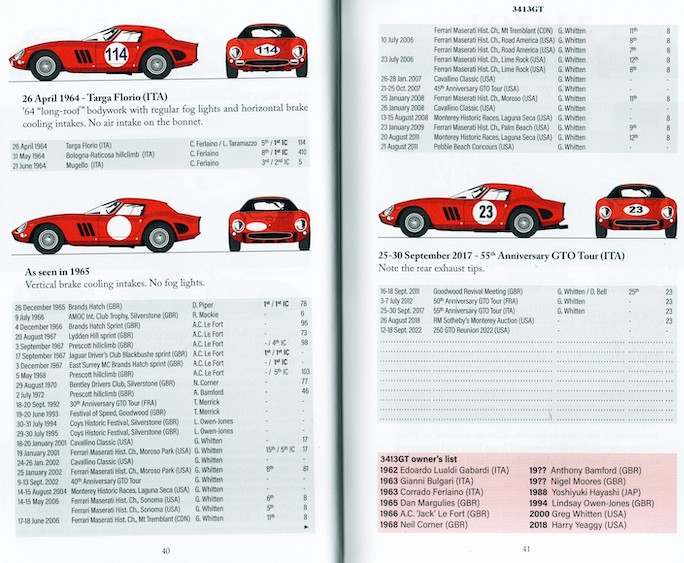
And there’s more. A chapter on (known) 250 GTO replicas, the 250 GTO in the (Sports Car) World Championships 1962–1964, an index to licence plates, and finally spotting notes and a personal notes section. No index but plenty of different ways to access information—drivers being an exception
If you want to emulate an I-SPY spotter and tick off all thirty-six targets you will need very deep pockets to travel the world and gain entry to the premier events. And there will remain the challenges of somehow working your way into those stored in citadels whose owners prefer to remain anonymous.
Tongue-in-cheek comments aside, this is a useful, up-to-date, and inexpensive way of gaining an introduction to the 250 GTO universe. There aren’t that many books specifically devoted to the GTO 250 anyway. If your appetite is whetted by the racing histories, look for Doug Nye’s GTO 64 (Watermark Publications), James Page’s two-volume Ultimate Ferrari GTO, and Ferrari 250 GTO 4153 GT by Keith Bluemel (the latter two published by Porter Press). Even for books those deep pockets come in handy.
The author has been a motoring journalist since 1998. He is editor-in-chief of Enzo, the leading French magazine on Ferraris as well as French editor of Octane magazine. He also is a member of the jury for the Historic Motoring Awards. This book, his first, is “the starting point of a collection dealing with the most emblematic racing cars of the 20th century.” The printing was funded by a crowdfunding campaign. Although available internationally in a few select bookstores, ordering it through the author’s website will help in funding the next publication.
The first 250 copies were numbered and signed.
Copyright 2026, Paul Lea (speedreaders.info)



























 Phone / Mail / Email
 RSS Feed
 Facebook
 Twitter