
Kaga and Akagi: Aircraft Carriers in the Imperial Japanese Navy
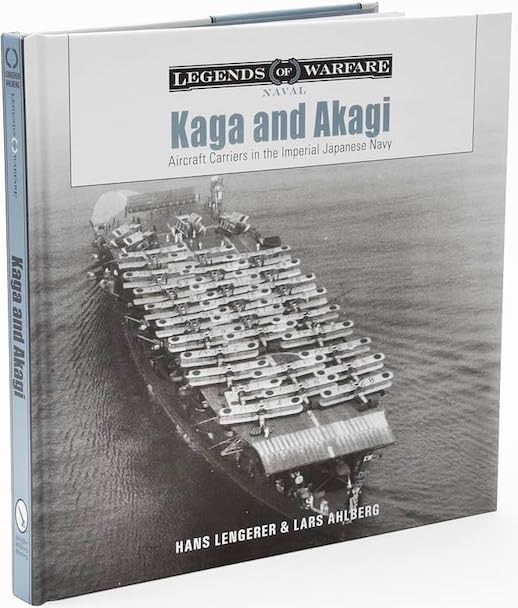 by Hans Lengerer & Lars Ahlberg
Parallel lines—that was the name of the very memorable album by the trend-setting and popular rock group Blondie in 1978 but was also accurately descriptive of the development of the aircraft carrier in both the United States and Imperial Japanese Navies in the decade of the 1920s as a direct result of the Washington Treaty on the Limitation of Naval Armaments of 1922.
Both signatories were required to immediately sacrifice capital ships then under construction. Coincidentally in the case of both navies, these involved battle cruisers (and battleships) that had been started but were still on the building ways and some way away from being ready for launch, much less ready for service. The treaty allowed each navy to convert two of their incomplete battle cruiser hulls to aircraft carriers, at that time an entirely experimental type of warship with undetermined capabilities and limitations. At that time the capabilities and limitations of aircraft themselves were largely undefined and would go through several transformations in the years leading up to the Second World War. The U.S. Navy converted the hulls of the two most advanced (of six authorized) battle cruisers, provisionally named Lexington and Saratoga. Their conversion was arguably highly successful, but that’s another story for another time.
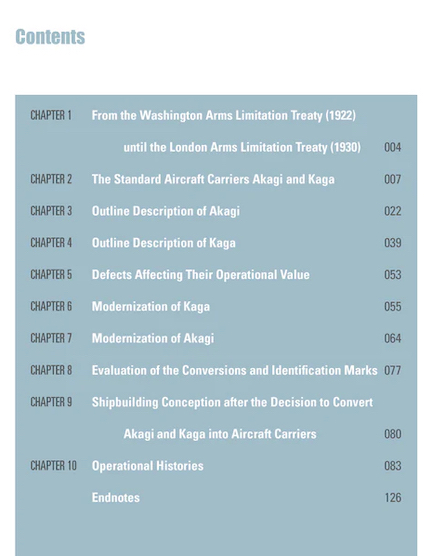 The Imperial Japanese Navy (IJN) selected their incomplete battlecruisers Akagi and Amagi. Battlecruisers were considered the preferred, if not ideal choice for conversion due to their inherent greater length and high speed capabilities in respect to all other major warship types. However, while Amagi was still on the building ways but close to being ready for launching, the area of Japan where the shipyard was located was hit by a major earthquake in September 1923 so severe that the hull was dislocated from its building slipway and the stern area was seriously twisted and critical propulsion and steering equipment was damaged beyond economical repair. This forced the IJN to consider an alternative hull for conversion. Kaga was the second and final unit of the TOSA-class of battleships, both of which had been launched and were fitting out at the time of the signing of the Washington Treaty but were required to be sacrificed under the terms of the treaty. TOSA was considered too far advanced to be converted. Kaga had been launched in November 1921 and was not much more than a floating, empty hull when the Treaty was signed in February 1922 and all work on her was suspended. The IJN designers and engineers carefully evaluated and reevaluated the ship’s plans and compared them with those of Akagi and concluded that while it would involve an enormous amount of rework and expense, a marginally acceptable substitute, in the sense that while the ships would outwardly appear to be very similar, Kaga would always be notably slower than Amagi due to its shorter and broader hull and substantially less powerful engineering plant. There was really no other option, so the significant 5-knot speed penalty was reluctantly accepted, and the conversion proceeded.
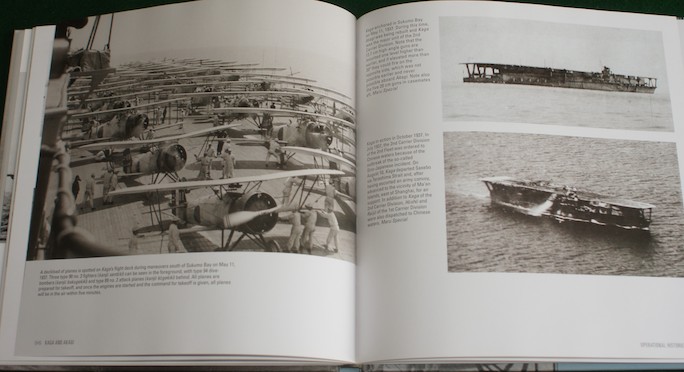
Kaga flight ops.
This volume is no. 30 in Schiffer’s notable and well received “Legends of Naval Warfare” series. As one would expect, it fits right in with all the others on the bookshelf in size, colors, and presentation and quality of production. Schiffer has admirably held the line on pricing. Considering what you typically get in the volumes of this series, this one is tagged at a very modest $24.99, a real bargain these days. Thank you, Messrs. Schiffer!
This installment is particularly welcome as it focuses on well-known but until now not well documented major vessels of the IJN of World War II. Many readers may find it somewhat ironic that the author is acknowledged internationally to be the foremost authority on the IJN, particularly in regards to published material in the English language, since he is German and English is not his first language. He has had a major article published virtually every year in the annual publication WARSHIP since the early 1980s. As one might expect, the topics of those articles run the full gamut from battleships to torpedoes to radar and everything in between. Incidentally, I have the full WARSHIP set on my library shelves, and it currently occupies almost 42 inches. I should do a review of WARSHIP on its own once I get through my current backlog of reviews.
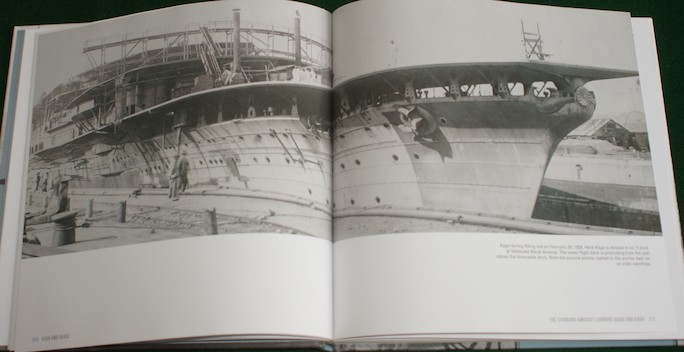
Close-up of Kaga‘s bow.
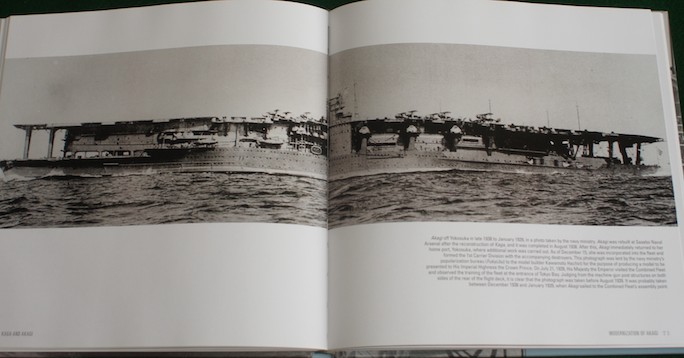
Kaga port side.
Occupying 128 pages, a more or less standard length in this series, this book is primarily a photographic work, and this is where things are more than just a little surprising, for a variety of reasons.
First of all, the IJN was noted for its secrecy, and was very selective about what it allowed to be seen by the public in print, and that wasn’t much. The sheer magnitude of photos here, the vast majority of which are from the author’s collection acquired over decades of diligent search, and the variety of views, especially of details, is surprising, as is their also obvious variety of sources. Many are of professional quality in terms of composition, focus, and exposure or nearly so while others are clearly amateurish and barely acceptable. The quality of reproduction is commendably and remarkably consistent, especially so as it is obvious that in light of the above comment the quality of the original photos varied greatly. A significant number are printed full-page (ca 9 x 9″) and there are three very impressive two-page spreads as well. That so many usable photos have survived for a century or nearly so is remarkable in itself, but even more so considering the deliberate purging and destruction of historical files by the Japanese High Command when it became clear that the war was lost, surrender was imminent, and anything possibly incriminating should be destroyed. A great deal of such material was, particularly in regards to the super battleships Musashi and Yamato, so much so that I consider it questionable if we will ever see a volume in this series on those ships due to the lack of sufficient historical photos to fill 128 pages in the manner to which we have become accustomed to receiving from Schiffer.
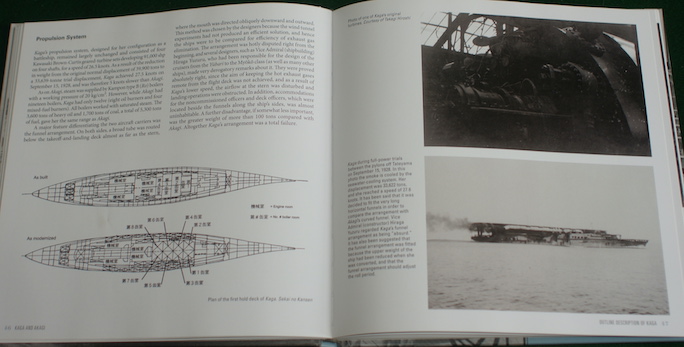
Kaga propulsion plant.
Both ships were reconfigured, or reconstructed, twice during their careers, and the photos of their appearances in their various configurations are supplemented with highly detailed 2D line and 3D perspective drawings that clarify details not evident in the photos.
As this is a technical history with photographic emphasis, the ships’ operational histories are summarized with only the highlights being mentioned. Both ships participated in the Pearl Harbor attack. Akagi participated in the Indian Ocean operation of early April 1942, and then both were part of the operation against Midway in early June, where both were lost. For a highly accurate and highly acclaimed account of their losses, I heartily recommend Shattered Sword, The Untold Story of the Battle of Midway by Jonathan Parshall and Anthony Tully (Potomac Books, 2005).
If you’ve started collecting the titles in this series, chances are you’re already hooked and don’t need to be sold, but if you’re curious and just starting out you can’t go wrong by acquiring this volume to “sample the water.” Welcome aboard!
Copyright 2026, Mark Dwyer (speedreaders.info)















































 Phone / Mail / Email
 RSS Feed
 Facebook
 Twitter