
Ferrari: The Monopostos of 1948–52
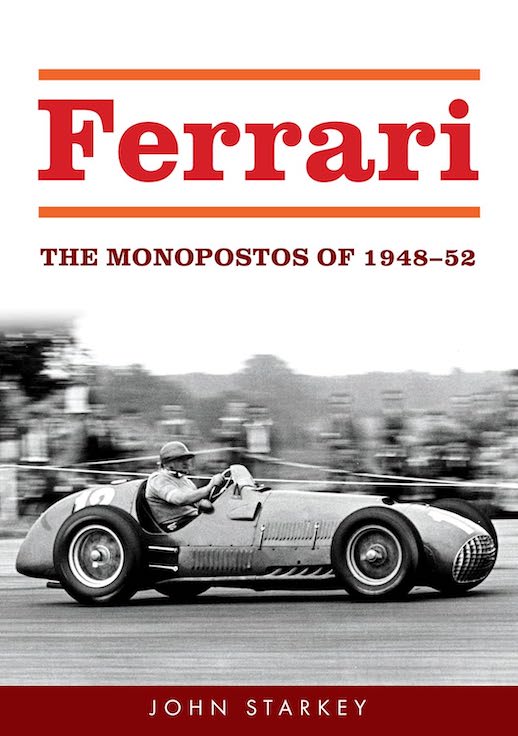 by John Starkey
“Having read many books about Ferrari, it seemed to me that although much has been written about the great racing and roadgoing sports and GT cars, by comparison not much has been written about the early Formula 1, 2 and Formula Libre cars, starting from when they first seen by the general public in September 1948.”
Really, another Ferrari book?
Books on Ferrari are probably numbering in the tens of thousands by now. Or so it seems at least. Even your humble scribe, scarcely a Ferrari fanatic or connoisseur by any means, probably has several dozen Ferrari books on the shelves. And those are only the ones focused solely on the marque itself. Goodness knows how many books in which Ferraris were major factors there are on top of that.
And now we have this one, Ferrari: The Monopostos of 1948–52, by John Starkey. Famous cars. Considering the proverbial forests that have been denuded to provide the paper to print all of those Ferrari books, the question that begs to be asked is, Why this book? What does it add to the narrative of the Ferrari marque in general and the early monoposto machines in particular?
For once we have here a Ferrari book that is not even remotely expensive so if its purpose is to be an inexpensive introduction catering to an audience not very familiar with these Ferrari single-seaters, okay, that would work.
But if it is to provide a more in-depth look at these important early monopostos, one geared towards the sort of enthusiast who expects detailed tables of specifications, results, chassis numbers and their histories, maybe not. Because there aren’t any. Which apparently is not the author’s doing!
Starkey has let it be known on various racing forums on the Web that it was the publisher who slashed his planned 40,000+ words to about half, as well as omitting the intended charts and tables. Starkey is, to put it mildly, a prolific author, grinding out books relating to racing topics that are generally focused on marques, or types within a marque. One notable exception might be Racing With a Difference: The History of IMSA (Gryfon Publishers, 2001), a two kilogram doorstop that IMSA founder John Bishop detested, an opinion he expressed to me in no uncertain terms and several times. I have lost count regarding the number of updates/revisions that Starkey penned regarding the Lola T70 series, but it was at least three. At this point I should note that in most of his books, narrative tends not to be Starkey’s strong point. This is not at all unusual with books in this genre. Not everyone is a Doug Nye or Karl Ludvigsen or Graham Gauld, much less a Henry N. Manney III.
Since there are no tables and charts to deliver data, Starkey has to intersperse it with the body copy. It may not help the flow of the text but at least no one who has a hankering for bores, strokes, displacements, wheelbases, gear ratios, etcetera etcetera can complain it’s missing. Chassis Cultists must be appeased . . .
Speaking of same: it was rather nice of Starkey to give some sort of acknowledgement, however brief, to those at Autosport.com’s The Nostalgia Forum, along with Doug Nye, for their assistance with sorting out the cars. Much of the identification of individual cars tends to be ex post facto, of course, as well as those identities tending to be aligned with the often myopic Anglocentric thinking regarding Identity rather than how the Italian firm might have at the time. But, I digress.
Would the world of Ferrari literature have felt seriously incomplete without this book? Probably not. But again, it is quite reasonably priced, and a discussion of the early cars that put the marque on the map can only help new F1 fans gain a more rounded picture.
So we rephrase our starting question—Why?—to Why Not?
Copyright 2025, H. Donald Capps (speedreaders.info).
 RSS Feed - Comments












 Phone / Mail / Email
 RSS Feed
 Facebook
 Twitter