
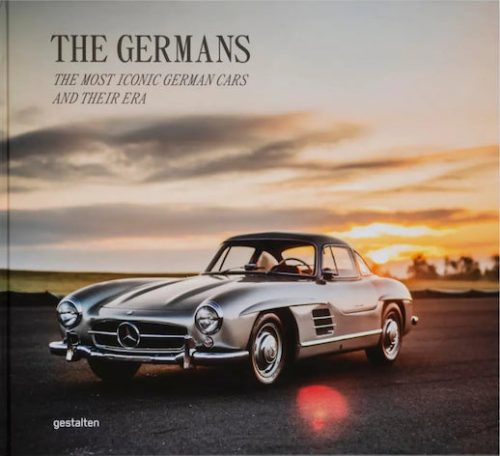
The Germans: The Most Iconic German Cars and Their Era
 by Blake Z. Rong
“Isherwood, a British expatriate who had moved to Berlin to immerse himself in hedonism, felt compelled to witness the unfolding history. He was fated to observe a mix of optimism and nihilism that pushed the boundaries of art, architecture, and cinema during the brief window known as the Goldene Zwanziger, or ‘Golden Twenties.’”
These words from the beginning of the book, the author’s Preface, reference many things—but not cars. Not yet anyway. The only people who would moan about this are those who missed the word “and” in the title: Cars and their Era, not “of their Era,” the distinction being that the book is as much about cars as the specific context of their time. Well, it really is more about cars, but the eras—the 1920s to the present—kind of explain why it is these 50 cars that made the author’s list. What it is not, and doesn’t have to be, is an encyclopedia-type or “best of” sort of book.
Cars range from the inevitable big names—540K, 300 SL, 911, Quattro (and if you don’t know what marques these models go with you’d better read this book anyway)—to the decidedly lesser known such as, say, a Glas 2600 (aka the “Glaserati”) or RO 80. The common denominator is that these cars embody both the design vernacular of their era as well as a specific “German-ness.”
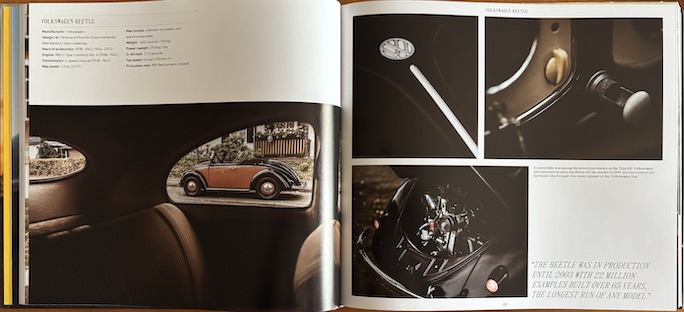
The fact that the Beetle spec table lists as designer Ferdinand Porsche, Erwin Kommenda, Béla Barényi, and Hans Ledwinka can be taken as a sign that the author is really making an effort to offer detail.
The latter the author firmly links to a distinctly thorough German way of engineering things, and also to that other location- and culture-specific phenomenon, the autobahn, because the (partial) absence of speed limits does require soundly built vehicles. The autobahn nod could easily be taken as a bit of a red herring but Rong demonstrates nuanced understanding of the subject by not only rhapsodizing about all-out speed but the rigorous driver’s license process that “can take several months and cost thousands of euros” which in turn creates disciplined drivers who can apply such speeds responsibly. Such critical thinking is evident throughout, so enjoy this book without prejudice.
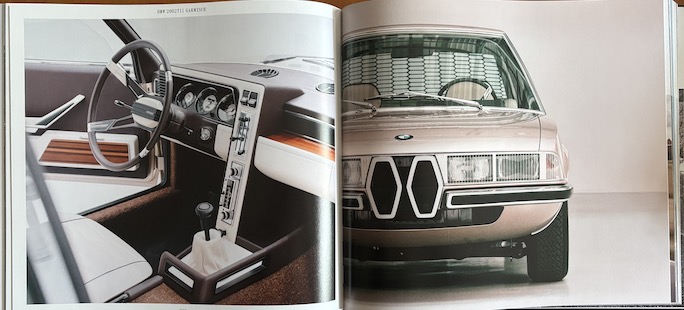
Certainly an extreme example of a being a car of the times, the Marcello Gandini-designed BMW 2002 Garmisch concept car. What the book doesn’t tell you is that this rarity was believed lost for decades and this is a recreation.
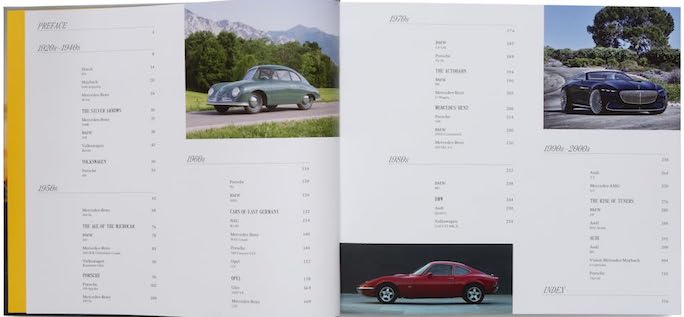
The book is divided into six eras, each introduced with an essay-type overview of what’s happening in design, culture, and technology. Specific models are then presented, on several pages each, and in no discernible order (which is of no practical consequence in this type of book). The first car is the 1935–39 Horch 853, the newest the 2019–present Porsche Taycan.
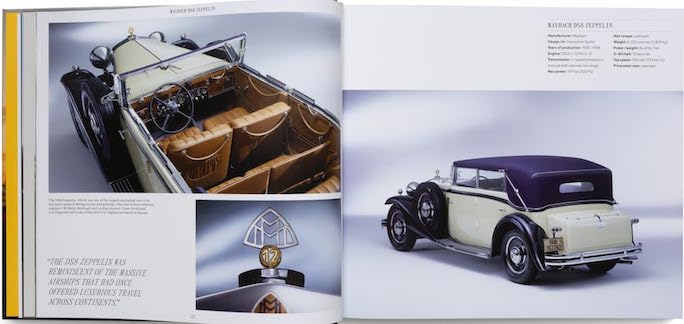
Few were built so you may well ask what specific chassis this is but you’ll have to look elsewhere.
The photos, incidentally, may in many cases show one particular chassis (this would be especially applicable to prewar cars) but the commentary as well as the spec table is about the model in a generic sense. Each era will be accompanied by at least one special feature, several pages long, that discuss larger topics, for example “Cars of East Germany” or “The Rise of Tuners.”
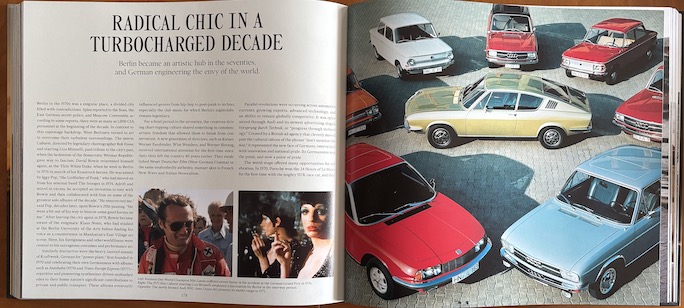
An example of a Special Features section.
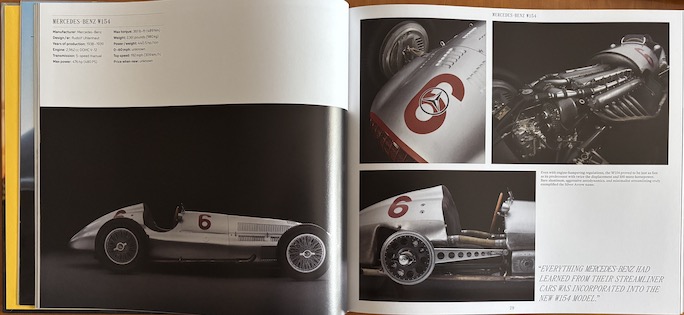
The photos may be from stock sources but are really well chosen. Note bottom right: the bodywork is removed.
If you are a book collector all of the foregoing may have put you in mind of similar books by this publisher, and indeed this is one of now four in their “Beautiful Machines” series. That photography and photographers are important to this publisher is evident in the fact that the one-page Index lists cars along with the photographer’s name and contact info. Moreover, the Index page is preceded by a listing of all chapters and special features along with photo source/contact info by page number.
While the publisher is German, the author is very much American, widely published, with a plethora of interests (“buys more books than he reads”) and all around sympatico. Nicely laid out in landscape format and with a properly rounded spine this is a fine book to behold. If you buy it as a gift you may not bring yourself to part with it!
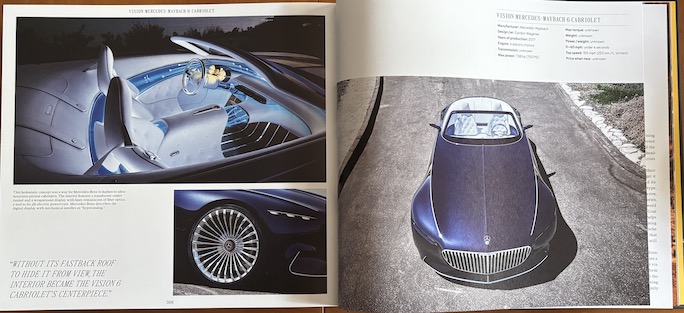
An extreme concept car, the Maybach 6. Note the translucent center tunnel and cabin wraparound.
Copyright 2025, Sabu Advani (speedreaders.info).
 RSS Feed - Comments

























 Phone / Mail / Email
 RSS Feed
 Facebook
 Twitter