
Ultimate GT40 – The Definitive History, Vol 1
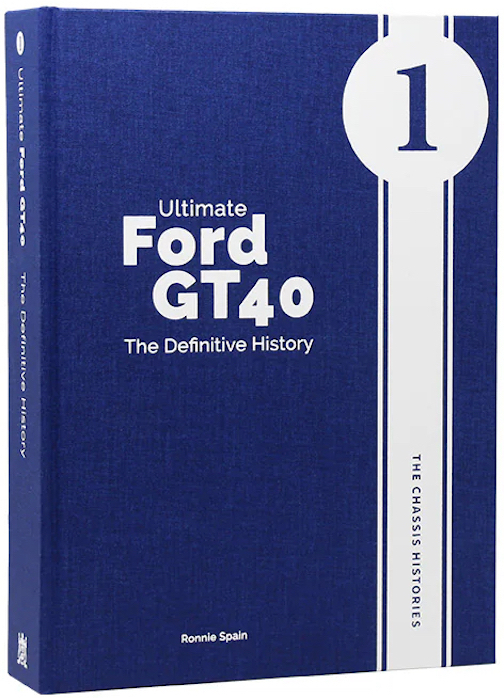 by Ronnie Spain
”I’ve now been actively researching the Ford GT40 for over 46 years. Scary isn’t it?”
If you time-travel back ten years to 2016 you’d see yourself on pins and needles expecting this book, after years in the making and finally slated for publication in the 50th anniversary year of Ford’s epic Le Mans win. Didn’t happen.
It’s another decade later now, and the project has grown to four volumes of which two are in circulation and the other two no longer vaporware but not physically printed just yet.
Since 1970 there have been approximately 30 print publications in English devoted primarily to the Ford GT40. This total does not include multiple editions, books in languages other than English, or magazine features.
Of that quite large selection, Porter Press itself has already issued three GT40 books, and there are four on individual chassis—Porter Press with P/1016 and P/1075, Ed Heuvink (McKlein) with GT/101, and Adelino Dinis (Edicoes Vintage) with P/1022.
This Porter Press book states that it is “The definitive record of each and every original Ford GT40 built.” With a slightly elastic definition of “original,” the last GT40 was built in 1971. There were 133 chassis numbers but actually 134 chassis built. The continuation/replica market started around 1981 when John Willment, who owned the JW Automotive team authorized the construction of “new” GT40 Mark Vs; these are not included in this book.
Spain had written GT40: An individual history and race record in 1986. Updated several times it held its place as a definitive source of GT40 chassis information, commanding healthy prices in the secondary market today. But Spain had all along set his sights on a bigger, better book—that this new one is called “definitive” has as much to do with its scope as this publisher using that word for a specific type of (series of) book they are rightly famous for. Before looking under the hood, realize that Spain, an unassuming no-nonsense Scotsman who coyly presents himself as a former truck driver and gardener, has earned a reputation as the massively knowledgeable go-to guy in the GT40 world. But, as there can be no new “original” chassis to report on since his 1986 book, what all went into the new books, each running to over 500 pages and 1000 images?
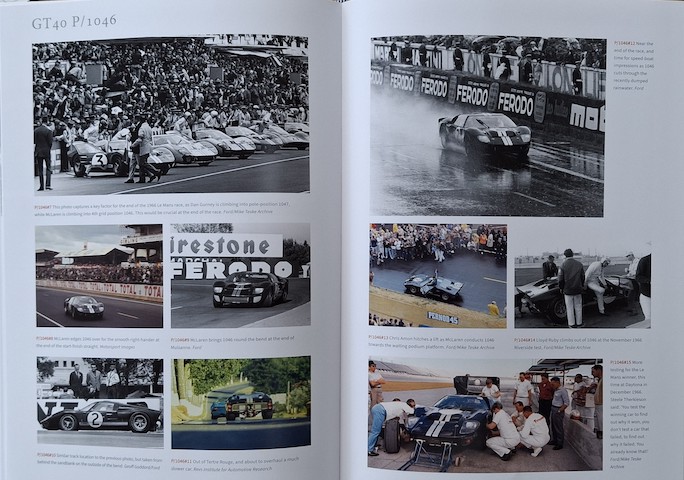
For a start, the 1986 book ran to 134 “chassis” pages whereas Vol. 1 which is comprised of the chassis record section, has 576 and over 1300 images, clocking in at a hefty 10 lb. A chassis-by-chassis history is indeed what you get. At the start is a half-page Foreword by GT40 owner Henri Bercher, followed by a two-page Introduction by the author, and finally a three-page Owners list. The remaining 564 pages are chassis histories, starting at GT/101 and finishing with J12.These cover:
- Prototypes
- Roadsters
- Production GT40s (Mark I) and Mark IIs
- Mark IIIs
- Original unnumbered “spare” chassis
- Alan Mann cars
- Mirages
- J-cars and Mark IVs
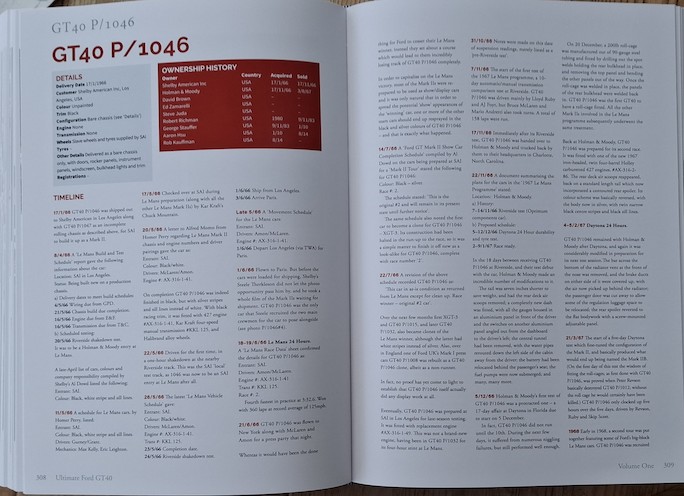
For each chassis the section is broken down into details / timeline / ownership history / competition history. Details contain basic information regarding delivery, customer, and initial configuration. This is basically similar to the 1986 publication but now vastly more detailed. Obviously, the same chassis are covered. Engine specs / numbers are included when supplied with the original chassis. Ownership history is of course interesting to know but the reality is that it can be out of date on publication day already—a fate no printed book can escape.
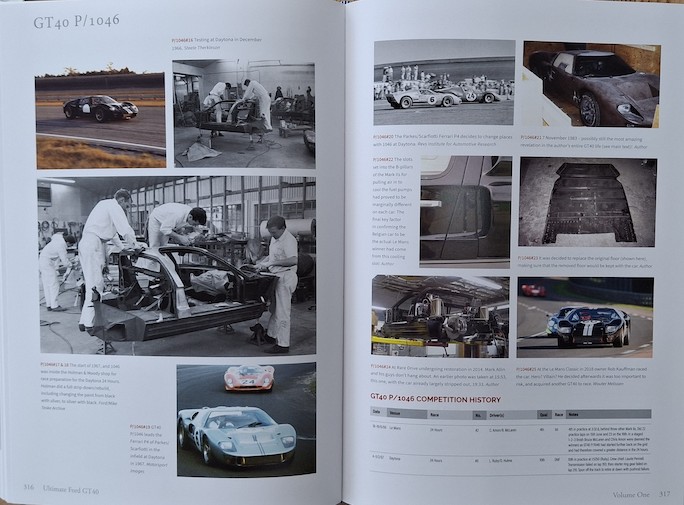
Where the book really becomes interesting is the timeline. A lot of new and/or additional information has come to light since 1986 which had mainly one photo per chassis, albeit often more in the development / racing sections, as well as a handful of color photographs. The new book has many more photos, many of which in color. You get the data on the history of the chassis life from delivery to the latest owner. You also get informative and often humorous comments from Spain himself when his GT40 research and expertise as the world’s leading GT40 authority was invoked and he had to burst proud owners’ bubbles with unpleasant but unassailable facts about provenance and authenticity. Unsurprisingly, Spain has been threatened with litigation; to date he has identified around 70 bogus claims. In the early days it was common practice to both destroy crashed chassis or cobble new ones together from other cars’ parts; only meticulous record-keeping in period—which is the exception and not the rule—could guard against fraudulent future claims as to authenticity. J10 in particular keeps “reappearing” at auctions over the years but there is no evidence any element of it is original.
GT40s have been resurrected from close-to-death experiences. P/1060 was burnt to a shell and collapsed roof in a 1975 California brush fire but was totally restored by 1989.
Working slowly through the entries you will come across gems that make it all worthwhile. Dan Gurney, unusually tall at 6 ft 4″, is noted for the “Gurney Bubble,” the adjustment to the door / roof to accommodate his helmet. This palls into insignificance to the Colin Crabbe “bubble.” He too was big and tall and his car really should have been designated a GT43 (the “40” in GT40 represented the car’s height at the top of the windscreen). Crabbe also inadvertently modified the P/1021 bodywork on several other occasions, eventually leading to a chassis replacement.
The book does not list a lot of prices which is no great loss. There is the occasional auction price noted but many sales were private anyway. We do get an entertaining exchange of letters in 1965 between Abbey Panels (the constructor of the chassis) and Bruce McLaren Inc. who rightly complained they were overcharged for X110. Five years later Shelby cut up / destroyed the car to avoid customs liabilities.
The competition history list is detailed and comprehensive. As in the 1986 book it covers the period 18 April 1964 to the early 1970s. “Original” GT40s were raced successfully nationally and internationally after then but this seems an appropriate point to draw the line.
Since then GT40s have continued to race in Historic races up to the present time. At least one of the owners of an original car has had a replica built to go racing because originals are too valuable to put in harm’s way. New builds get FIA certification to show they are built entirely as an original was. Spain has no issue with this provided potential buyers and the racing spectators are aware. I have been going to the Goodwood Historic events for over 15 years and I can’t recall the commentators ever mentioning whether a GT40 was original or not. In 2013 there was actually a race solely for GT40s. Many on the grid were replicas but certainly P/1006 was there. The book includes several other instances of recent “original” races. The 2026 Members Meeting had a race with Jenson Button (original Lightweight E-Type CUT 8) having an incredible dice with Yelmur Buurman (Ferrari 250 LM possibly original but racing insurance would be eye-watering) and Nikolaus Ditting (Ford GT40—not in the book as an owner so likely a replica). I shall remember this for a long time.
A subtle correction to the 1986 edition: then-P/1075 “became the first car in the history of the event to win Le Mans twice.” Now it reads “a lasting place in motor racing history by winning Le Mans two years in a row.” The honor of being first belongs to Ferrari chassis 0816 which won in 1963 bodied as a 250P and in 1964 as a 275P—and publisher Porter Press has the book about that!
If I have a personal lament it is that there is no overall index printed in each volume, for which the publisher does offer a reasonable explanation. And they also offer a workaround: they will email a PDF of each volume’s index to those who know to request it at office@porterpress.co.uk. (Considering the 10 lb weight of the printed book this is actually a user-friendly solution.) There is an Owner’s Index, but this is not particularly helpful in identifying a chassis at a particular event. Where the owner was driving the car, yes, but in myriad instances, for example Alan Mann Racing and Shelby American, the drivers were not the owners. The 1986 book has a chronological race record from 18 April 1964 to 1 November 1970 so that alone would be a reason to keep it handy. The publisher will include a full multi-volume Index with Vol. 4 but that’s not due until 2027, and obviously the index cannot be created before then.
Ronnie Spain is a cheerfully self-confessed GT40 “obsessive” whose interest was kindled in a car showroom in Birmingham in 1970—not perhaps an obvious location for a GT40 sighting. Things snowballed after that. He is without doubt the foremost GT40 historian anywhere and this book could not have been written by anyone else.
Should you invest in this book (numbered limited edition of 750 [1])? Other than the existing cars changing owners, or one of the mythical missing chassis being discovered, nothing will change. This exercise will not be repeated. My advice is that if you can afford it, buy it. If you can’t afford it but love GT40s, prevail on family and friends to get you a joint birthday / Christmas present. And make sure you have strong bookshelves.
Vol. 2 covers 1963 up to Le Mans 1965. A very cursory flick through the pages suggests you may need to continue the joint birthday / Christmas present tactic. Anyone aiming to collect the four-volume set will need to earmark around £1,300. If you want to step up to the Collector’s Edition (100 copies, hand-bound to order) you’ll need to part with £3,196. And for the Owner’s Edition set of 145 copies, expect to pay £4,796 although for this you do get Jackie Oliver’s signature and a special binding / slipcase.
Porter Press publications sell to a wide range of customers with budgets ranging from £20 to £5000. The quality of their books is on par with the very best publishers. They are a pleasure to look at, not just read. I kicked off some years ago with the “Autobiography” series in which the photographic reproduction and narratives are outstanding.
I confess to being a GT40 enthusiast, owning a third of the available English-language books. I also confess to being a proud owner of a GT40. In my instance this is an Exoto 1/18 scale Mk IV which will suffice until I win the lottery as original GT40s typically sell for $4m—$13m. Although I could have snapped up a replica at the Goodwood Members Meeting for a mere £99,999.
Note to US buyers: Porter Press does not presently have a US distributor. This is subject to change but until then the usual caveats re. tariffs, customs, De minimis thresholds, carrier surcharges etc. apply.
- You may find an early book that has “1000” printed in it; ignore that.
Copyright 2026, Paul Lea (speedreaders.info)














































 Phone / Mail / Email
 RSS Feed
 Facebook
 Twitter