
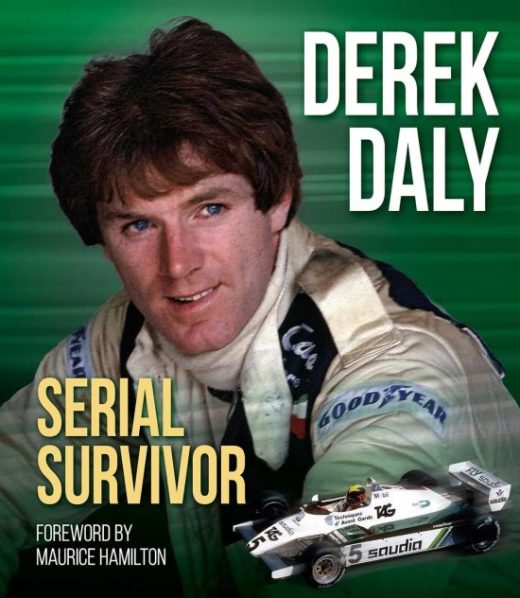
Derek Daly: Serial Survivor
by Derek Daly
“My spectacular accident unfortunately wiped out the entire Tyrrell team. When I jumped from the car, [team-mate Jean Pierre] Jarier had already grabbed [Bruno] Giacomelli and was blurting what I assume were French swear words. … On reflection, I think the accident was probably the beginning of my fall from grace with ‘Uncle’ Ken [Tyrrell].”
—[1980 Monaco Grand Prix]
I bet you watched the Indy 500 this year, right? You’ll remember how Conor Daly was one of the (yes) fourteen different leaders in a race that culminated in Indy’s equivalent to a soccer World Cup penalty shoot-out. How could the feisty kid from the Dublin suburb ever have imagined that his racing driver fantasies would come true, and that one day his son would lead the Brickyard field and that he’d end up alternating homes between Arizona and Indiana?
Derek Patrick Daly (b. 1953) was one of the cohort of race drivers from what political commentators now often call “the island of Ireland.” Names, religion, and much else besides are still hot button issues in Northern Ireland and the Irish Republic so I’ll stick to a simple “Ireland.” It’s a country that produced a lot of racers in the ‘60s and ‘70s, and from both sides of the border. Among them David Kennedy, the late Eddie Jordan, “Shoulda woulda coulda” Tommy Byrne, Martin Donnelly, John Watson, and “You lookin’ at me?” Eddie Irvine.
And now Derek Daly has written the story of his life, on and off the track. It takes 368 pages and even more photographs—this book doesn’t skimp on detail. Not many race drivers are very good at doing joined-up writing but yer man Daly is the exception. No ghost writer for the guy from Kilmacud, just a Foreword by countryman and racing polymath Maurice Hamilton, and you’re into a comprehensive account of a life etched by triumph and tragedy. The first of the 28 chapters establishes the wry mood music, endearingly entitled “Audacious Dreams and Dead Chickens.” We read of the likable kid who struggled at school but fell in love with motorsport when his Da took him to the Dunboyne street race in 1965.
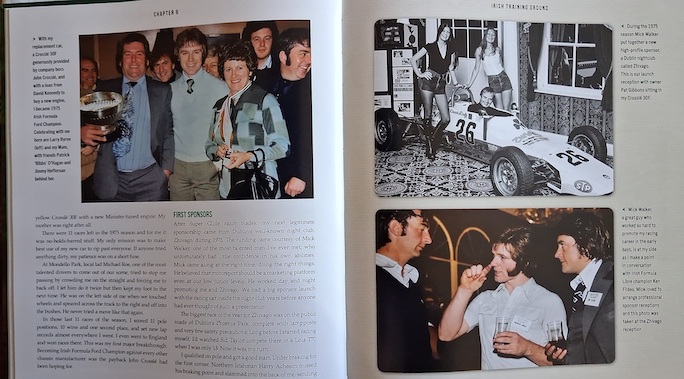
Early days in Formula Ford.
Tragically, but not untypically for the era, two drivers were killed in that race but, like every 12-year-old kid, Derek knew he was immortal. He writes “The sights, sounds and smells of the racing cars … have stayed with me ever since … it was also the day I decided I was going to be a professional racing driver.” And so he was, describing a common career arc for Baby Boomer racers—he started with cheap and cheerful stock cars*, then progressed to what was then the most popular and important single seater series in the world, Formula Ford 1600. Success in that series, which in Derek’s case included winning the Formula Ford Festival at Brands Hatch in 1976, almost guaranteed promotion to more senior formulae.
In ’77 Daly raced almost exclusively in Formula 3, and the following year he raced in both Formula 2 and made it to Formula 1—cum laude. As became common practice (think Nelson Piquet, Teo Fabi, Mark Blundell, Stefan Johansson, inter alios), after his F1 career fizzled out, Derek then raced Indy cars, followed by sports car side hustles before a media career post-retirement. Unlike some of his peers (notably including a guy called Nigel), Derek speaks not only with charm and authority but writes with assurance and lucidity. Such as his description of working at Larry Byrne’s garage in order to fund his weekend’s racing in his purple Ford Anglia: “Larry’s place became the enjoyable epicentre of my life. … It was the dirty-clothes, dirty-hands, foul-language, long-hours place where I schemed away to somehow become a professional racing car driver.”
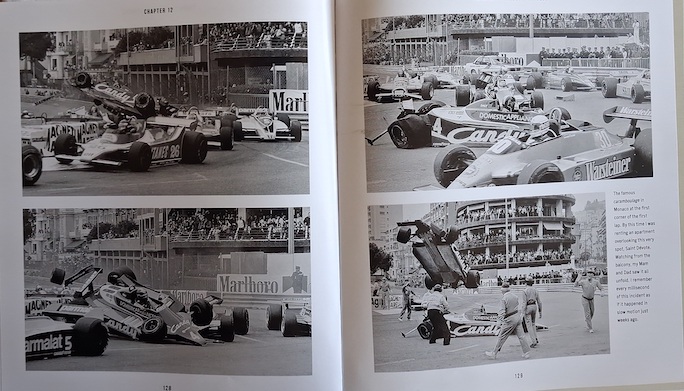
Flying high with Tyrell in Monaco 1980.
Stylistically, it’s noteworthy how Derek Daly’s post-driving life as a commentator and (especially) as a motivational speaker has affected his writing. There’s a hint of ex post facto psychological commentary to key events in his career—it’s thin ice, but it’s navigated carefully enough to avoid sounding 21st Century woo-woo. Most drivers can’t do this, only a man as smart as a Damon Hill, or a Derek Daly, can, for example, acknowledge weakness as well as strength. It would be unfair to say Derek was a nearly man, but when he was just a coming man, even greater successes were foreseeable. Never more so than when I saw him at a soaking Silverstone in March 1978. Driving his outdated Hesketh 308E, Daly briefly led the Daily Express International Trophy. He did so after having overtaken James Hunt and led race winner and future nemesis Keke Rosberg in his shed of a Theodore.
Daly was a grafter, even working in the furnace heat of Australian iron ore mines, alongside pal David Kennedy, to pay for his racing. No silver spoons or trust fund largesse in this family, but Daly made it to the summit and stayed there longer than I remembered. He drove, not once but twice, for Theodore, and also for Hesketh, Ensign, Tyrrell, and Williams in his six-year F1 career.
One of the two focal points of the book is the account of Daly’s unhappy time as a Williams driver. His chief sin was the same it had been for most other Williams drivers—he wasn’t called Alan Jones. And he presents a convincing argument that he paid the price by the team having given Keke Rosberg preferential treatment: “… facts don’t tell lies. It appears my career was being sabotaged.” But this news won’t break the internet, because similar refrains have been heard from almost every F1 driver whose teammate enjoyed more success. Ask anyone who had Schumacher, Senna, or Verstappen in the next garage …
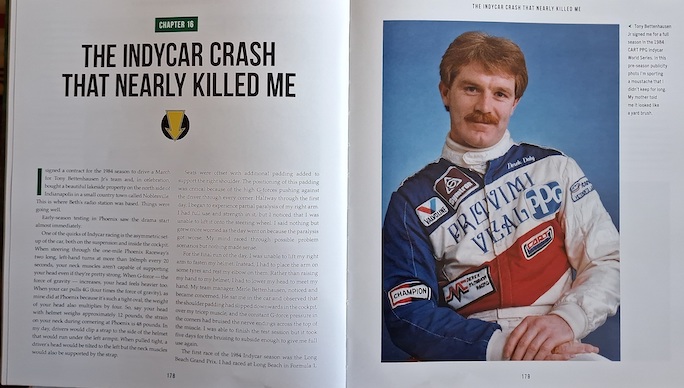
The chapter heading says it all.
The other focus is on Daly’s long US career in CART. Success? As with F1, there were no wins, but there certainly wasn’t disgrace either. CART rarely hit the headlines in Europe, but Daly’s appalling smash at Michigan in 1984 was enough for even the more Eurocentric magazines to feature the 217 mph impact. The pictures are horrific and the story of his treatment and agonizing recovery aren’t for the squeamish either. Another crash, at Michigan again, four years later and this time at 225 mph, left Daly unscathed but the reader can understand why a switch to TWR Jaguars, despite the perils of the Mulsanne at—Jeez—245 mph, might have seemed a safer option.
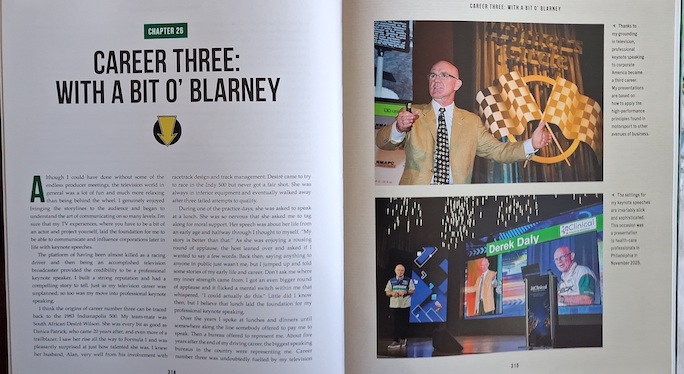
Daly the keynote speaker.
And what of Derek Daly outside the cockpit? We aren’t spared the detail, from broken relationships and (partner) infidelity to business success and even that ghastly modern phenomenon, cancel culture. Long story short, after becoming a respected media guy Derek was wrongly accused of making a racist comment about another driver. He hadn’t but he was hung out to dry by his employer. Turned out he’d once uttered—decades before—a racist expression then in wide usage. It was certainly disingenuous, and crass in hindsight, but it was (another) example of 21st Century standards being applied to the distant past. He survived, just as he’d survived all the other bad stuff he’d endured in his long, eventful but ultimately successful career. Some guy, some life, and it was a privilege to read a life story told with such searing honesty.
Racing driver autobiographies are often anodyne, and it’s a testament to the author that this book is riveting! Terrific pictures too, plus a decent Index and a full list of races contested.
Trust me, you’re going to need a damned good excuse not to buy this book.
- Stock cars in Seventies Ireland were nothing like NASCAR but near-standard old road cars, usually with short life expectancies.
Copyright John Aston, 2026 (speedreaders.info)






 Phone / Mail / Email
 RSS Feed
 Facebook
 Twitter