
Benjamin Holt & Caterpillar: Tracks & Combines
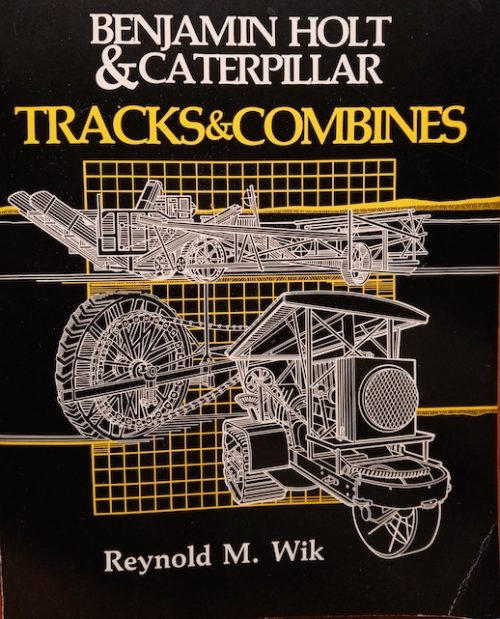
by Reynold M. Wik
“Holt’s outstanding contribution to world history—the development of the first successful track-type farm tractor, which later served as a prototype for the military tank, the bulldozer, and other track-laying machinery.”
Every boxed paper tissue isn’t a Kleenex as other makers have their own brand name tissues such as Procter & Gamble’s Puffs. Likewise all cotton swabs aren’t Q-tips but … and so it is with track-laying machines—all are not truly Caterpillars.
That name correctly only applies to those invented and manufactured by Holt and today by the Caterpillar Tractor Company in Peoria, Illinois. That said, the average citizen—especially the more youthful ones—will look at a machine using tracks to make forward (or backward) progress and say “Hey, look at that caterpillar!”
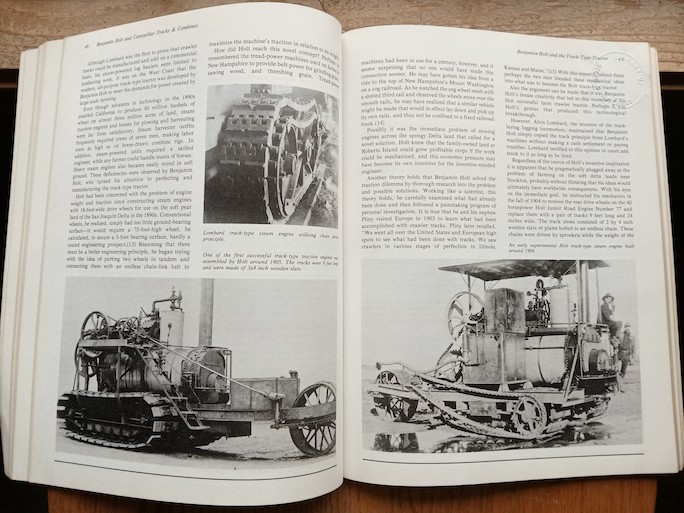
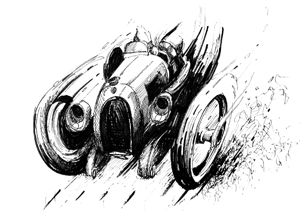
Early track-type traction being developed by Holt circa 1905.
It had initially been my intention to review a hardcover book published two years earlier than this one titled Benjamin Holt, The Story of the Caterpillar Tractor until, more than halfway through that hardbound’s 112 pages, there’d been virtually nothing about either the man or his inventions. Instead the book is a self-described monograph by five authors that is about city, urban, and suburban planning and growth of the town of Stockton, California. That is the area and town where Holt settled and began his business but, as the country grew, in order to sell to farmers from the Atlantic to the Pacific, as 1909 drew to a close he established an Eastern plant in Peoria, Illinois.
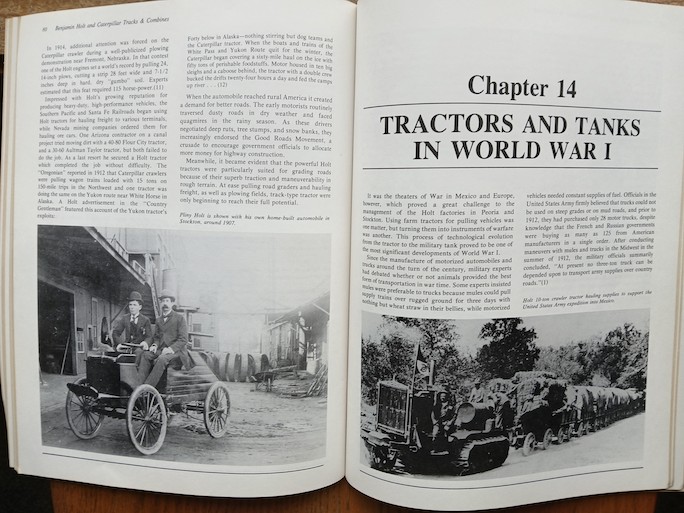
Left shows Pliny Holt behind the wheel of the Holt automobile he created. Right a Caterpillar demonstrates its hauling capability to the US Army.
The hardcover book (ISBN 978 093115 61 51) is interesting and does, eventually, contain some bits of information about Holt—both the family with that surname and the equipment their company built and sold—so is worthy of mention here but is not the focus of this commentary for that book turned out to be more about Stockton and its history than about the company founded there.
Holt enterprises consisted of seven independent companies. At the behest of legal counsel they were merged into one giant corporation on the very last day of 1912 and thereafter The Holt Manufacturing Company enjoyed a period of rapid growth. Growth included the “technological evolution from tractor to military tank proved to be one of the most significant developments of World War I.”
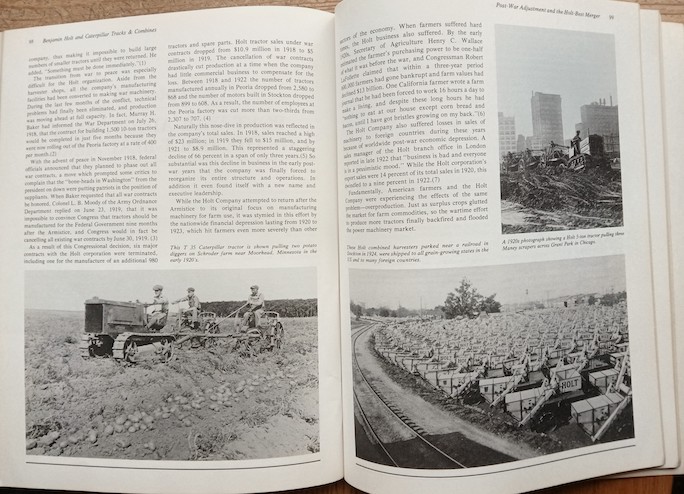
Post WW I with smaller tracklayers needed by farmers, Holt turned its attention to making the T 35 (left) and combined harvesters (bottom right). The 5-ton Holt in upper right is working on Chicago’s Grant Park.
In 1925 Holt Manufacturing Company “merged” with longtime competitor Best Tractor Company to form Caterpillar Tractor Company, maker of Caterpillar® equipment. It wasn’t a “bona fide merger, but a consolidation of the two machinery companies in which the buyers of the new stock would be restricted to those who already owned stock in one or the other. … Neither the Holts nor the Bests had sold out.”
The Caterpillar moniker had come about quite by happenstance while a photographer was observing Benjamin Holt demonstrate his new machine. He noted “the moving tracks created an optical illusion giving the impression that the top of the track was moving forward while track resting on the ground was standing still … exclaiming ‘It crawls just like a caterpillar.’ Benjamin Holt, struck by this apt expression, replied, ‘Caterpillar it is. That’s the name for it.’ The name ‘Caterpillar’ as a trademark was registered … in 1910 and has remained the sole property of the corporation.”
“Two years after the Holt Caterpillar crawler tractors were put on the market, the Holt Company had sold more of them than all their wheel steam tractor engines produced in the previous 15 years.”
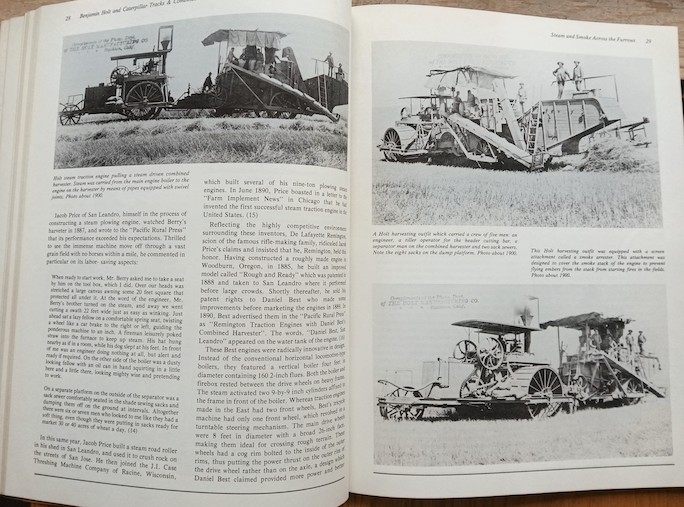
Although Holt will be best remembered for its track-laying Caterpillars, before track-layers the company made farm implements such as the combined harvesters seen here with Holt steam traction engines pulling that implement which harvested and threshed; hence “combines.”
Prior to earning that Caterpillar moniker, track-laying tractors had been described as paddle wheels, mud turtle wheels, platform wheels, railroad wheels among others. “The ramifications of this technological breakthrough proved to be immense, probably more than Holt himself could have dreamed … of its worldwide consequences.”
Registering its name globally resulted in some interesting translations of the name. In Dutch it was Rups. Norwegian was Larve. Larv in Swedish and Toukka in Finnish. In Spanish it is Oruga, and Lirfa in Icelandic. But all those languages only point up the global usefulness and marketability of tractors and other equipment made by Caterpillar.
Today, over a century later (and 40+ years since this book telling of its beginnings was published), Caterpillar is a global company making and marketing hundreds of machines and ancillary equipment as well as parts to keep them operating. It’s website indicates whether “you need loaders, dozers, excavators, scrapers or trucks, your Cat dealer can put the right industry system together from the largest selection of equipment on earth.”
Copyright 2026 Helen V Hutchings (speedreaders.info)











































 Phone / Mail / Email
 RSS Feed
 Facebook
 Twitter