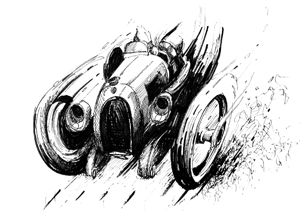

The Last Train to Basel: Schlumpf, Bugatti and the French President
 by Stuart Ager
“What was the Schlumpf Affair really about? Without a satisfactory answer, I resolved to find out for myself. Little did I expect a tug-of-war over a collection of vintage cars to involve the President of France, let alone tyre company Michelin, Joan of Arc, Marie Antoinette, the Nazi Occupation of France, Concorde, General Franco, French Indochina, Renault’s ambitions to win the Le Mans 24 Hour race, illegal political party funding, the Lip watch company, Opus Dei, The General Agreement on Tariffs & Trade, Cold War politics, and the unsolved murders of French politicians … but it did.”
At the time it all seemed so straightforward. In 1976 the textile businesses run by the Schlumpf brothers Hans and Fritz in the Alsace region of France were declared bankrupt. The brothers fled by train over the nearby border into Basel, Switzerland, never to return. When their workers occupied the textile factories, they were enraged to uncover the Schlumpfs’ private collection of 584 vintage cars, including over 100 Bugattis. Why would the cowardly/greedy/foreign (the brothers were born in Alsace when it was German territory) former industrialists not return to France to face unprejudicial justice?
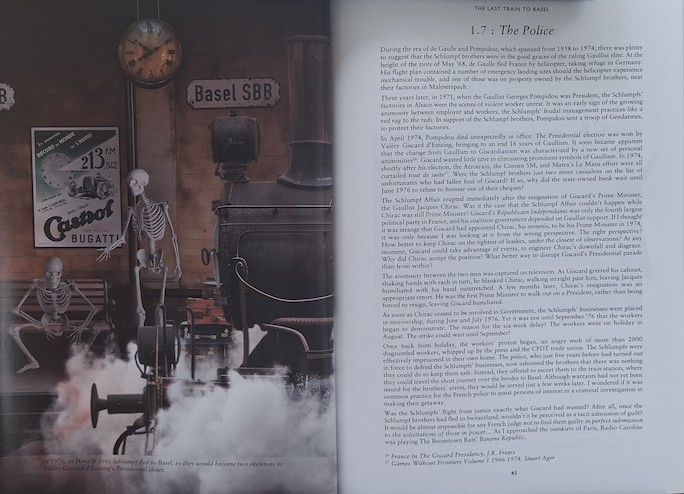
The Schlumpf brothers flee to Basel where they will be (figurative) skeletons in a French President’s closet.
The author frames the story around a six-day road trip from England to Basel in 2025. The travel dialog reads like a hardboiled gumshoe plot (Mickey Spillane and Mike Hammer/Sam Spade and the Maltese Falcon, take your pick) and a murder mystery. But Ager doesn’t uncover a smoking gun, he uncovers a smoking arsenal.
The Schlumpfs were undoubtedly aware of the fate of Ettore Bugatti. Up until the Second World War his cars in French racing blue, built in Molsheim (Alsace), reflected well on France. After the war things changed. Bugatti, who was an Italian-born citizen tried to reacquire his workshops. The Communist unions were after his blood and the French Communist party was part of the French coalition government. His request was refused. Later as Bugatti was dying the French court reversed its decision—too late for Ettore. By a strange “coincidence” the Communists were no longer part of the Government, a removal conditional of France receiving postwar aid under the Marshall Plan. Ditto the Schlumpfs would likely have known about the “bankruptcy” of Citroën in 1934—legally and financially it wasn’t bankrupt.
Ager’s narrative revolves around a web of six French elements: Politics, Business, Finance, the Judiciary, the Police, and the Press. And the spider at the center of the web is Ager’s favorite bête noir President Valerie Giscard d’Estaing (also see earlier Ager book reviews). Giscard was educated at the Ecole Nationale d’Administration (ENA). ENA graduates (Enarques) were groomed to lead, direct and co-ordinate politics, and private and public business. A typical Enarque was blind to the possibility that an idea of value might emerge from a lower rank.
As Ager makes his way towards Mulhouse where the Schlumpf collection is held, he also travels around the world and backwards and forwards in time tracking down the very many persons and organizations linked to the downfall of the Schlumpf empire. Few if any emerge with credit and the few that do often died suddenly and mysteriously, sometimes with risible “suicide” verdicts.
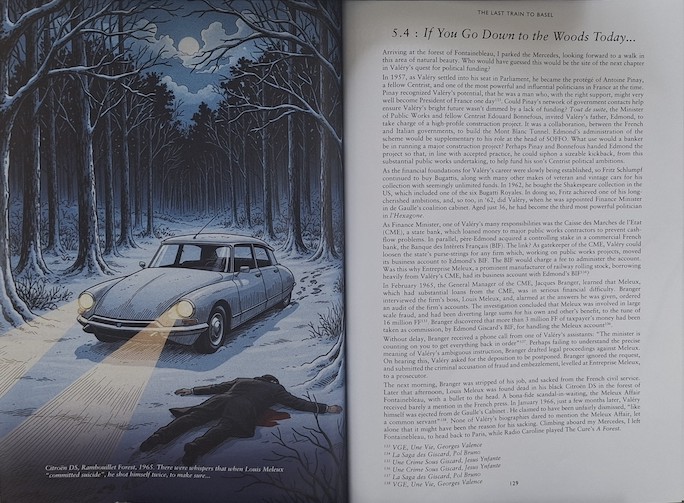
When yet another financial scandal emerged, the suicide victim “shot himself twice just to make sure.”
Eventually the Schlumpf collection was “purchased” (quotes intentional) by the French government to try and boost Giscard’s attempts to be re-elected in 1981. Spoiler alert—in one of the few good outcomes in this book—he failed. He was beaten by François Mitterrand, who in turn had a murky collaborationist/Petainist past and in 1959 faked his own assassination attempt.
Eventually Ager makes it to the Schlumpf Museum. Even then there is a sting in the tail, but I won’t spoil the ending.
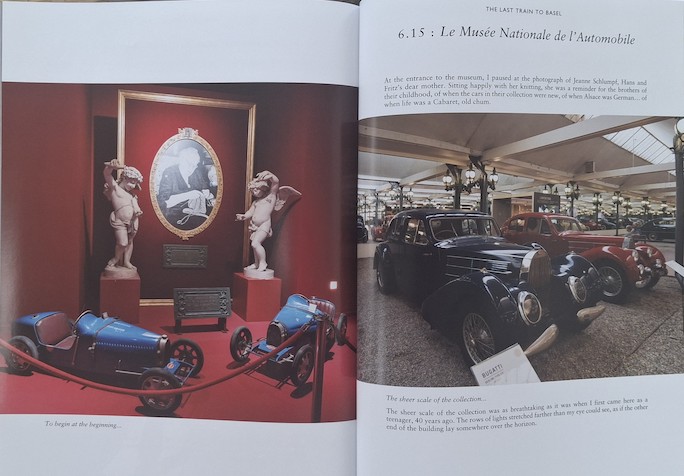
The end of the trail.
Unlike the Maltese Falcon, the Schlumpf collection is very real, as are the accompanying machinations that Ager unravels.
Perhaps a summary of the book contents can be encapsulated by a quotation from the 2009 autobiography of Fritz Schlumpf’s widow Arlette. She describes a 1976 meeting she attended with her husband and a lawyer also present. They met in Basel with senior French officials who had been briefed by a high-level state minister to broker a pre-trial deal. “Give us the cars and all this will go away.”
So does the author deliver the links what were promised in the preamble above? Oh yes, and a lot more. Heard of the Smurfs? They were small blue comic characters created by a Belgium artist and enjoyed widespread European popularity. Ager makes a Smurfs connection: Smurf in German is [der] Schlumpf! He also manages to include a Frank Herbert/Dune science fiction reference. You will also get to discover his musical tastes delivered from the Becker Mexico radio in his trusty white 1974 Mercedes-Benz 350SEL, identical to the car bought by Fritz Schlumpf in 1974.
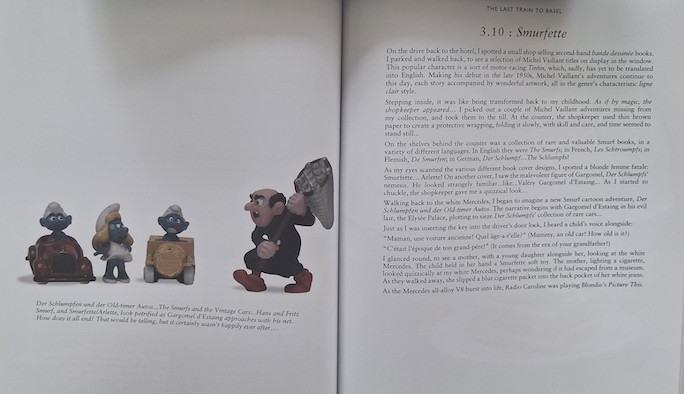
Hans and Fritz Smurf and Smurfette/Arlette look petrified as Gargomel d’Estaing approaches.
Having previously read a number of books on 20th Century French history (the books by Julian Jackson and Philip Short on French Presidents noted in the Bibliography are well worth following up) Ager’s conclusions do not come as a total surprise to me although the scope of the linkages do. He acknowledges that there are areas where conclusive evidence has yet to surface, for example the bankruptcy court’s Schlumpf files are still unavailable 40 years on, despite this being illegal under European Union law.
This book has similarities to Ager’s earlier publications. You will not mistake an Ager cover. This book has even more graphic design/artwork than previously, included to evoke the spirit of the accompanying text. There are not that many in-period photographs, although this is not a criticism. This book is more complex than those previously with the author going literally on a personal journey of discovery.
If your primary interest is in technical details—cylinder numbers, valve configurations, gearbox designs etc.—then this book may not be for you. On the other hand if you enjoy an educational, informative, entertaining and not least eye-opening read then this should be on your shopping list.
I had previously reviewed CTX 500, The Last Train to Cockfosters by David Brodie. This book, published by Andrew Brodie Engineering [despite their surnames, no familial connection], deals with a train to a different destination. The only things their books have in common are their brilliant idiosyncrasies.
Copyright 2026, Paul Lea (speedreaders.info)
















































 Phone / Mail / Email
 RSS Feed
 Facebook
 Twitter