
Mustang vs. Camaro, The Battle for Pony Car Supremacy
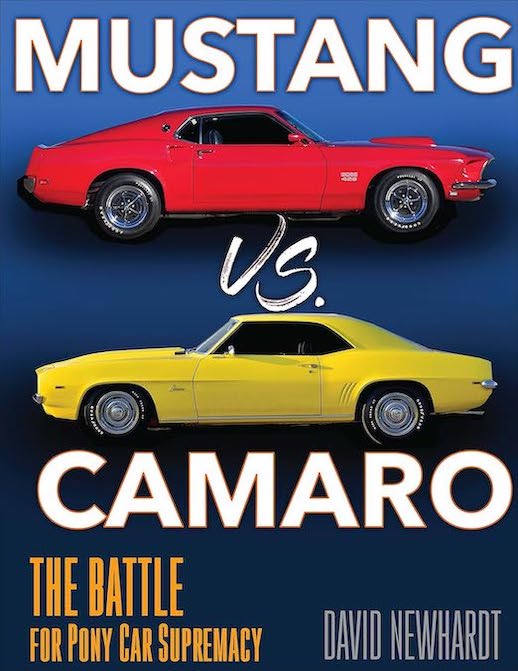 by David Newhardt
“The battle between the Mustang and Camaro has lasted for decades, and the pendulum has swung between the two marques several times. … Sure, the two manufacturers had fought for years before the Mustang and Camaro existed, but the emotions that the pony cars elicited made the rivalry more personal.”
As the quote above suggests, Chevy and Ford have been arch rivals for as long as any reading this can recall. David Newhardt, veteran author and skilled photographer, today serving as Mecum’s chief photographer, chose to narrow his focus on a segment his generation (b. 1955) has experienced first hand, the pony cars. Happily Newhardt extends his coverage beyond just describing the models as he also describes some of what went on behind the scene within the corporations. He also includes motorsports activities in which pony cars competed.
Mustang debuted in 1965 so enjoyed “playing in a field of one” for a couple of years until Camaro went on sale. For each of the sixty years, 1965 to 2025, there are two or three pages describing the ponies, both the halo models and the more bread and butter of each year beginning with a little box giving total production of each for that model year. Production numbers shouldn’t be confused with sales, although the text does sometimes infer such.
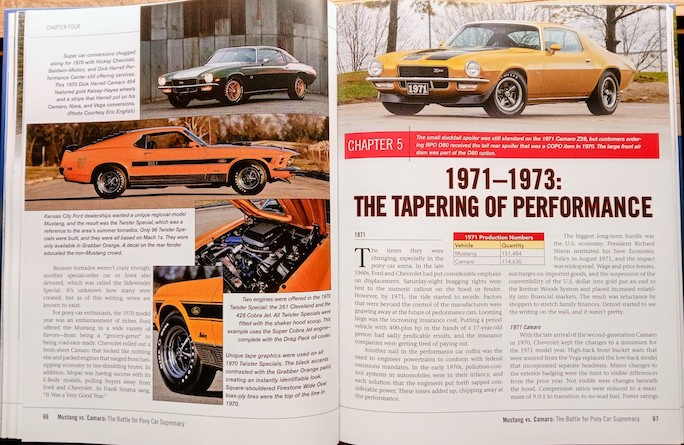
Emissions regulations would start to weigh in mid-1970s but until forced to comply both manufacturers ignored what would come and how each would begrudgingly comply. Until then, each supported the “wanna go fast” folk running in SCCA’s Trans-Am, the drags, and street performance. As Newhardt writes, “For pony car enthusiasts, the 1970 model year was an embarrassment of riches. Ford offered the Mustang in a wide variety of flavors …. Chevrolet rolled out a fresh-sheet Camaro that looked like nothing else and packed engines that ranged from fuel-sipping economy to tire-shredding brutes.”
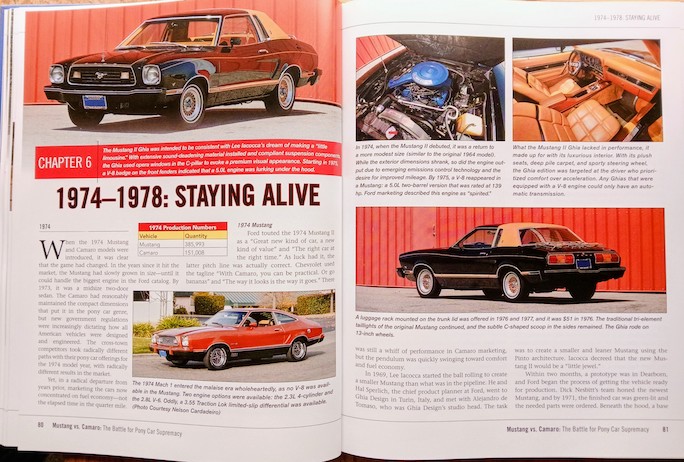 The middle ‘70s brought changes to which all automakers had to adapt and adhere; among them emissions requirements, the OPEC oil embargo, mandatory unleaded fuel. Sales of the two pony cars saw Mustang II dipping to the 180,000s with Camaro not far behind.
One of Camaro’s big boosts during the ‘80s decade was its selection as the car used by the International Race of Champions (IROC) thus cementing its performance credentials while Ford’s Mustang paced the ’79 Indy 500 and a few years on developed a law enforcement/Special Services package. The coverage those cars earned encouraged dealer showroom traffic although both companies had to be careful that the tweaks, changes or added features also made enough money to justify their costs.
“As the 1990s continued toward the end of the century, … the rivalry was as intense as it had been in the late 1960s.” Steve Saleen and Jack Rousch customizing Mustangs made the news. However, Camaro production was forced to take a hiatus at the beginning of September 2002 as it “wouldn’t pass federal head-impact standards.” Camaros wouldn’t return to dealer showrooms until 2010.
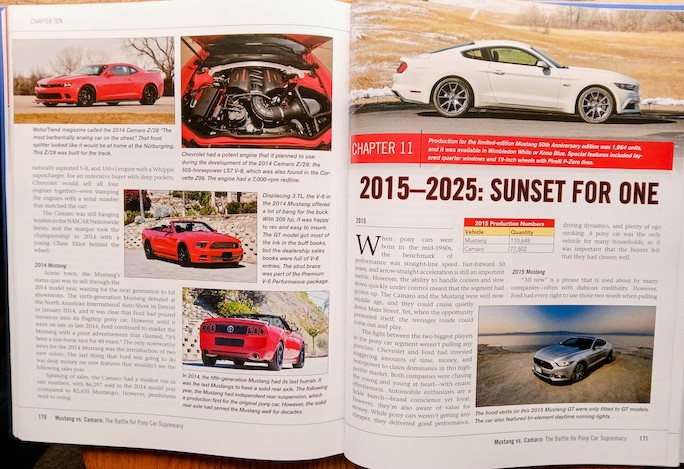
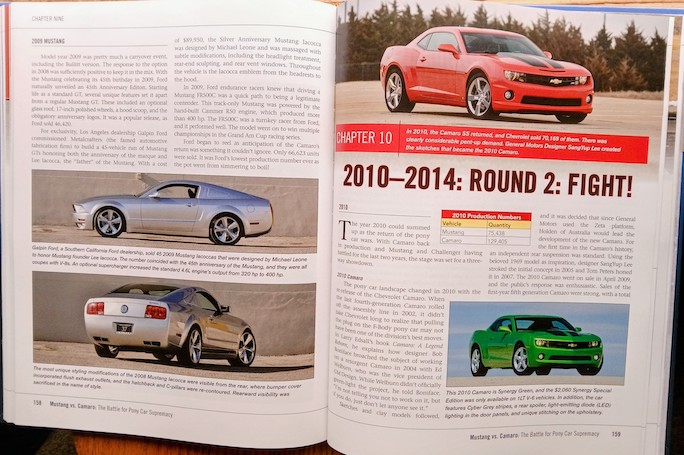 “Chevrolet and Ford had invested staggering amounts of time, money, and manpower to claim dominance in this high profile market. … While pony cars weren’t getting any cheaper, they delivered good performance, driving dynamics, and plenty of ego stroking” as those produced in this last decade would prove.
 Sixty years of Mustang vs. Camaro in 192 pages is a nice summation of the two manufacturers’ developing and marketing their pony cars. The future for each is a bit less certain. Ford’s CEO Jim Farley has said his company intends to continue producing a Mustang model with an internal-combustion engine. Camaro’s future is more tenuous although it does appear, according to Newhardt that “it looks like Chevrolet won’t let the Camaro name wither on the vine.”
Copyright 2026 Helen V Hutchings (speedreaders.info)









 Phone / Mail / Email
 RSS Feed
 Facebook
 Twitter