
Daredevil at the Wheel: The Climb and Crash of Joan LaCosta
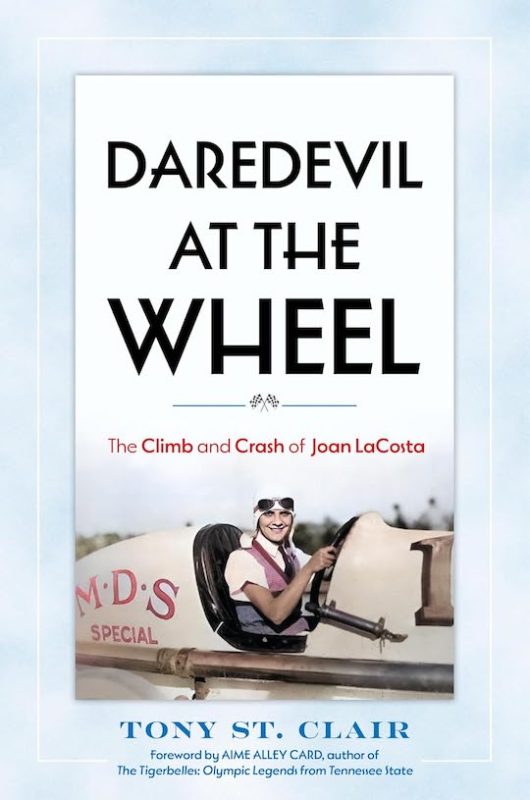 by Tony St. Clair
“Women are notoriously reckless drivers, and this pair were no exception. Miss Mais, driving a Mercedes, was outmaneuvered by the French girl who was at the wheel of a Fronty-Ford. They skidded their mile in a quick time of one minute and a fraction over eleven seconds. It was a nice exhibition of wheel-work and nerve.”
Hang on. A mile in 1:11? A trained runner can achieve that on foot. Better do some research.
Research is something this book has in spades—putting to shame some of the source material it draws on. That excerpt above is from a proper broadsheet of 1925, the Leader-Post. It still exists. That “French girl“ on the other hand does not, and never did. Elsewhere she’s called “the celebrated English record holder [Brooklands, no less] and European champion.” Didn’t exist either.
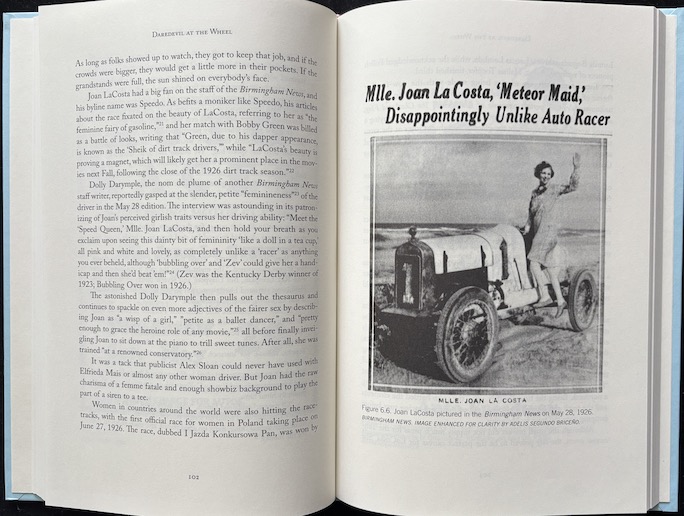
Look at this photo, and the one on the front cover and you can see why “Mademoiselle Meteor Maid” was described as having “personal magnetism.” Does she have “arms strong as boat ropes,” or steely eyes, an unnerving cocky devilish smile, and win-at-all-costs attitude?
Ever heard of Josephine Rust, Marion Carver, Joan LaCosta, Joan Maurer? Probably not. This is a trick question: they’re the same person. It won’t take many pages of reading before your head is spinning, both from the real and remarkable achievements during these early days of wild-west motorsports and also the bottomless gullibility of the media of the day and the guile of the promoter who knew how to hawk publicity stunts.
Our tomboy protagonist, born 1901, would make history as “the most famous female racing driver in the county.” She drove the family car at 12, married and got pregnant at 16, divorced at 19, at 20 married her ex husband’s auto mechanic, got divorced, and, oh, was put on trial for attempted robbery using chloroform and a toy pistol. Look up impulsive or reckless and you’ll see a photo of Joan LaCosta, “speed queen” of Kentucky not France.
We don’t say it often, so, drumroll: Very highly recommended. And let’s throw an exclamation point at it too. Very highly recommended!
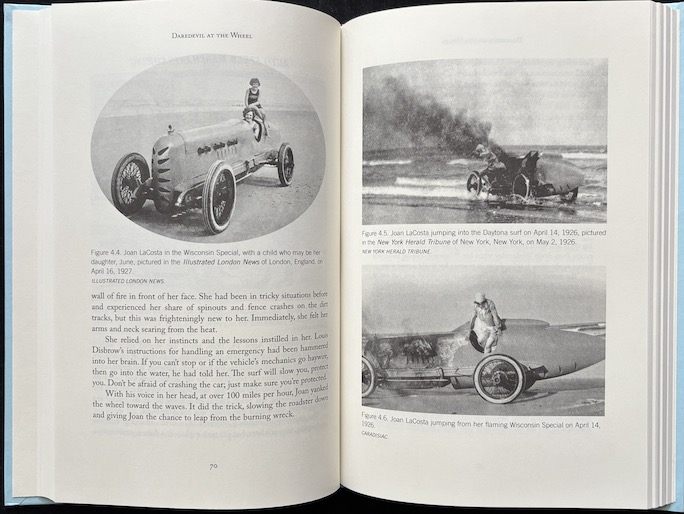
1926, Daytona Beach. LaCosta captured mid jump escaping her smoking Wisconsin Special, Sig Haugdahl’s 180 mph monster (also shown on the left) in which he had set a speed record. LaCosta was the only women he trusted to drive his car.
If putting one photo above another implies a temporal sequence, why is she already clear of the cockpit in the top one but still in it in the other? As to the increase in the amount of smoke, it’s not inconceivable that it went from bad to worse quickly.
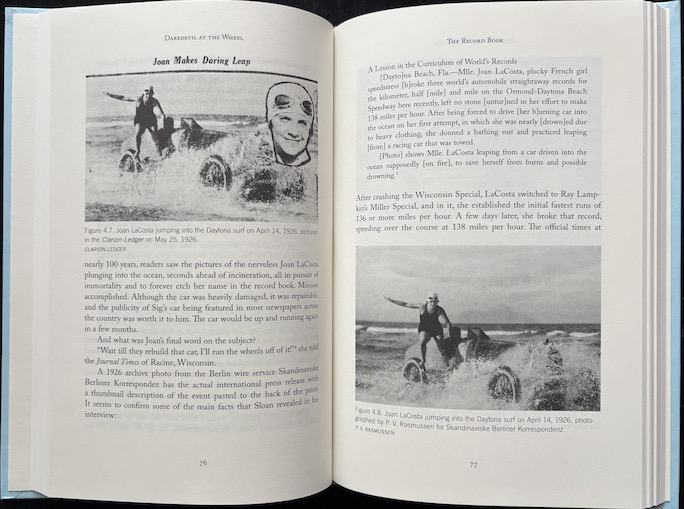
The same scene as above. Or so the newspapers would have you believe. Except here she’s wearing a bathing suit (!) and she’s jumping out of the other side of the stricken car that is now not smoking at all. And there are now waves crashing against it. Elementary, dear Watson: all these photos are staged. The accident really did happen but no one was around to photograph it in real time.
Let’s begin by saying that the author is a playwright, has a multitude of vintage car interests, runs/writes the popular racing blog Deadly Curves, and you may have noticed his byline in hot rod publications. Meaning, a skill set that suits both the dramatic arc and the nitty-gritty car specifics of a tale that seems too outlandish to be true, even without the whole robbery bit.
If you follow the academic side of motorsports you could see St. Clair’s treatment as warranting inclusion as a learned article in Automotive History Review or as a presentation at The Henry Ford Museum’s “Racing in America” exhibition, or a Center Conversation at the International Motor Racing Research Center. It is odd that no one has tackled this subject before.
I am nothing if not a skeptical reader but my positive initial reaction only got stronger. St. Clair provides the context within which the persona “Joan LaCosta” existed and as such is as much about the world of the promotor J. Alex Sloan during the 1920s and his stable of performers with their hyped up and often staged antics and rivalries (think today’s reality show, or WWE). The first time Sloan used LaCosta she was an unknown, a “footnote.” Within the year her very real talent, both as a driver and as a performer, put her on a trajectory to become a legend.
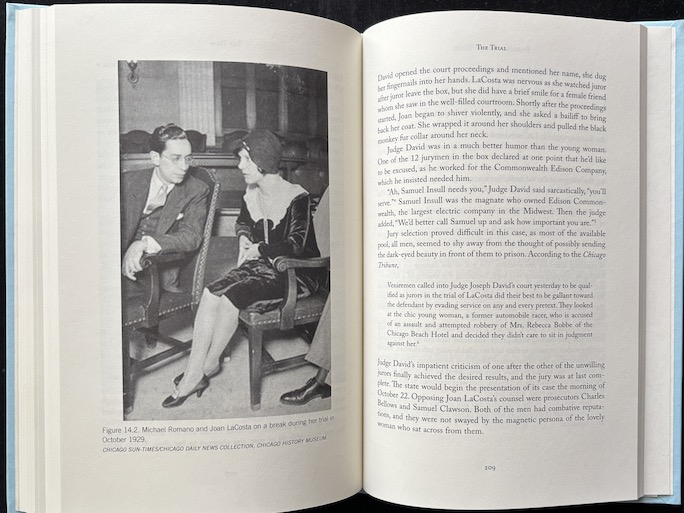
“Jury selection proved difficult in the [robbery] case, as most of the available pool, all men, seemed to shy away from the thought of possibly sending the dark-eyed beauty in front of them to prison.”
Then there is the story itself, of which most readers would have little knowledge, I would imagine. I myself had only some vague idea of LaCosta on the IMCA circuit, and no detail knowledge of her reception and treatment by the press in period. St. Clair has engaged in extensive research of primary sources such as newspapers and wire services, even international reports. They are excerpted at length and he provides end notes and a bibliography (there is a good index too). To his credit, St. Clair manages to fit the pieces of a complex puzzle together, and covering it in book-length is entirely warranted.
Copyright 2025, Don Capps (Speedreaders.info)
 RSS Feed - Comments





























 Phone / Mail / Email
 RSS Feed
 Facebook
 Twitter