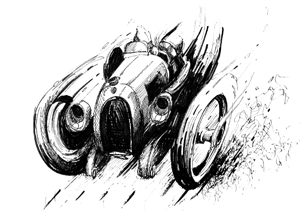

Alfa Romeo 8C 2300: The Autobiography of Zagato Spider 21110044
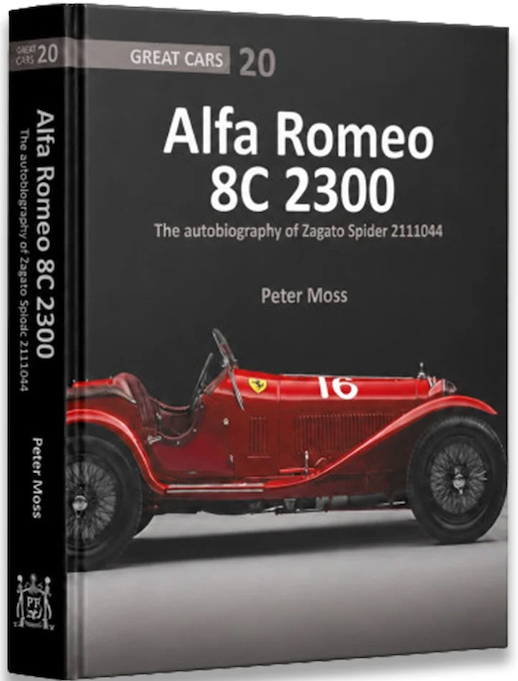 by Peter Moss
“2111044 was always recognised as an important car, one whose lengthy period in single ownership protected it from most of the changes that befall so many fine machines as they pass from one custodian to the next. But the previously unknown history of the car’s original identity elevates this 8C 2300 from a great car to one of the greatest.”
The Alfa Romeo 8C 2300 was the product of the genius designer Vittorio Jano. From its introduction in 1931 it was a race winner. It was available in two forms, a single seater for Grands Prix and a sports body for such events as the Mille Miglia and the Targa Florio.
In July 1932 chassis 2111044 was given a sports body, although evidence uncovered during a recent restoration suggests that the chassis was actually that of one of the 1931 Grand Prix cars. It won its first race driven by Tazio Nuvolari. In total during 1932, 2111044 competed in four events. After these it was sold and did not take part in races again.
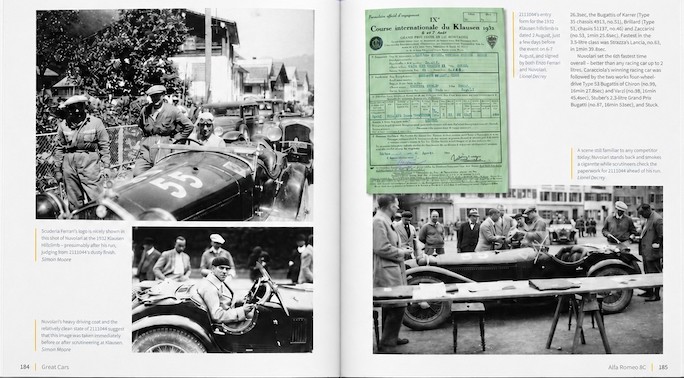
2111044 in competition.
In 1934 it arrived in England. No record survives of its whereabouts 1935–1937 but in early 1938 it was purchased as a 21st birthday present for Michael Crowley-Milling. He was a remarkable individual. During WW2, he worked on microwave radar, and after the war on a proton linear accelerator at the Atomic Energy Research Establishment at Harwell in Oxfordshire, England. His scientific career eventually took him to CERN in Switzerland where he worked on a 300 GeV super proton Synchrotron (probably not often referenced in motoring literature). He was subsequently made a Companion of the Most Distinguished Order of Saint Michael and Saint George (CMG), a title in the British honors system. Why the focus on that one owner? It is because he owned 2111044 for over 70 years and in between smashing atoms he administered a prolonged rebuild (22 years), mostly his own work.
And here lies a problem with this book. Apart from those four races mentioned, 2111044 had no other competition history. The author quite rightly explains how the 8C 2300 came to be developed and the overall competition history. Since that would yield only a limited story he bolsters it by expanding the scope of the book much wider. The first three pages, for instance, are devoted to early 20th century Italian politics which is of course generically interesting but of little relevance to the primary topic at hand. We also get an extended history of Alfa Romeo and numerous personalities, whether having a direct connection to the 8C 2300 or not. Thus, rather than being an “auto-biography” this work is more “life and times and a great deal more.” But there are already many books in existence on Alfa Romeo history, and too many of this book’s 320 pages would have to be classified as extraneous.
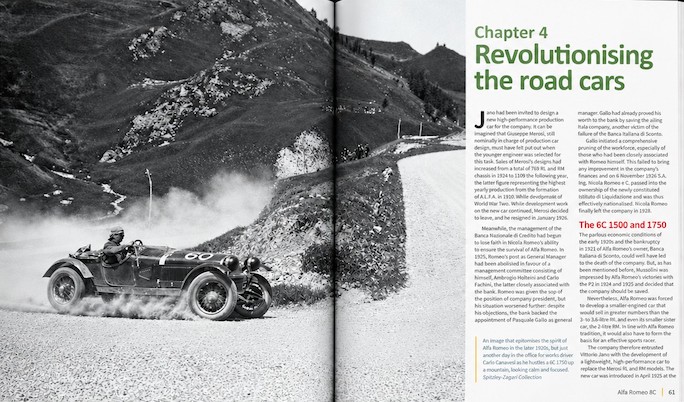
An ancestor of 2111044.
There is a considerable amount of technical information that may leave more casual readers struggling. The section on the development of the P2 engine includes a sidebar on secondary longitudinal rocking couples which left me somewhat perplexed (crankshaft vibration is an interesting and vexing technical problem but a mere sidebar doesn’t do it justice). There are over a dozen pages on the 8C 2300 opposition leading up to 1932—Bugatti, Maserati, Talbot. Coupled with information being repeated and a to-and-fro of the narrative, this is not an easily assimilated read.
We are nearly a third of the way through the book before the 8C 2300 appears, and over halfway before 2111044 makes its debut. Even at this point we get to hear about Maserati chassis numbers in a race, and Maserati chassis numbers not in that race. The last third of the book concerns the Crowley-Milling ownership, the rebuild he undertook, and the very recent restoration by its latest owner.
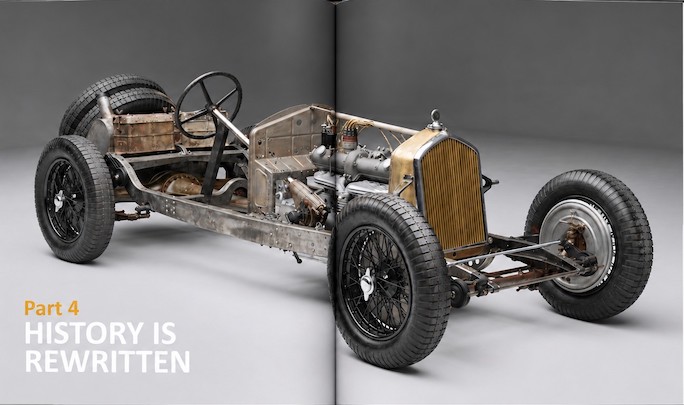
Restoration underway.
On the plus side the quality of the book is up to the usual high Porter Press standards. The pictures in particular are a joy to examine, even those with a rather tenuous link to the subject in hand. They range from incredibly detailed period images through delightful informal snapshots such as Alfa Romeo works drivers Giuseppe Campari and Tazio Nuvolari relaxing on the beach—originally captioned the whale and the minnow—to detailed pictures of the rebuild/restoration. The author has also used forensic detective skills to discover the true origin of the 2111044 chassis.
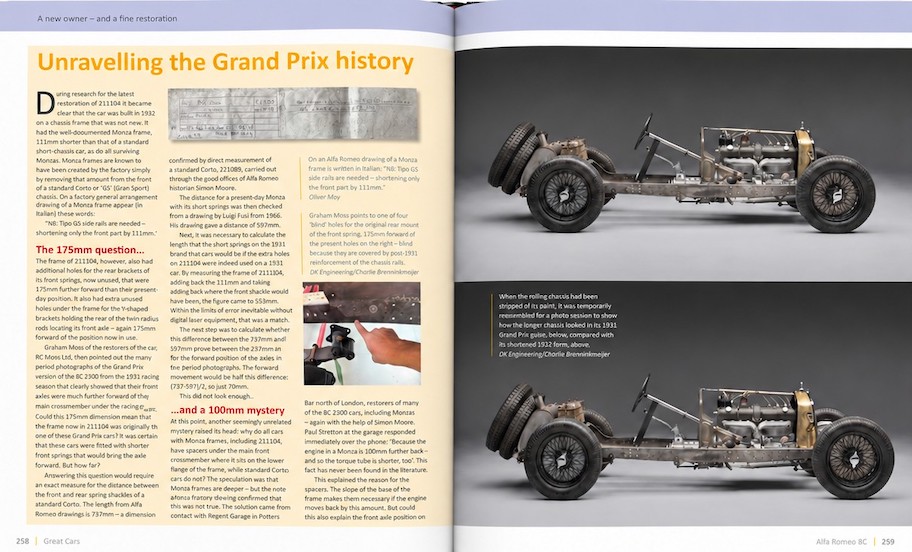
Unravelling the Grand Prix history.
This book is the twentieth in the Porter Press “Great Cars” series With recent editions having focused on relatively recent vehicles, this is a return to a car from a much earlier era. Of all the books in the series, 2111044 has by far the shortest competition history, which probably accounts for the detailed pre-history and numerous detours. It is also by far the most technically detailed of the series.
There is an index and bibliography.
Peter Moss is a chemical engineer and former industrial consultant with a passion for motoring history. He has written for motoring publications and spoken at automotive history conferences. In 2021, he co-authored, with Richard Roberts, Making a Marque: Rolls-Royce Motor Car Promotion 1904–1940.
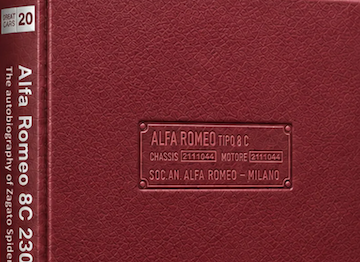 The book is also available as a made-to-order Limited Edition of 1000 copies in red leather with a debossed period-style chassis plate in a grey slipcase, $568/£425 (ISBN 978-916578-02-9).
Copyright 2026, Paul Lea (speedreaders.info)













 Phone / Mail / Email
 RSS Feed
 Facebook
 Twitter