
Joseph Figoni: Le Grand Couturier de la Carrosserie Automobile
 Catalogue Raisonné—Vols II, III, IV: Bugatti
by Peter M. Larsen and Ben Erickson
“And as the research progressed on the Figoni Bugattis, it soon became clear that for every time something was found, a discovery was made, large or small, much more that was not there, was gone forever.
We are not making excuses. But as reader, it is important that you are aware that for every item or piece of knowledge that in fact is there, there is much that is not.”
Well, the authors and their advisers and collaborators have thrown over 1100 pages at that problem so if there were more to be found, it’s not for lack of looking.
Ah, the sheer Monumentality of it all: words, pictures, the smell of fresh paper in the morning, the unimaginable effort of having filled blank pages with serious work. Unimaginable because even when the authors can tell you that you’re looking at 297,076 words, that number is as unrelatable as the distance to the moon, 238,855 miles, even if you perfectly well know what one mile looks and feels like.
A reviewer’s greatest enemy is an inability to resist commenting on everything in a book so let’s take the following spread as a representation of the level of magnification throughout:
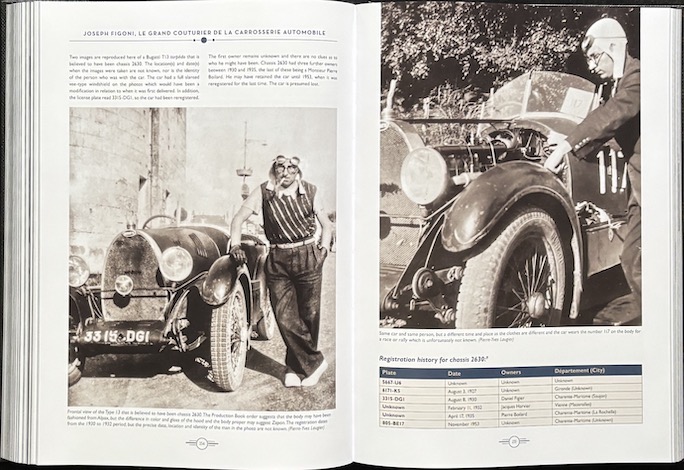
You’ll learn about coachbuilding literally A to Z. Based on Figoni’s own records this body may have been made from Alpax but Larsen thinks it’s more likely Zapon. Why? Because he factors in a “difference in color and gloss on the hood and the body proper.”
We have here the second installment in a series that will contain at least three more (Delage, Delahaye, Talbot) plus one final “sweeper” catch-all tome on lower-volume makes. Neither “Figoni” nor “Bugatti” should require explanation, certainly not on their own but you may wonder why these three Bugatti volumes occupy the second slot: the series progresses in descending order of volume of coachwork orders, meaning Bugatti was Figoni’s second-largest customer (after Alfa, the subject of the first book).

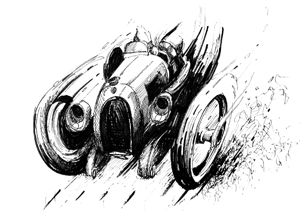
Color is a key factor in a coachwork designer’s thinking. Period photos are often only b/w so this aspect is lost to the modern viewer. These lovely color renderings are the first—and maybe last—time they’ll be in a book because their creator, Gerrit-Jan Caviët, died unexpectedly as this book was finishing production.
Books like this cater to bibliophiles as much as car folk (be they owners, auctioneers, restorers etc). Each of these groups has different expectations but one common denominator will be that those who started allocating shelf space back in 2021 may have taken the four-year pause since the first one came out as a sign that the project had been abandoned. Well, blow the cobwebs off that space you’ve been wanting to fill.
 If you did find yourself agitated over the delay, consider that such bespoke behemoths require multi-step production paths that have them crisscrossing the globe navigating lingering pandemic-era supply chain snags, newly implemented tariffs/taxes, and the occasional production glitch. And let’s not forget the two rewrites when new source material presented itself! And definitely let’s not forget that an entirely unforeseen 328-page book elbowed its way to the top of the line in 2024. . . . You surely own or should own or want to own that one too!
That the authors have not lost their sense of humor over all these tribulations is evidenced by the clever title for a closing chapter: this is a book about Figoni but have you ever heard of a Faux-Goni? You can guess that this will be about those chassis that heretofore had been thought to be by Figoni but in the authors’ assessment do not qualify.
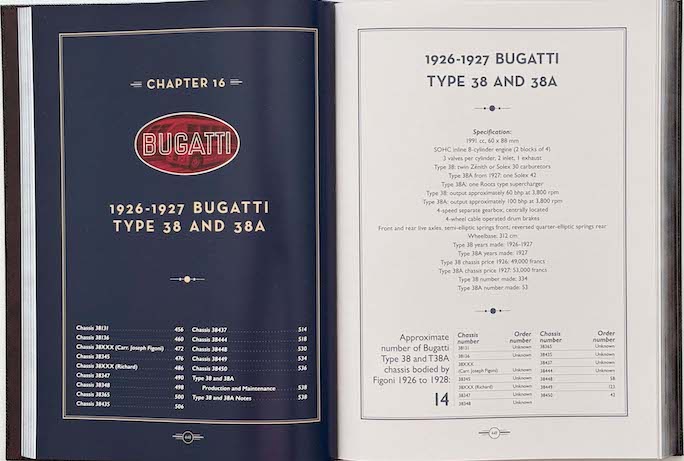
The book is divided by model/type and then chassis. Chassis descriptions and photos will vary in length depending on extant source material; in many cases they will include relevant pages from the Bugatti works ledger as well as Figoni records.
Now, realize that there are only 600 numbered copies of the book to go around and many were already pre-sold to subscribers (also the only way to request “your” special number). If sales of the Alfa-Romeo book are anything to go by, order your Bugatti set before you even finish reading this review. That it isn’t “cheap” is neither here nor there because there hasn’t been a Larsen book yet that failed the “value for money” test!
Design is subjective. No argument. And Larsen is absolutely the last person to do anything without a reason. But some reasons are better than others, non?
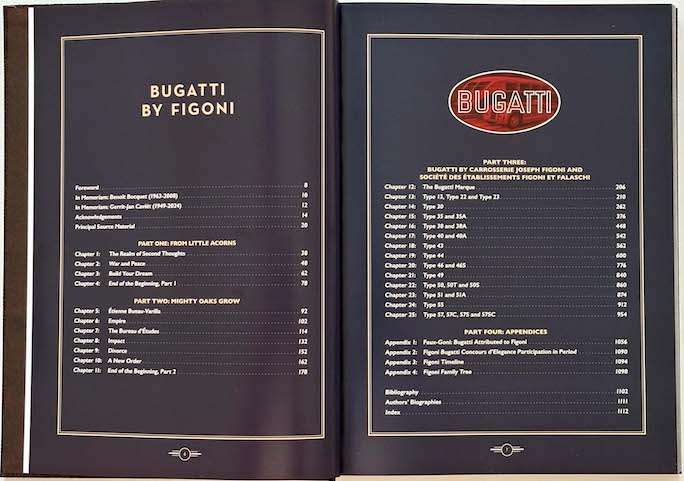
Consider the Table of Contents. It covers all three volumes and is reproduced in each. Great! It shows all 24 chapters (plus backmatter)—but how will you know which individual volume a chapter is in? You won’t. Vol. 2 ends with ch 14, 15–19 are in vol 3. Each book weighs many pounds; do you really want to have to pick them up repeatedly just to find what is where? Something as unobtrusive as a solid line between those chapters could have served as a demarkation point.

Alea iacta est—the die was cast with the first book in a set that from the beginning was planned to contain a dozen or more. One day, when you’ve spread them out all around you (or even just scan the spines on the book shelf), will you know that Vol. 1 was Alfa[-]Romeo and, say, 12 was Talbot? You will not. (The slipcase does list the marque, but that’s of no help once the books are out of it.) Since the lettering will presumably remain black it’ll be interesting to watch what color the next covers will be.
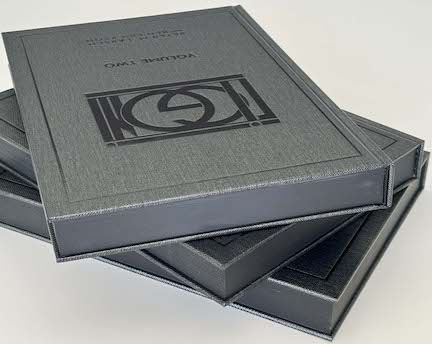
This is not the sort of book to rush through and “finish” but it is the sort of book that lends itself to piecemeal reading, say by model/type or even individual chassis. Being a Catalogue Raisonné implies a methodical, systematic treatment at the nano level. It’ll take some 200 pages before you get to the 113 chassis—and it wouldn’t be a Larsen/Erickson production if it didn’t have that signature epic, worlds within worlds context-laden sweep that examines everything and the kitchen sink (also SOP: there are chapter end notes, an Index, and extensive cross-references). From culture and society to politics and industry you’ll be learning many things about many things. Including, if only by observation, high-end bookmaking. Civilians have no idea how much effort goes into, say, the making of the slipcase or the books’ metal edges. Nor can they really fathom how an author really goes about doing research, which is why this book devotes several dozen pages to showing and explaining examples of actual company ledgers and other records:

Heed your New Year’s resolutions—when you see this book you will vow to stay healthy long enough to be around for the conclusion, in a few years (?), of this monumental book series.
Copyright 2025, Sabu Advani (speedreaders.info).































































 Phone / Mail / Email
 RSS Feed
 Facebook
 Twitter