
Douglas DC-8
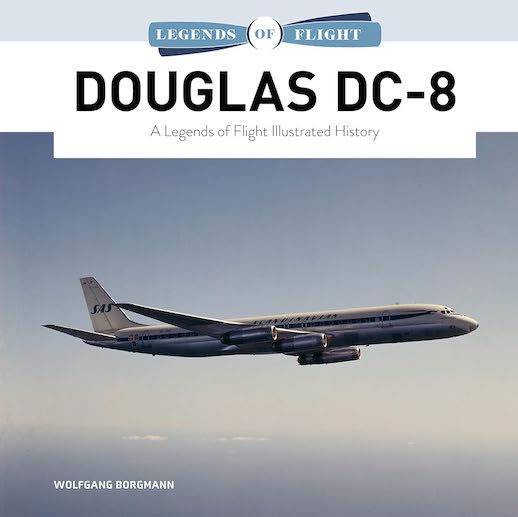 by Wolfgang Borgmann
“Game of poker between the airline, on the one hand, and aircraft manufacturers, on the other hand. . . . The cards will soon be reshuffled—and, as in the case of the Douglas DC-8 at the end of the 1950s, it remains exciting to see which ideas will prevail.”
This book’s author, Wolfgang Borgmann, has been an editor with the German aviation magazine Aero International since February 2022. He currently primarily supervises the Industry & Technology section although, all told, he’s worked as an aviation journalist for slightly more than 30 years. To date he’s had numerous titles published in German and English, with those Schiffer has published numbering a dozen.
While the DC-8 is the focus of this book, the quote at the beginning of this commentary is from a side discussion Borgmann engages in concerning the still-in-the-future-but-desirable carbon neutral propulsion. That reference harks back to when Douglas and others were considering and developing next-generation aircraft, the debate had been whether it really was time for jet engines or whether turboprop-powered aircraft would sell better. “Various concepts are being investigated . . . Either they depend on climate neutral sustainable aviation fuel (SAF), or on ‘green’ hydrogen, or . . . battery-powered electric motors . . . While researchers agree that SAF is the only fuel that can be considered for long-haul and wide-body jets, there has been movement in the design of new short- and medium-haul aircraft.”
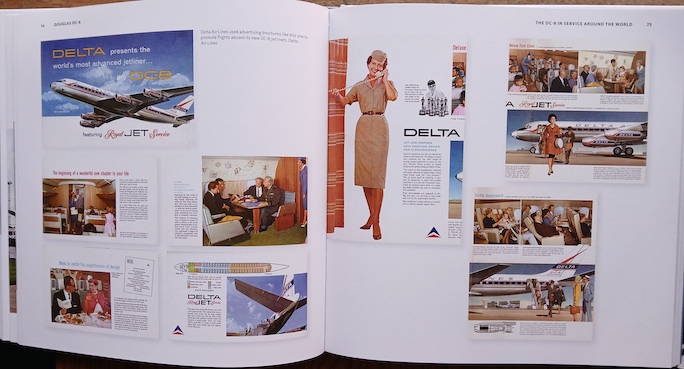
These images from various Delta brochures and advertisements illustrate the comforts and luxuries travelers experienced aboard the DC-8.
Sharing some of Douglas’ history (it didn’t become McDonnell-Douglas until 1967) places the DC-8 in perspective within its maker’s company among its propellered predecessors. Ironically, one of them, the twin-engine DC-5 initially had only one purchaser. That had been the then head of Boeing and its founder William Edward Boeing, who purchased one for his own personal transport. Subsequently a total of 13 were constructed and found purchasers but it certainly wasn’t a bestseller as the DC-8 would be or its smaller sister ship, the DC-9, would be either for that matter.
Staying true to his technology editor’s role with Aero International, Borgmann lists and explains the DC-8 “Technical Refinements” in the third chapter. Those include “How the DC-8 got its ‘Smile’ [from] the air inlets for four compressors installed in the nose” which, when that air is pressurized, provides the cabin air. Next described is the patented “Palomar Seat,” followed by “Development of the Thrust Reverser,” then “A Little Engine Lore” and “Wing Research.”
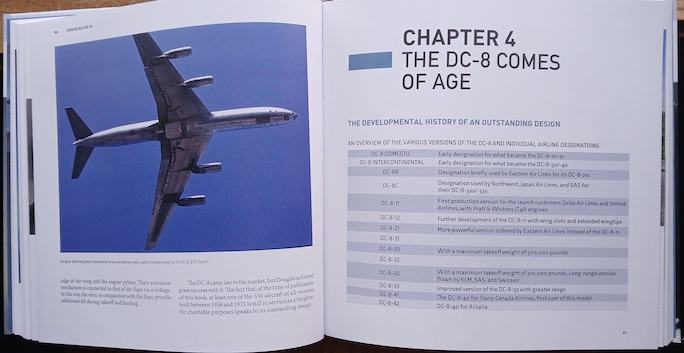
DC-8 wing profile developed in cooperation with NASA in wind tunnels and by Douglas engineers drawing on experiences gained from military Douglas programs and planes with swept wings.
Once designed and built, albeit a bit behind its competitors, Douglas did enjoy sales of its DC-8s. Borgmann devotes 42 pages to writing, with appropriate illustrations, a paragraph about each of the 42 airlines of nearly 20 different countries all around the globe that flew the DC-8 to its place of fond memories during a period oft described as the Golden Age of air travel.
One of those airlines had been Eastern Airlines (not to be confused with the EA flying today). EAL (the original one) had a strong relationship with Douglas that endured after it became McDonnell-Douglas, flying as many as 54 Douglas-built planes—a combination of both models of DC-8s and two configurations of DC-9s—while an additional 65, again a mix of 8s and 9s, were on order.
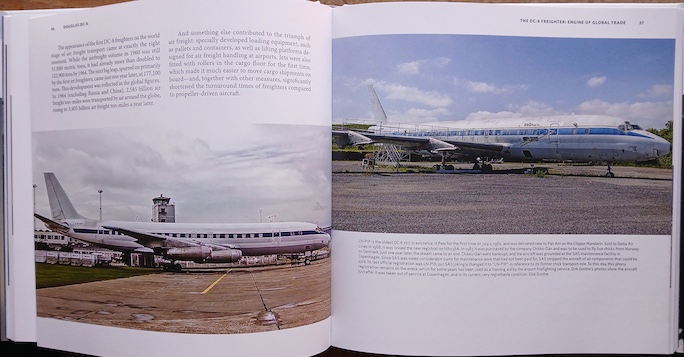
These are bittersweet photos—both of the same aircraft, LN-PIP. It is the oldest known DC-8 in existence and, as seen on right, is in sad condition in Copenhagen where it has been used as a training aid.
When Eddie Rickenbacker passed on July 13, 1963, then-head of EAL, Floyd Hall, pulled a DC-8-61 out of service, sending it, fully crewed, to bring Captain Eddie’s ashes home. It’s a small discrepancy with Borgmann’s DC-8 history indicating EAL took delivery of its first DC-8 in October 1960 while David Lee Russell wrote in his Eastern Airlines, A History, 1926–1991 that the airline had received its first DC-8 ten months earlier as the 1960 year had begun.
Another aside in his narrative has Borgmann offering a mini-history of the air freight aspect of aviation services noting “the Douglas DC-8-63CF and AT versions . . . brought the big breakthrough for aviation” in the realm of air freight as “their payload of 110,000 pounds and range of 3,000 miles laid the foundation for today’s logistics chains.”
In closing, Borgmann offers a full chapter on the planes from other makers which were the DC-8s main competition. For the record those include Boeing’s 707, most notably flown in this country by Pan Am and TWA, Convair’s 880, and the UK’s Vickers-built VC10.
This Douglas DC-8 title is part of Schiffer’s “A Legends of Flight Illustrated History” series. As such it provides good value for aviation enthusiasts of any age as it is a generously illustrated, nicely written hardbound volume offered for a reasonable price.
Copyright 2026 Helen V Hutchings (speedreaders.info)
























 Phone / Mail / Email
 RSS Feed
 Facebook
 Twitter