
Gilroy Indians: The Indian Motorcycle Company of America, 1999–2003
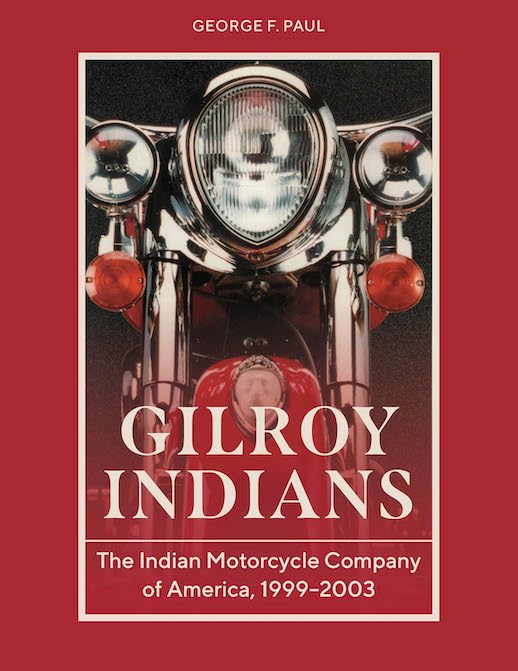 by George F. Paul
“After half a century, the Indian motorcycle designs, trademarks, and model names were once again under the legal ownership and protection of a single corporate entity: the Indian Motorcycle Company of America (IMCOA). In this way the iconic Indian motorcycle brand was resurrected.”
A first glance at the pages of this nicely produced book may give the impression that it is a factory-backed or -produced book. Not so! Although it is also likely that either its author or publisher—or both—were aware such might be potential readers’ perceptions. It is warded off at the outset with “This book is not sponsored, endorsed, or otherwise affiliated with any of the companies whose products are represented herein.”
Snooping a bit more, it turns out this is not author George Paul’s first book. Moreover, he’s a one-time active motorcyclist brought back into the fold of that activity by his (by then) adult son. Son Tim became entranced with two-wheeled modes of transportation but particularly and specifically astride Indian motorcycles.
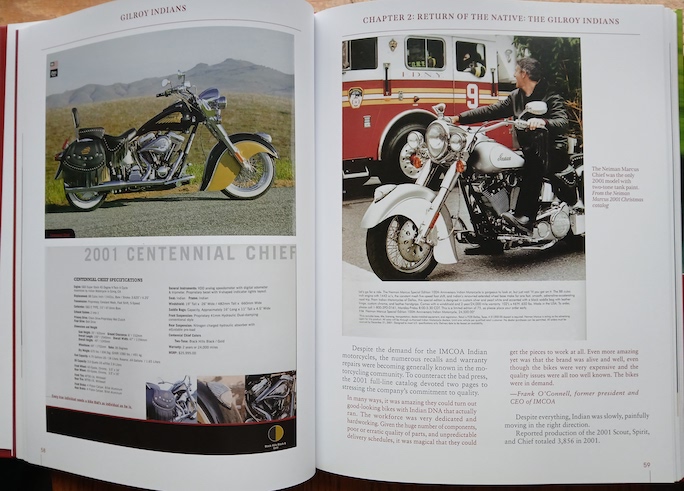
On left, a page from 2001 catalog; (r) the 2001 Chief Neiman Marcus edition, the only 2001 Chief sporting two-tone paint on the fuel tank.
Your commentator had her own personal encounter with a ’40 Indian Scout owned by my dad during the seventies decade. (So what if that dates me). I did learn to ride it solo, while also gaining great respect for why this heavy American-made bike’s transmission shift was generally referred to as a “suicide clutch.” Thus, reluctantly, when my dad passed far too early, that motorcycle went to a new, respectful, home.
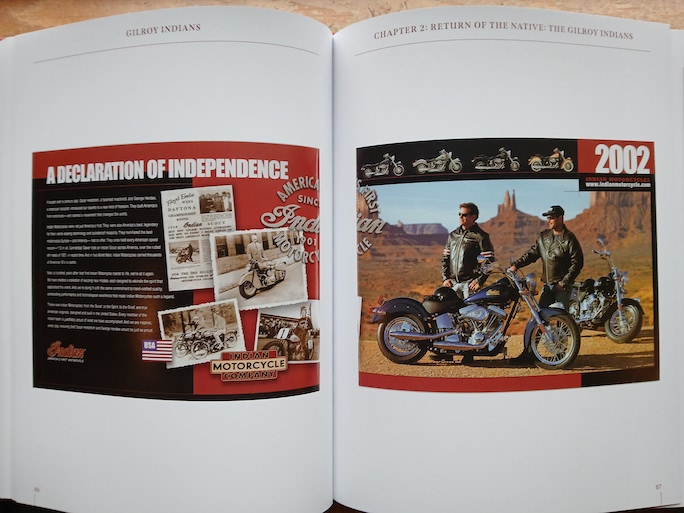
2002 catalog pages show how IMCOA used historic images alongside current ones in its sales literature.
Fully two thirds of this book’s pages feature just photos with numerous of them reproduced from various sales brochures and catalogs. It is a nostalgic look back on a serious attempt to resurrect this American motorcycle maker whose history is told and celebrated in the oft-reprinted 1977 book The Iron Redskin.
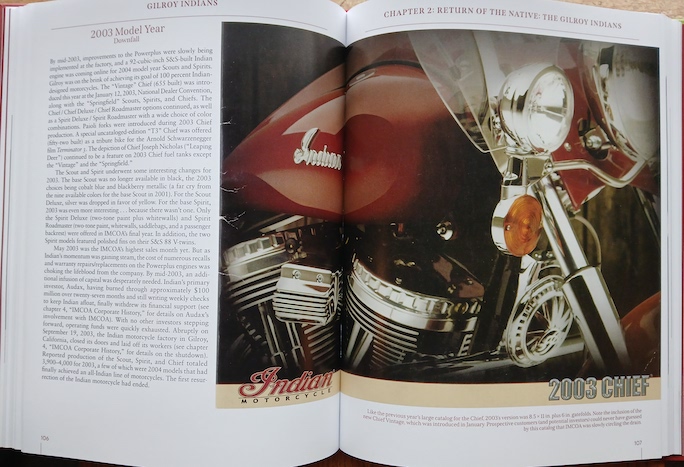
Catalogs were 8.5″ x 11″ and featured 6″ gatefolds with artful imagery such this from the 2003 catalog.
You’ve heard often that history repeats itself. Reality is, we humanoids often don’t show much ability to be able to learn from—or never bother to read and learn of—the past and thus repeat similar mistakes over and over. Reading Gilroy Indians, that reality echoes as Paul writes “when Indian’s founders George Hendee and Oscar Hedstrom left the company after financial control had been assumed by a board of directors/investors … followed by major management reorganization,” he tells of similar actions with the Gilroy-based company.
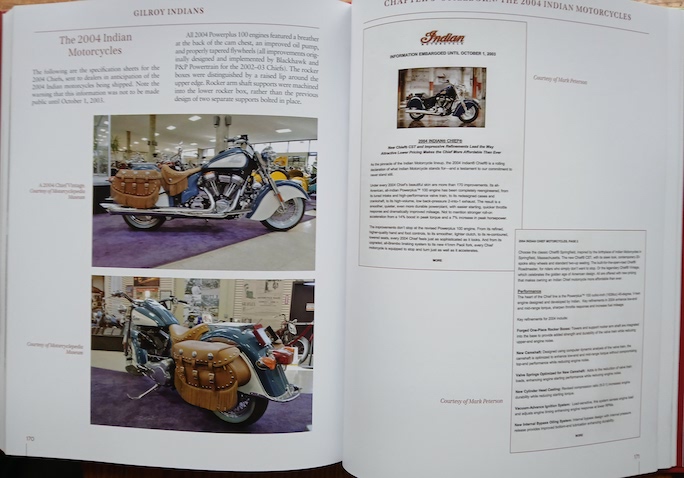
The 2004s were being produced as IMCOA ran out of money. On left is a 2004 Chief Vintage model, (r) are both sides of the 2004 Chief specification sheet.
Indian motorcycles were produced 1901–1953 and in the process becoming America’s largest motorcycle builder. But it wasn’t just the company’s size or number of bikes it produced that earned it the reverence in which it was held. Once it closed, the rights/trademarks and such were sold to one entity and the manufacturing rights to another. Others had tried over ensuing years to make Indian whole again with no success until 1999 when a company based in the central California town of Gilroy, known as “The Garlic Capital of the World,” succeeded—at considerable expense. Shortly thereafter, the Indian Motorcycle Company of America (IMCOA) began producing Indian motorcycles again.
This genuinely beautiful book relates that company’s story of trading on nostalgia, building genuinely beautiful and desirable—but flawed—Indian motorbikes. Those flaws necessitated repairs under warranty and in some instances actual recalls, all “choking the lifeblood from the company … having burned through approximately $100 million over 27 months. … Abruptly on September 19, 2003 … [it] closed its doors and laid off its workers.”
Although the first resurrection of the Indian motorcycle had ended with “approximately 13,000 of these historic machines manufactured from 1999 to 2003,” IMCOA had set something in motion. And while the subtitle indicates the story ends in 2003, it really doesn’t.
First there was an additional between 39 and 43 2004 models that had been built. They were sold as part of the liquidation sale. Then “July 2004, the Indian IP [intellectual property as in trademarks, logos, and rights] was purchased by Stellican Ltd. … Production of new Indian motorcycles commenced in 2009. … April 2011 Polaris Inc purchased the Stellican operation” continuing to build and market Indians until February of just this 2026 year. February 2026 Polaris sold a majority stake in Indian to the private equity firm Carolwood LP with manufacture projected to continue uninterrupted.
“Indian motorcycles whose fundamental designs were developed by IMCOA” are at the heart of the survival of the manufacture, sales, and service of the much-storied and still revered American-made Indian motorcycles with “designs, trademarks, and model names under the legal ownership and protection of a single corporate entity.”
This well-produced and –illustrated book provides the details of how IMCOA managed to bring the facets of Indian back together again, its own subsequent struggles as well as what its mere existence enabled going forward to today—meaning there’s another, third Indian history book just waiting to be written and published!
Copyright 2026 Helen V Hutchings (speedreaders.info)











 Phone / Mail / Email
 RSS Feed
 Facebook
 Twitter