
CTX 500, Last Train to Cockfosters
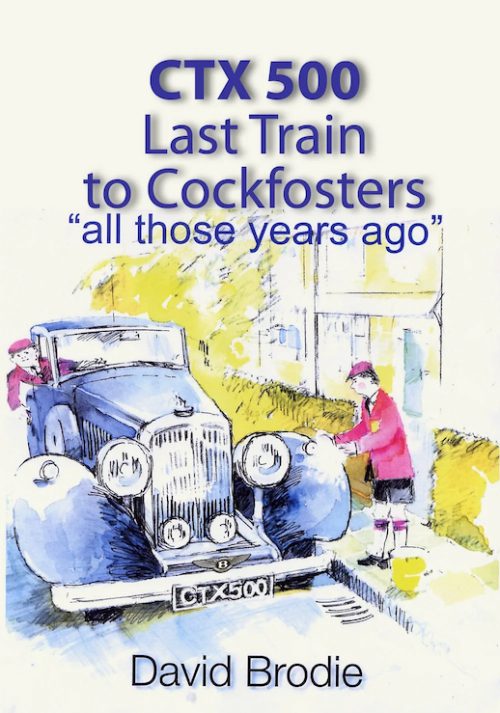 by David Brodie
“I would like to have included my thanks and very nice to know you, to a whole bunch of ‘Dolls’ I’ve known over the years as well, but no point really as this book is for guys only, and by that I do mean proper guys, so any wimps out there, stay well away, yep take a long hike, this is for proper guys only!”
Brows are furrowing all over the land.
Stay with us.
Fifteen hundred pages divided into five volumes of unorthodox thinking and intentionally—see above—unorthodox grammar and spelling are in front of us. If this wasn’t a motorsports biography we would run for the hills.
The opening quote above is from the author’s introduction. David Alexander Brodie (1943–2024) is British and his countrymen would call this a “Marmite book” because of that sticky, savory spread’s “Love it or Hate it” marketing slogan. If you’ve ever partaken of it you know why. Made from brewers concentrated yeast extract (Australia has a similar—but never say identical—product, Vegemite) it is not something you’d not have an opinion about.
 My bookcases have barely adjusted to the trauma of bearing the weight of the first two volumes of Ultimate GT40, and now here come another 17 lb. Hardly “light” bedtime reading even when handled one volume at a time.
But to start at the beginning and the title. CTX 500 is the registration number of the author’s father’s Bentley. This was a 1937 Park Ward-bodied 3.5L straight six. Young Master Brodie crashed it, at the age of seven. Cockfosters is the name of a London Underground station. And there’s a second review cultural reference. UK readers may remember a 1990s advertisement for the Australian beer Fosters Lager. Cockfosters is name-checked by actor Paul Hogan. The rather rude joke can be viewed on YouTube.
The core of the book relates to Brodie being a highly successful saloon car racer for nearly forty years. He competed at club, national, and international level including Le Mans.
Brodie’s most famous race car was his immaculately prepared and presented Mk. 1 Ford Escort nicknamed “Run, Baby, Run.” It was the most successful of its type ever raced. It was finished in a dazzling metallic black with gold pin striping, a livery that “coincidentally” appeared a few years later on the Team Lotus John Player Specials. He remained proud that he was the “Forever” lap record holder in his car’s class at the Crystal Place, “London’s own Grand Prix track” (closed at the end of 1972).
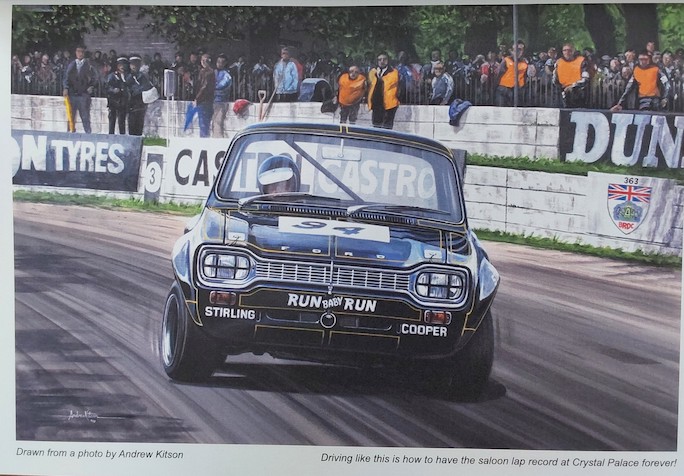
Painting of “Run, Baby, Run” (with the reviewer in the background).
He was also a founding director of Williams Grand Prix Engineering, a main board director of the British Racing Drivers Club (BRDC), and a trustee of the Gunnar Nilsson Cancer Charity Trust amongst other endeavors. He somehow found time to create his own motorsport engineering company.
Given those activities, he was on close terms with many of the sport’s elite. Best man at Ronnie Peterson’s wedding, who reciprocated for Brodie’s own. He swapped broken leg experiences with double world champion and Indy 500 and Le Mans winner Graham Hill. Hill badly damaged his at Watkins Glen in 1969, Brodie at Silverstone in 1973 which resulted in sixteen weeks in hospital. He had a jet ski accident that was fortunately without injury. The jet ski was driven by a certain Adrian Newey. Yes the unrivalled F1 designer (well, at least until his new employer’s Aston Martin debacle). These anecdotes just scratch the surface.
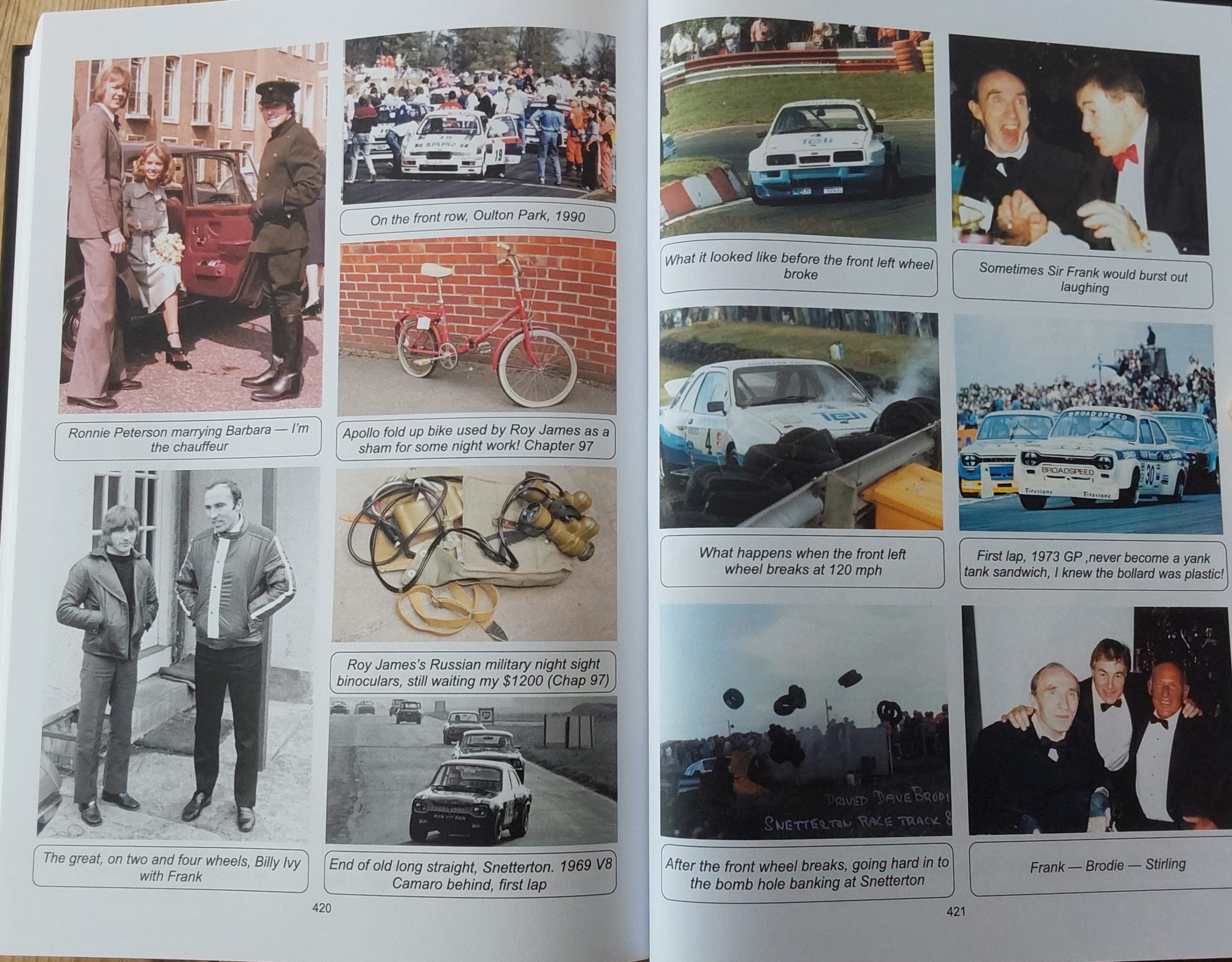
It is not just motorsport glitterati he rubbed shoulders with. He charmed his way into a private castle and was given a tour, talk, and cup of tea. The venue was Saltwood Castle, the host Lord Clark—writer and presenter of the acclaimed 1969 TV series “Civilisation.” He was a close friend of George Harrison, the Beatle being himself a motorsport fan. At the other end of the spectrum he was a good friend of Great Train Robber Roy James (above); see my review of Rich Duisberg’s book. It was whilst interviewing Brodie that Duisberg spotted the book Teach Your Dog Welsh.
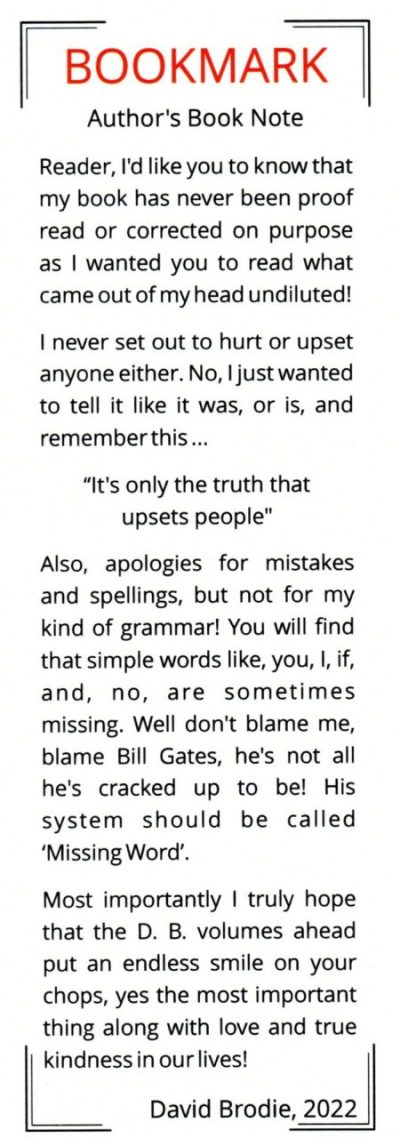
Any potential reader should be aware that the author has a writing style in which fact checking, spelling, punctuation, grammar and syntax are, ahem, optional. Is it intentional that the name of Sir Stirling Moss is also rendered as Sterling? Brodie has helpfully included a bookmark which we reproduce.
The book is not for the faint hearted, the easily offended, or even the not so easily offended. I have struggled to describe Brodie’s writing style. Think: humorous stream-of- consciousness fusion of James Joyce, Hunter S Thompson, and Joseph Heller.
Volume 1 has an Index (“Of Guys and Dolls appearing in my book”) that is in no discernable order and has no page numbering. What it does have is an idiosyncratic list of people on whom Brodie has one-liner opinions. These include his racing contemporaries, either approved of or disparaged as “couldn’t drive sheep” (or worse). And there are numerous references to popular contemporary music performers and songs he approves of. And a list of his girlfriends and their “attributes.” And last but not least a seemingly random list of historic figures ranging from Shakespeare to Oscar Wilde to Adolf Hitler, the last of whom he disapproves of.
Brodie was one of the four musketeers of UK saloon car racing in the 1960s/1970s, the others being Gerry Marshall, Tony Lanfranchi, and Barry Williams. These have written their own autobiographies too but nothing like this one. To bookend an earlier comment, Gerry Marshall won the very last race at the Crystal Palace driving the ex-Bruce Halford Lister Jaguar WTM 446. The only motorsport autobiography remotely similar in style and size that I am aware of is Smokey Yunnick’s Best Damn Garage In Town (which we must review here if we ever find the time).
The author stated that he was motivated to record these memoirs by hearing the remark “every graveyard in the world has thousands of unwritten books.” There are doubtless quite a few people who wished that this book was one of them. Zing. He also wanted his family and friends to remember him “as he was.”
The price and content of the books are what one might call obstacles. This is not a conventional motorsport history in any sense but it is a hugely enjoyable read that merits consideration. Almost all of his “outrageous” stories appear to be based on fact. Although I do doubt that at a BRDC dinner he sat next to Lord Lucan. (For non-UK readers, Lord Lucan vanished after being accused of the murder of the family nanny and the attempted murder of his wife. This was over 25 years before the dinner!) I also have my doubts about that ISBN number, or this being a Third Edition.
You will rarely if ever find copies of this book on Amazon, eBay, or specialist motoring booksellers. There are copies still available from the Modern Artists Gallery in Whitchurch on Thames in Oxfordshire because it is run by the author’s widow Peggy Brodie (the Brode, as he was known to his friends, died in 2024). Unless you are able to visit and collect the book, postage and packaging costs especially to outside of the UK may be daunting.
As a coda, the publication is stated to have 100 images. Actually there are more than 200 in each volume. So you in fact get over 1000, albeit it is the same 200 at the end of each volume. And the page count really comes to around 1850 although this includes the photos and the index at the end of each volume. Needless (?) to say there’s no bibliography.
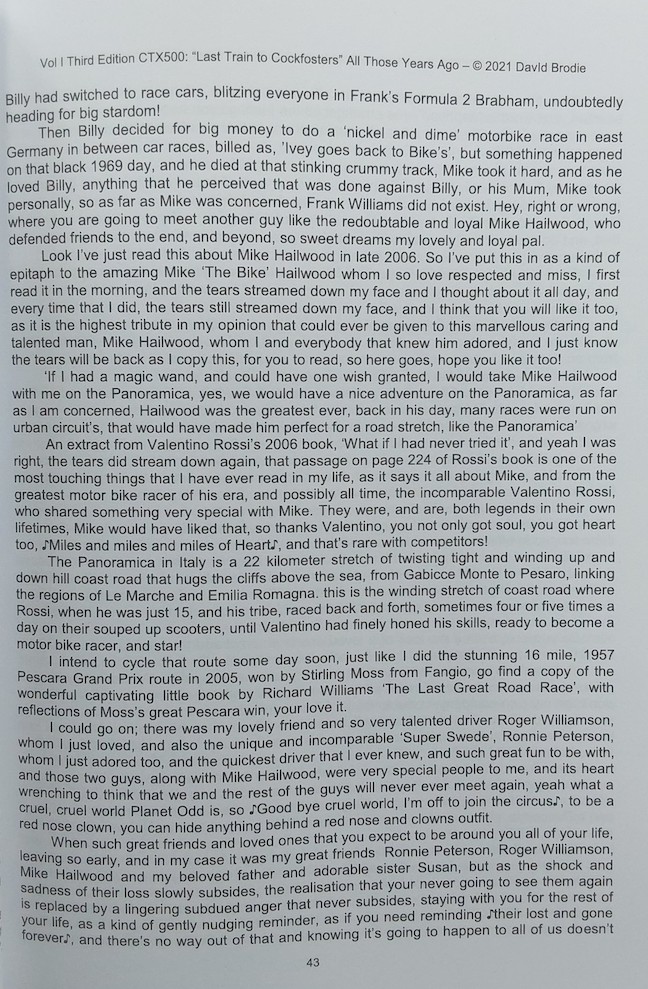
If the above makes you want to have a closer look, here a sample page.
Copyright 2026, Paul Lea (speedreaders.info)








 Phone / Mail / Email
 RSS Feed
 Facebook
 Twitter