
F1 Racing: Drive – The Secrets to Formula One Success
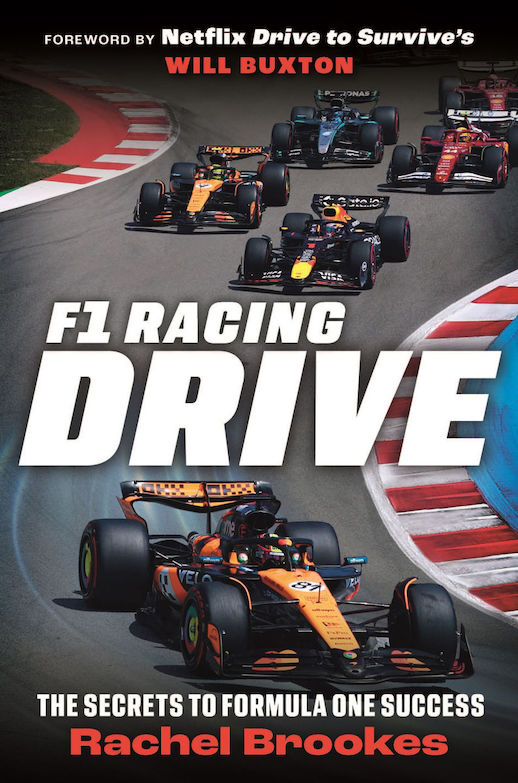 by Rachel Brookes
“When you think of late braking, you think of Daniel Ricciardo. His trademark move? Out-brake two or three cars at once and dive bomb into the apex like a heat seeking missile.”
In Ye Olden Tymes, the only way to experience a Grand Prix was by being there. And as often as not, you’d have navigated there by a route taking in club racing, perhaps with a seasoning of Formula 3. But 2026 F1 fans don’t need a gateway drug, because you can be mainlining F1 races before your fresher year is through. But do you really know what’s going on and why? Do you have to piggyback the commentary team’s opinions or do you know how to deconstruct what’s happening to create your own race narrative?
This book will help new F1 fans familiarize themselves with the vocabulary of the sport and to translate its arcane language into something that makes sense. If you’re a stranger to the undercut, bemused by the alchemy of the diffuser, or think that a bargeboard is something you’d find on a canal, this book will serve as an excellent primer for your sophomore year.
Rachel Brookes knows her way around the F1 paddock, having worked as a TV and radio presenter and reporter for over a decade. She has interviewed the big beasts of modern F1 and is thus well equipped to write about The Secrets to Formula One Success. Eleven of this absorbing book’s 12 chapters are on different facets of race craft, from racing in the rain via set-up to “tactical defending on track.” The twelfth is “The GOAT – who is the greatest and why?” but I’ll save talking about how flawed that chapter is until later (he said, ominously).
Like other books from this publisher, this one is priced at half the industry norm, but without many obvious economies having been made. The paper isn’t going to be mistaken for the stuff you’d find in a Palawan Press glossy, but 300 pages for the price of an hour in Starbucks gets no complaints from me.
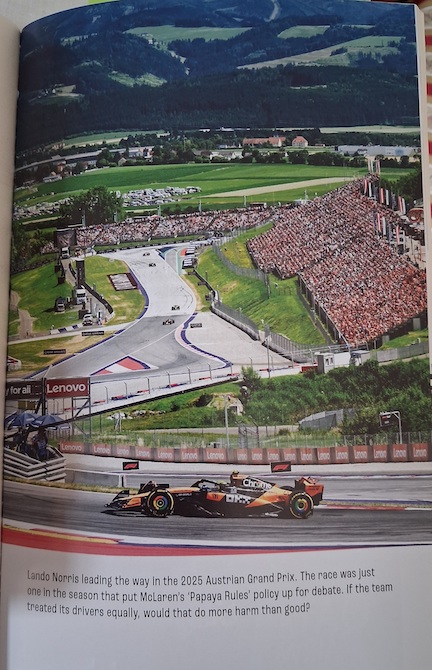
There are two sections of photos, most of which depict recent events in F1. The exceptions are the compulsory pictures of the now beatified Ayrton Senna and a poorly-chosen picture of Graham Hill at Monaco. It depicts the long past-it Hill in 1975, when he failed even to qualify. (Far better to have depicted Hill in his glory days; maybe a shot of his Lotus 49 in 1968, when he won from pole?)
The book is written in a fast-paced, almost tabloid style (as in the breathless opening quote above) and it benefits from first-hand accounts from the F1 community. Not just drivers, but team bosses such as Toto Wolff and also Martin Brundle, the best TV commentator the sport has ever had. The author, to her credit, has also been diligent enough to supplement aperçus from the experts with examples of on-track events in recent Grands Prix. The fact that little of what I read was news to me is more indicative of my having followed the sport since the DFV’s debut than of any shortcoming in the text. We are spared the “In F1 your biggest rival is your teammate” cliché but there are still a few “No shit, Sherlock?” moments. Like this insight: “Toto Wolff…told me that speed needs to be part of your DNA for you to get into Formula One. Of course, speed gets you noticed, but speed alone is not enough to keep you there.”
How to stay in front.
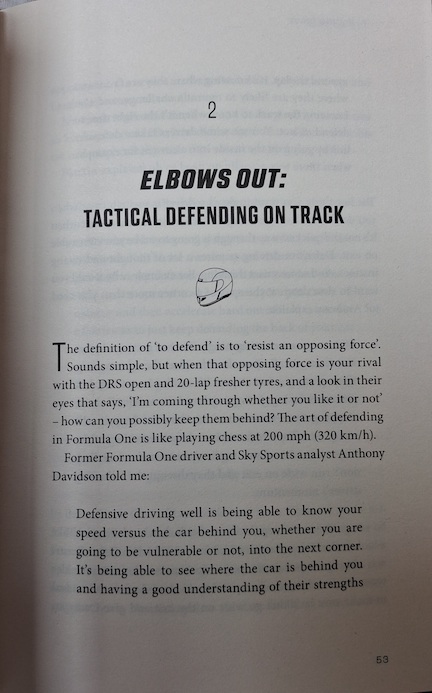
But even old cynics (hi there) can learn from this book. I found the chapter titled “Elbows Out: Tactical Defending on Track” so insightful that it provoked some involuntary cussing, and I mean that as a compliment. I must have nodded off when the TV pundits were discussing the latest refinement to the Driving Standards Guidelines so the following text prompted my eyebrows to head north, and sharpish: “The main change is that the overtaking driver has priority. The guidelines now state that ‘an overtaking driver has priority; it is the responsibility of the defending driver to avoid a collision or forcing off an overtaking driver.’” I must also have missed the announcement that Lewis Carroll had been drafted in as FIA boss.
Just like everybody else, I’m a Monday morning quarterback when it comes to pit stops. In “To Pit or Not to Pit: The Secrets of Strategy” the description of the team resource deployed to decide simply when to pit was another eyebrow disrupter. It made me wonder why sometimes even the casual observer can see what a team can’t see for itself. At the Qatar Grand Prix last year, were Zak Brown’s McLaren guys thinking (if I may repurpose another Hamlet quotation) “Though this be madness, yet there is method in’t”, or did they just, y’know, screw up royally?
The only person who can’t see what Nico is doing is Lewis.
Rachel Brookes’ immersion into the sport, and especially her access to its movers and shakers, endows most of the book with real authority. Fully to understand the nuances of a modern Grand Prix, the viewer needs to have a working knowledge of the importance of tire degradation, the challenges a loose rear might present, and how and why some drivers can alchemize a wet track to their advantage. Psychological warfare isn’t neglected, and there’s an interesting contrast made between Fernando Alonso’s Latin macho man schtick and the Machiavellian warfare Nico Rosberg waged against teammate Lewis Hamilton in the former’s ascent to world champion in 2016. At those rarified altitudes Rosberg prevailed, and if you listen to any interview with Rosberg, you know why, because this is the man who elevated being the school smartass to an art form. As Nico said to the author, “Become aware of the weaknesses of your rival.” He exploited that knowledge exquisitely, and perhaps the irony is that Lewis learned so much from Nico’s mind games that he then forgot how to lose and couldn’t stop winning until the Abu Dhabi ’21 farrago.
With one caveat, this is a well researched and authoritative work which deserves a wide audience, especially given its remarkably low price.
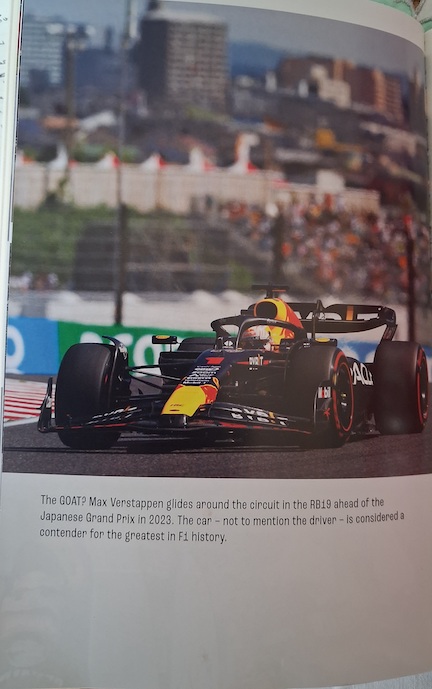
GOAT? Don’t even go there.
Now to the GOAT chapter. It doesn’t significantly detract from the book’s overall appeal but it’s still terrible because the premise is terrible. Look, if you are going to use a portentous term like “Of All Time” it’s a damned good idea to reflect on the full 75 year history of Formula One and, arguably, upon Grand Prix racing’s much longer heritage. The approach taken here is superficial, lacking any historical perspective and, thus, any real authority. The author relied on the views of her interviewees, principally drivers and team principals, for their nominations. And predictably enough, they nominated Senna, Schumacher, Alonso, and Hamilton. Jim Clark? He “only” won two WDCs, ironically the same number as Alonso. But hold on… Clark won 34% of the Grands Prix he contested, and Alonso only 8%! Clark was also racing when F1 cars were as fragile as they were unreliable, when a simple mistake could result in injury or death and when a season had fewer than half the number of races we have now. Juan Manuel Fangio? “His record is extraordinary, yet few knew of him and even fewer saw him race?” What?? Even as a kid, I’d heard of Fangio, and countless thousands saw him race. The fact that not many of them are still alive is irrelevant. Does Harry Styles eclipse the Beatles because his living audience is bigger? Alain Prost at least gets a brief mention, whereas Messrs Stewart (victor of the 1968 German Grand Prix by four minutes), Stirling Moss (do I really need to say why?), Alberto Ascari (just look it up) are accorded “also ran” status. But the author is not to blame, she just asked the wrong people. Notoriously, Formula One folk are focussed on the “now” and have a goldfish recollection of the “then.” Next time, Rachel, speak to experts versed in the grammar of perspective. Try Doug Nye, Nigel Roebuck, or Mark Hughes for an informed view.
This is an expertly researched book from which F1 fans will learn a lot. Just skip the GOAT stuff, all right?
Copyright John Aston, 2026 (speedreaders.info)




 Phone / Mail / Email
 RSS Feed
 Facebook
 Twitter