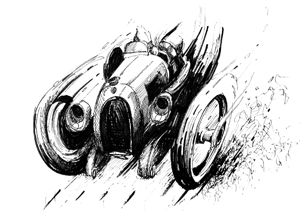

FIAT in Motorsport Since 1899
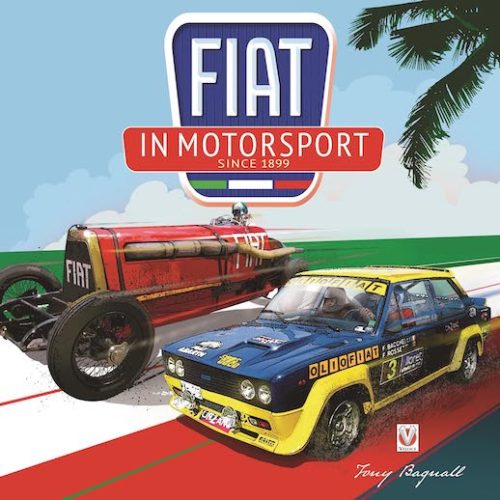 by Anthony Bagnall
“Today many people think of Fiat as a manufacturer of small/medium-sized cars, with the occasional foray into sports cars such as the Fiat 124 Spider which has now sadly ceased production. However, over its 120-year lifetime, Fiat has had many noteworthy competition successes particularly in the very early days of Grand Prix racing, and later, during the 1970s, international rallying. Fiat models, or Fiat-powered models, were also present in other forms of motorsport, and on several occasions even involved in World Land Speed Record attempts.”
This big story is told in a compact 160 pages enlivened by numerous photographs and drawings.
The treatment of the early days here tends to be a rather, for lack of a better word, dry record of dates, circuits, drivers, car models, and results. The paucity of information pertaining to that era, particularly pre-WWI, is reflected in a lot of “may have been,” “probably,” or “it can be assumed.” Occasional sidebars, such as driver biographies, flesh out the narrative. Bagnall is by training a numbers guy (accountant then high-level finance) and so his threshold is probably different from that of the run of the mill reader; when he does break away from the bare facts, the results are eminently enjoyable for any and all.
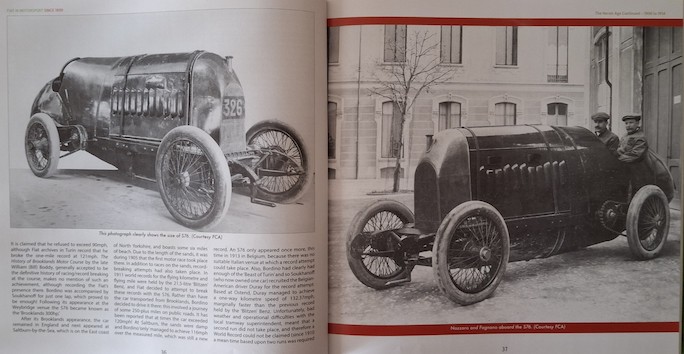
An early example is the Fiat S76 of 1910 (the red car on the cover; and again below) which was designed to tackle the World Land Speed record and knock the Blitzen Benz off its peg. It had a four-cylinder engine totaling 28,352 cc producing 290 bhp at 1900 rpm. Due to the height of the car, the radiator cap towered 5ft above the ground and could only be accessed by standing on the front chassis rails. Fiat works driver Felice Nazzaro—who was so capable that he had won the Targa Florio, the French Grand Prix, and the Kaiserpreis all in one year, 1907—considered it to be uncontrollable and never drove it again. Works driver Pietro Bordino also declined to undertake another record attempt, in Ostend in 1913. His run had produced a marginal improvement over the first but the return run alas did not take place due to “bad weather and operational difficulties with the local tramway superintendent.” Only two cars were built, and they survive today cobbled together into one, fittingly named the “Beast of Turin” which is a regular in Historic Racing.
The Grand Prix saga ends abruptly in 1927 when Fiat not only withdrew from racing but also destroyed the latest successful models. There follows a fallow period in the 1930s with private entrants campaigning sports and saloon cars mainly in Italy. But starting to emerge were constructors such Amédée Gordini who used Fiat components in a range of successful vehicles. Future Grand Prix star Luigi Villoresi cut his teeth driving one. Following WWII, the Fiat-based marque Cisitalia produced the successful D46 single-seater. Tazio Nuvolari nearly pulled off a sensational victory in the 1947 Mille Miglia in a 1100 cc Cisitalia 202.
Most of the 1950s followed the 1930s in low-key motorsport participation but the advent of Formula Junior in 1958 made possible a final single-seater hurrah. At the outset the Fiat engine was an ideal fit for that formula, and plenty of Italian manufacturers took up the challenge in both 1958 and 1959. Wolfgang von Trips and Lorenzo Bandini, both future F1 Grand Prix winners, gained experience in Formula Junior. At this point British focus was on the 500 cc F3 category. However, FIA approval of Formula Junior for international recognition changed things. The entry of UK manufacturers such as Lotus and Cooper as well as engines from BMC and Ford effectively ended Italian/Fiat domination. This was in conjunction with the arrival of drivers such as Jim Clark, Denny Hulme, and Trevor Taylor.
The chapter on Formula Junior fills a significant gap in motor racing history because prior to this book little had been published in the UK on that subject. Fiat again entered international motorsport in the 1970s. The Abarth company had made a name for itself in competition-tuning Fiats, in particular Fiat 500s. It also manufactured sports racing cars. In 1971 Fiat took over Abarth and sold the circuit racing elements to Osella. Fiat then established a separate racing/rallying division. The consequent build-up of experience resulted in a number of World Rally Championship event wins using the 124 Abarth Rally. With the introduction of the 131 Abarth Rally, Fiat became World Rally Champion in 1977, 1978, and 1980. And finally, the Grande Punto was European Rally Champion in 2006, 2009, 2010, and 2011.
A (slightly) strange omission is the absence of the Fiat-Abarth successes in the European Touring Car championships in the 1960s. This was the forerunner of the European Touring Car Championship. Although there was a mish-mash of classes, circuits and scoring criteria, drivers such as Ed Swart, Giancarlo Baghetti, Willy Kauhsen and “Pam” aka Marsilio Pasotti helped Fiat win the Division 1 Manufacturers in 1965, 1966, 1967, and 1969.
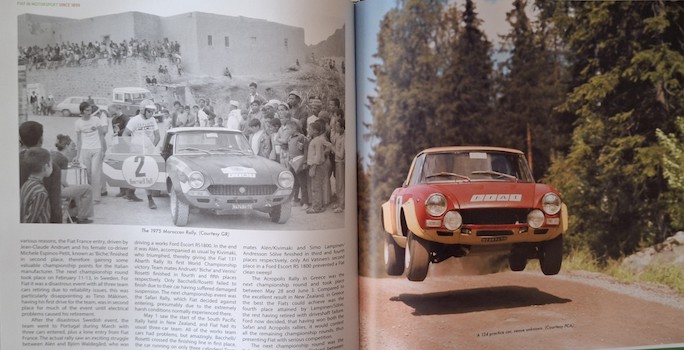
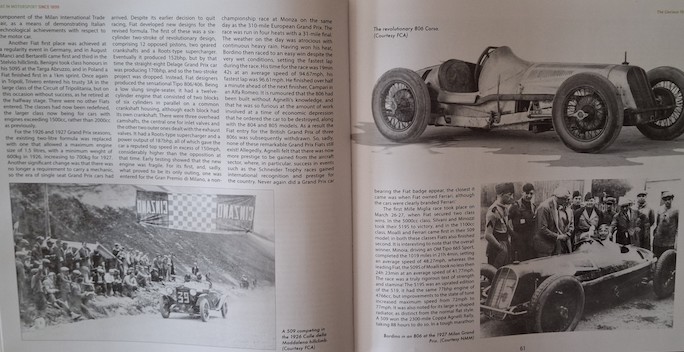
In summary, a large element of this book is a record of events which of necessity makes it somewhat repetitive. However, the photographs alone, particularly of the early days, are worth the price of admission. Bagnall has been able to source pictures from Fiat Chrysler Automobiles (FCA), the owners of the Centro Historico Fiat. These are complemented by more from the National Motor Museum (UK).
The author has previously written books about motor racing at Aintree and Alfa Romeo models 2000 and 2600. He is a member of the Society of Automotive Historians in Britain.
Copyright 2026, Paul Lea (speedreaders.info)


 Phone / Mail / Email
 RSS Feed
 Facebook
 Twitter