
Mr. Piper and His Cubs
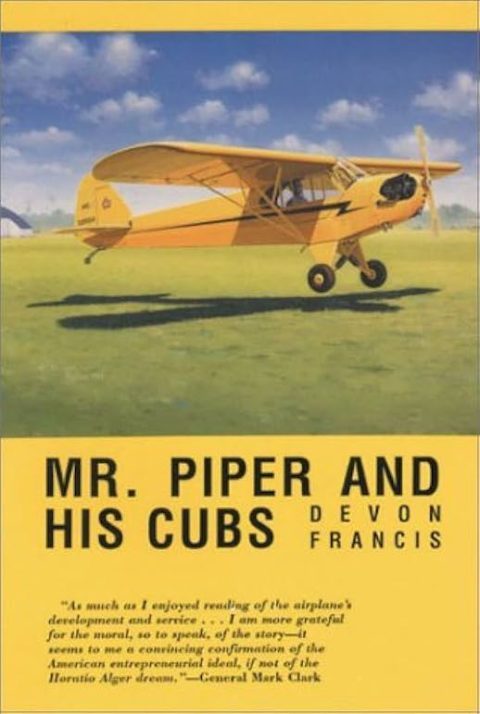 by Devon Francis
“Once again, W.T. Piper, the curious combination of plunge and conservative businessman, would gamble. Piper Aircraft would go for broke. . . . Once committed, W.T. Piper began thinking in no small terms.”
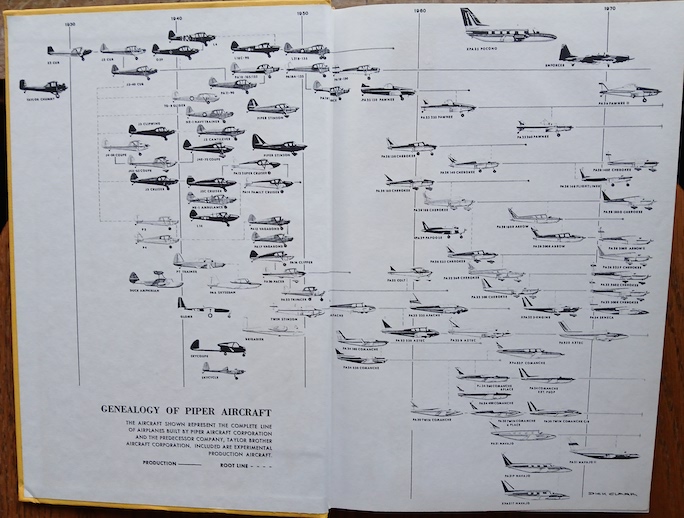
One look at the endpapers graphically brings home just how large the Piper family tree of aircraft grew and branched out over the decades. Of course, not all are named Cub, even as “throughout the world the corporation’s cable address has remained ‘CUB, U.S.A.’“ Now, there are Aztecs, Bonanzas, Cherokees, Navajos and more. But as Peter Egan wrote in his recently reviewed Landings in America , when they attended the Cub reunion that observed its 50th anniversary held at Piper’s home base, Lock Haven, Pennsylvania, they were met by six hundred Cubs flown in to attend. Quite by chance too they met the man who had been an employee then and had actually welded their very Cub’s frame. He proved it by locating and showing the Egans where he’d signed their Cub.
Although far from new, this book is so very well written, reciting the history of William Thomas Piper and his unlikely, almost accidental involvement with the company that would one day bear his surname, you need to know about it. Especially as the internet makes finding copies today quite easy. And a third printing is available (although supply is running low as of 2025) from the Piper Aviation Museum.
The first inkling that this might be an exceptional read came while perusing chapter titles on the Table of Contents page. Ah, shades of Beverly Rae Kimes’ clever titling of chapters in her 2005 SAE-published book Pioneers, Engineers, and Scoundrels! In this book I found chapters titled “Britches without a Fly,” “Two Bills of Divorcement,” “War Breeds Grasshoppers,” and “Of Bankers, Brokers, Barrister, and Hanky Panky.”
Then, looking at photos and reading captions, I found more nice turns of phrase. This book’s author seemed to be a master of the language and clever with a sense of humor. So Devon Francis turned out to be, with descriptive sentences such as this: “He looked at red ink with the distaste of a garment manufacturer for a nudist colony.” His bio noted him both a pilot and professional aviation writer who had sired two sons, one who became an airline pilot and the other a newspaperman.
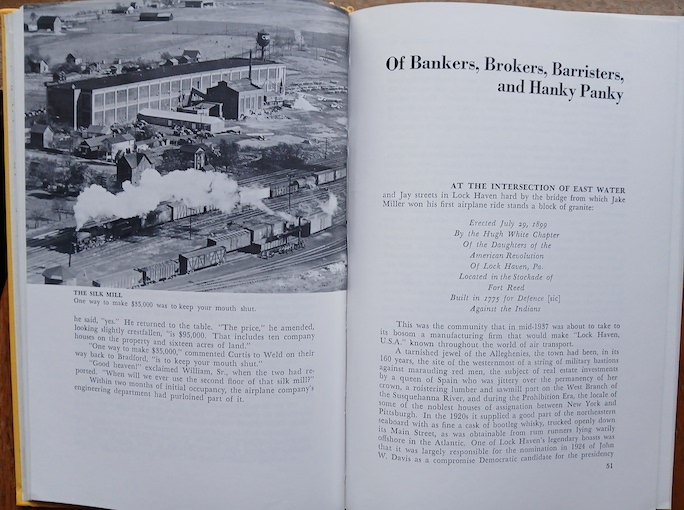
The plant where Egan’s Cub had been built had originally been an old silk factory along the Susquehanna River as you can see. The photo just happens to be facing the start of one of those creatively titled chapters.
With its origin traced back to the 1927-founded Taylorcraft, it was renamed Piper a decade later when the factory burned to the ground and relocated to an old silk mill in New Haven, Pennsylvania. The purchase of the two-story facility along a rail line included ten company houses on the total of sixteen acres of land. William Sr had opined then, for he was now actively involved with the company having invested the grand sum of $400, wondering when they’d ever need, much less use, all that space yet “Within two months of initial occupancy, the airplane engineering department had purloined part of it,” and growth just continued from there but not without some hiccups as this book tells so very well.
Piper is in business today although no longer family owned nor located in Lock Haven, Pennsylvania. In 1959 all production was moved to Vero Beach, Florida and another decade on, as a result of an attempted, and very much unwanted, corporate take-over, Piper-family ownership and management ended but not before the Supreme Court was called into play rendering a final ruling.
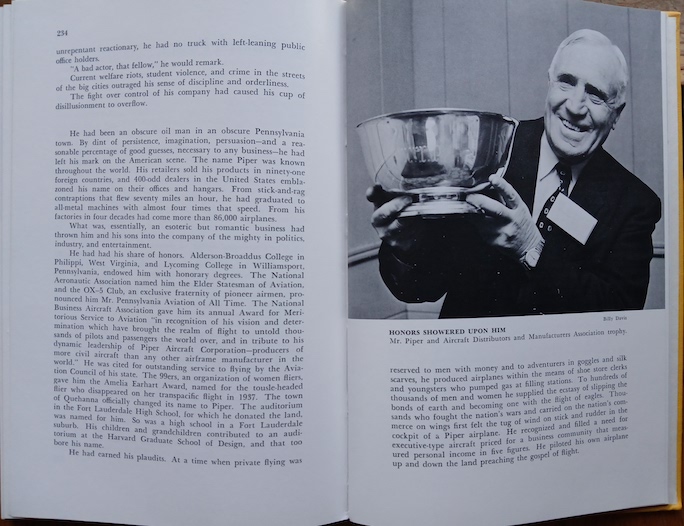
As noted above, perhaps Devon Francis felt a special connectivity to others who sired progeny following in their fathers’ footsteps as was the case with Piper patriarch William Thomas Piper who, truth be told, never started out to be a business mogul much less establish an aircraft-making company bearing his surname. Yet he and his sons, William “Bill” Jr, Thomas Francis “Tony” and Howard “Pug” proved themselves to be particularly adept in their respective roles. All became fine pilots as well.
It all began for the Piper clan quite by accident as said in the first paragraph above. W.T.’s work was drilling for oil in Pennsylvania. One of his business partners had invested $400 in Taylor Brothers Aircraft Corporation. Rather than make a big fuss, W.T. went along with it. As things progressed this man who knew nothing about flying or the airplane business found himself elected to Taylor’s board and appointed treasurer. Not one to shy away from a challenge, he learned and learned. Then, following instinct and his own judgment advocated—and instituted—changes that led to Taylorcraft being renamed Piper Aircraft. As his sons came of age and joined the business, the Piper family ultimately had parlayed that initial $400 into something like $30 million!
That’s the story Devon Francis recounts in page-turning detail in Mr. Piper and His Cubs. It’s far from a dry business story. Rather it is filled with anecdotes, humor, and some drama as Piper airplanes become well-known with those yellow Cubs ever and always the most recognized of all.
Copyright 2025 Helen V Hutchings (speedreaders.info)
 RSS Feed - Comments














 Phone / Mail / Email
 RSS Feed
 Facebook
 Twitter