
Main Street to Miracle Mile: American Roadside Architecture
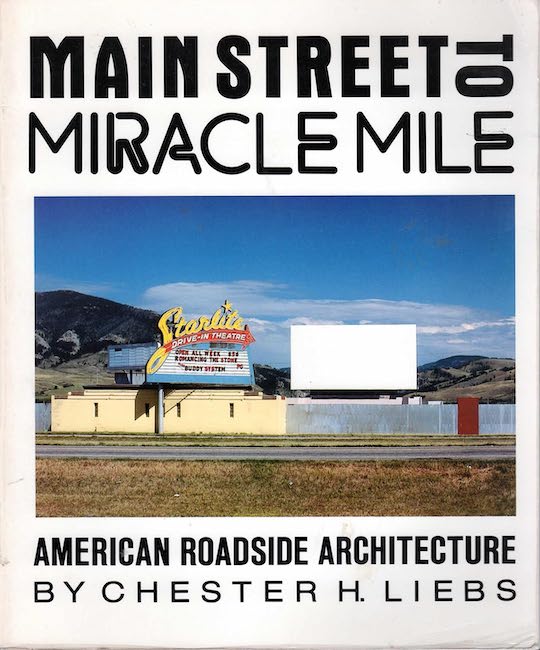 by Chester H. Liebs
In 1975, thanks to my university department’s class scheduling, I found myself with the “opportunity” to take an elective, something which my graduate school advisor supported as a “change of pace.” He suggested that I might take a look at several offerings in the Geography or perhaps the Economics Department. As I scanned what was going to be offered in the former, I noticed one class in particular: Urban Spatial Systems. I looked at the course description and thought it looked interesting. My advisor, PWB, signed off and when the class met, I was the sole non-geo major in the group. It was much larger than most of my other grad classes, about a dozen as compared to maybe the three to five or even six in my departmental seminars. Little did I realize that it was to be one of the most influential graduate classes I would take . . .
It was during that Urban Spatial Studies class sessions that I “discovered” the automobile. And automotive history. The professor had devised a game or simulation he dubbed CLUG or Community Land Use Game. While I managed to gain some Brownie Points by creating a computer program to better refine some of the outcomes in CLUG (keep in mind this was in Ancient Times when computers and those who could actually program them were relatively few and far between, even on large university campuses, and as a guy in the humanities who could program I was very much an oddity), what stuck with me was how little attention the automobile and its history seemed to be getting within the hallowed groves of the Academe. A half century later the story is pretty much the same.
From the time that I took the Urban Spatial studies class until the present day, the automobile and automotive history have remained the focus of my studies. It took time, of course, for this focus to begin to manifest itself. The literature on the topic tended to be what might charitably be considered as “lacking” or outright “absent.” In the 1980s there were various monographs emerging that began to pay attention to such topics as gas stations or restaurants or even motels.
In 1985, the book we’re looking at here appeared, almost as if out of nowhere. Main Street to Miracle Mile: American Roadside Architecture by Chester Liebs of the University of Vermont was one of those rare monographs that literally stopped you in your tracks when you first encountered it. It tied together a number of threads to produce the first monograph to address head-on the topic of American vernacular architecture in its expression as roadside architecture. That Liebs laid out the evolution of the architecture being created on the roadsides by the introduction of the automobile and how it affects the traveler—and consumer—was a truly revolutionary and novel interpretation at the time. I was not the only person knocked back on his/her heels after encountering Main Street to Miracle Mile for the first time.
A decade after its first appearance, the book was republished by the Johns Hopkins University Press for what might be presumed to be a somewhat “wider” audience. In an updated intro Liebs provides his reflections on the book a decade after its initial publication and its influence. Its addressing the issues of Space (From Main Street to Miracle Mile), Image (Architecture for Speed-Reading), and Type (Auto Showrooms, Gas Stations, Supermarkets, Miniature Golf Courses (!), Drive-in Theaters (!), Motels, and Restaurants) are as interesting and relevant today as they were decades ago.
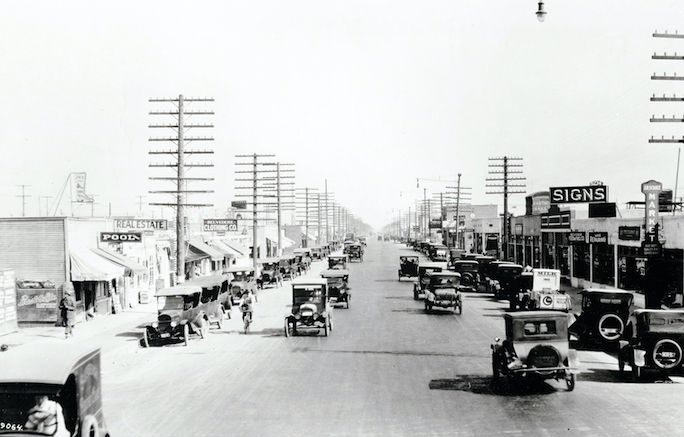
Basically, Liebs traces the changes on the roadside from the Main Street before and then as the automobile developed to the Miracle Mile of commercial development now commonplace as we travel from place to place in our automobiles. Sounds simple, but it is done with style and panache, which is not simple! It is one of those books that both the general reader and the scholar may read, ponder, think about—and enjoy.
Main Street to Miracle Mile manages to mix business, environment, sociology, architecture, history, commerce, consumer studies, automobiles, landscapes, and even archaeology (of the windscreen sort) into a single volume. I have always had copies of both editions of Main Street to Miracle Mile on my bookshelves. In fact I had to keep purchasing additional copies because I kept loaning mine to students and friends and was never surprised not to get them back.
This book is one of those few truly foundational works of automotive history (and all those other subjects mentioned as well). It has stood the test of time and gets more relevant with each re-reading.
Liebs’ research material for this book is held by the Center for Southwest Research under “Chester H. Liebs Papers 1869–1992, MSS 843 BC”.
Copyright 2025, Don Capps (speedreaders.info).




 Phone / Mail / Email
 RSS Feed
 Facebook
 Twitter