
Twice Around the Clock – The Yanks at Le Mans, 1980–1999
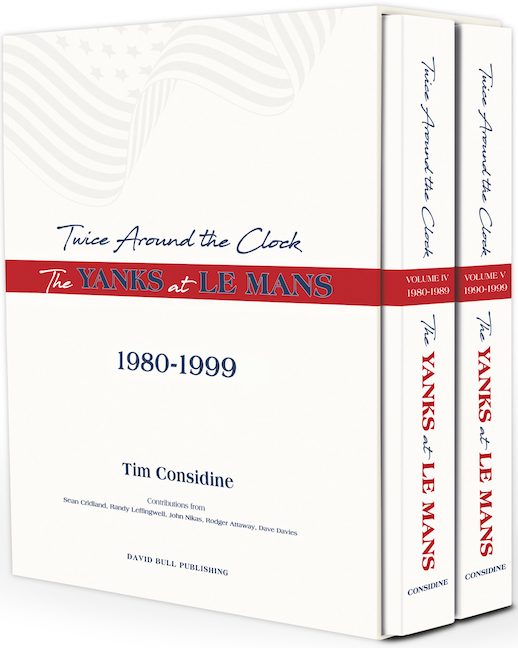 by Tim Considine
“As before, their stories will often contradict what ‘objective’ conventional histories tell us. They are at times controversial, always informative—and often, hysterically funny. ‘Yanks’ is their book and tells their truth. Enjoy!”
Here we have the long-awaited second installment of three that together will cover one hundred years of the subject. The first book started in 1923, so the last book will end in . . .
While published in sets of multiple volumes each, we will refer to it in the singular. It has many things to commend itself, not least that there is no other that zooms both in (hard race data) and out (interviews, quotes and such) as well as this one.
American involvement—meaning cars, drivers, team owners, crew members—at the 24 Hours of Le Mans began with the very first race. Yes, yes, American participation at Le Mans dates back farther than that, to at least 1906, but that wasn’t the 24 Hours. (Think French GP.)
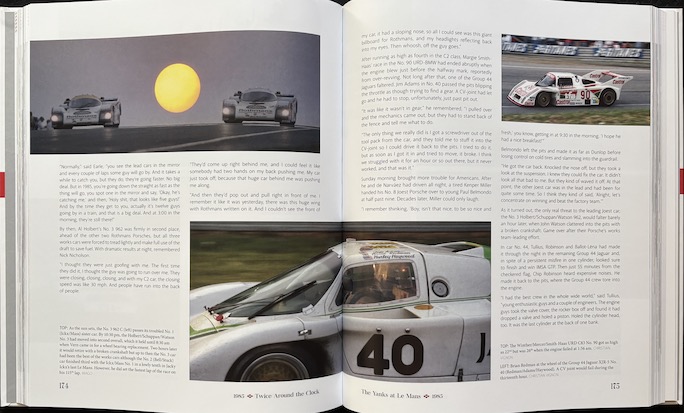
Is the sun rising? setting? are we up? down? Twice around the clock takes it out of everyone, even spectators!
This second set has been in the making for years but it is surely coincidence that when it finally did come out (delayed; launch had originally been slated for the 100th anniversary) it was the very year that for the first time in almost 60 years an American make qualified on pole—Cadillac. Starting right next to another Cadillac, plus two more further down the grid. This neatly plays right into the story line, just in case you need to convince your Minister of Finance why this is an essential purchase. It is certainly essential if you have the previous book, published in 2018 that covers 1923–1979, and also because there will be yet another one (2000–2023), and what’s the point in having an incomplete set?
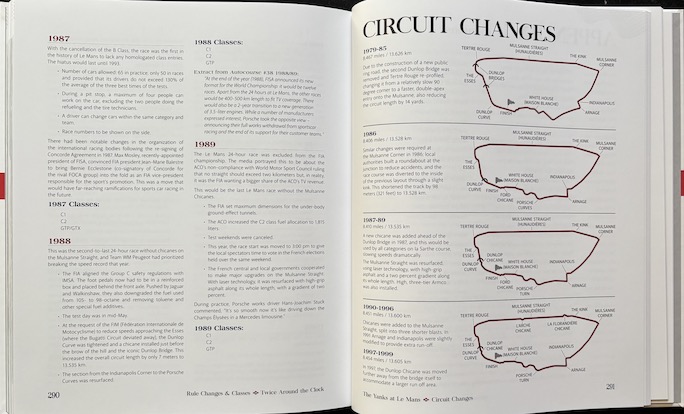
These pages explain the different classes and track layouts.
If for some reason you had not been aware of the existence of the preceding 3 volumes (self-published by the author in 2018 and sold only as a set) you can for once consider tardiness a virtue: the publisher of this 2-volume follow-up set, David Bull, has acquired the remaining old stock and is offering it at less than half the original price! [1] On the glass-half-empty side: that there still exists unsold stock is a head-scratcher. The new set will be printed in the shockingly low quantity of 400 (numbered and signed by Maria Bull) and one would think that so small a number will barely suffice to fill the demand of friends and family of author Tim Considine. Harumph, make that the late author Timothy Daniel Considine. TC died in 2022, which explains why there is now a bunch of additional names on the cover: Sean Cridland, Randy Leffingwell, John Nikas, Rodger Attaway, and Dave Davies. But let’s ruminate upon this for a moment: TC wrote the Preface to this book; it is dated 2/18/22; he was 81 years old; not two weeks later he had “tipped over” (his own expression! we’re not being disrespectful!!), unexpectedly.
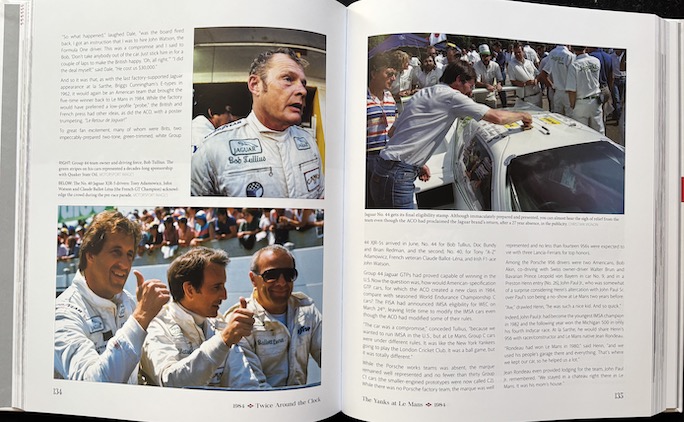
(right) Ever seen an eligibility stamp being applied to the bodywork?
It is not entirely irrelevant to mention that Considine, whom you may recall as an actor on beloved TV shows, was really aspiring to be a director. That directorial eye for the Big Picture and all the moving parts and putting everything into its place just so is fully in play in this book. From youth he had an interest in cars and then motorsports, actually sports in general, and post-acting became a respected historian, writer, and photographer. How respected? Soccer legend Pelé scribbled a personal dedication onto a ball and William “The Language Maven” Safire trusted TC to fill in on his New York Times Magazine column “On Language”!
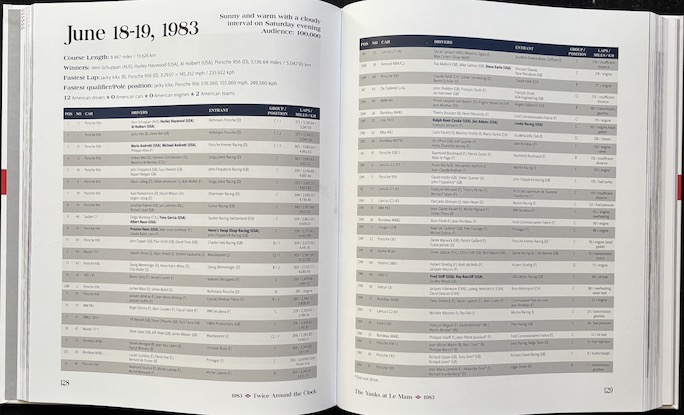
This is how comprehensive the Race Results tables are: “Sunny and warm with a cloudy interval on Saturday evening. Audience: 100,000.”
That the present book “sounds” so much like Considine is because he had the lion’s share of it already written. The book proceeds in year order and the last one entirely by his hand here is 1990, followed by three co-written with Randy Leffingwell; the remainder are by others, in each case attributed. (Forensic linguists can now debate style differences; bios of all are appended.)
Each year (chapter) is explored in 20–30 pages, extensively illustrated with photos (many never before seen) and realia from a variety of sources. You only have to read the first page of the first chapter to realize that the story will unfold without undue haste; quotes feature prominently, and while some may consider such POV snippets limiting in regards to the full sweep of events, they do what they do best—convey immediacy. The author/s know full well what all been written already, and how, and the whole point of their book is to add a heretofore missing or neglected dimension.
Considine reported from/at Le Mans professionally for many years and thus was able to make personal connections among participants and peers, amassing lots of interviews—hence the introductory excerpt we chose. They are minimally “cleaned up” and probably sound very authentic. Sources for all citations are listed at the back of each volume but are of limited help to researchers because most will only say “as told to author.”
Considine wasn’t a young man when he decided to devote years to turning three decades worth of notes, interviews, and research into a monumental series of books so he must have given thought to the future. Incidentally, how’s this for lang-range planning: the first set was red, this one is white, the next one will be ___.

Why reliable books matter:
Let’s assume you assume that there must have been female drivers, and that one of them would have to have been first. How would you expect the book to guide you to an answer? No easy solution. The page above from the Driver History appendix shows that the compiler anticipated such a question and helpfully added this notation to Margie Smith-Haas: “The first American woman to compete at Le Mans” (1984). The relevant book chapter describes her the same way.
Now let’s say you think AI could have given you that answer for free and instantly. Oh yeah? Try “first+american+female+le+mans+driver”. You’ll get Lyn St. James, 1989 (it just so happens she appears on the same page, above). Now what?
As the next book will be done entirely without Considine’s writing it will probably have a different voice and possibly a different publisher—but not a different look because graphic design and production will remain in the steady hands of Jodi Ellis whom TC fondly called DQ—Dezine Queen—and considered an honorary family member. If it needs to be said, any book that receives her ministrations already has a leg up in life because books don’t just want to look pretty—layout, typefaces, color, paper, ink—they need to work, especially data- and idea-intensive books whose riches would remain buried without intelligent organization, apparatus, index etc. The more you look up in this book the more you recognize that it operates at a high level.
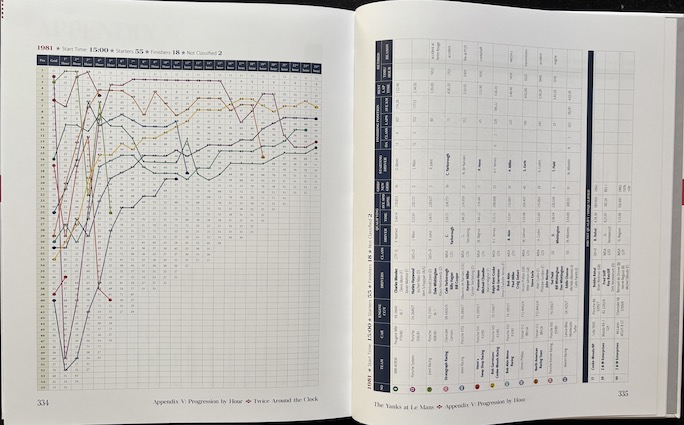
A spread from the “Progression by Hour” appendix. The graph is portrait, the corresponding table landscape; after you’ve wrestled the book this way and that a dozen times you too will think that correlating one page to the other ain’t easy—but there is really no solution that doesn’t beget other issues!
A few practical matters: these are two separate volumes but are meant to function as one in that they share no overlapping material. Page numbering is consecutive and each has its own Table of Contents. The Index (cars, people, teams) for both is only in Vol. 2. Each year ends with a results table. There is a Bibliography but it is unusual in that it really is a sort of reading and resource (internet, archives and the like) list; each contributor offering his own. There is minimal duplication but two names appear all the time: Quentin Spurring’s multi-volume Le Mans, The Official History (now continued by John Brooks, for Evro) and János Wimpffen’s Time and Two Seats which magisterially covers sports car and grand touring racing 1953–1998. Considine himself singles out Albert Bochroch’s Americans at Le Mans (1976) as “a landmark work” and “a great inspiration for Yanks.”
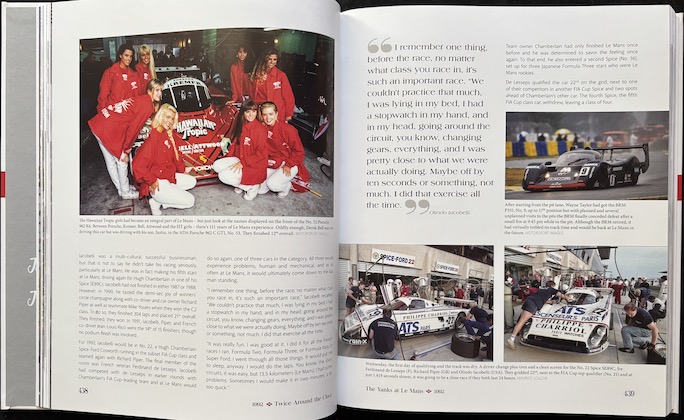
We leave you with a chuckle: So the Hawaiian Tropic girls (l) do own clothes!
- Europe: Hortons (UK) also has an allotment of the first set in stock but will set their own price.
Copyright 2025, Sabu Advani (speedreaders.info).

















































 Phone / Mail / Email
 RSS Feed
 Facebook
 Twitter