
It’s… A… New Track Record!
An Incredible “Decade” of Speed at the Indianapolis Motor Speedway 1962–1972
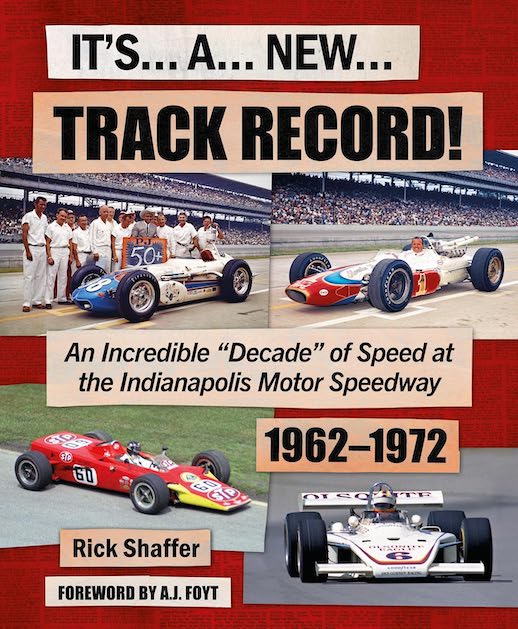 by Rick Shaffer
“Jimmy [Clark] and I are thinking of sponsoring an award next year for the highest-finishing American.”
—Graham Hill, 1966 Indy winner
I need to preface this review with the words you hear at the end of radio advertisements: #Terms and Conditions apply. I’ve paid polite but superficial interest to the Indianapolis 500 since, as a fourteen-year-old, I read about how Parnelli Jones (whoever he was) had seized defeat from the jaws of victory in the STP Turbine in 1967. Over half a century later, I might know my Sneva from my Hurtubise and my Mystery Eagle from my Lotus (‘Powered by Ford”) 38, but I’m still more of a Johnny Come Lately than a Johnny Rutherford.
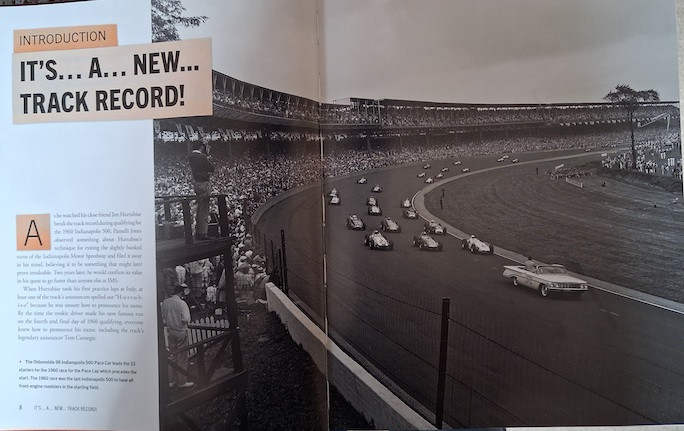
Pace Lane, 1964
Sharp-eyed readers will already have realized why the decade in the book’s title is in quotes, because the book actually spans eleven years of the Indy 500. Those years witnessed exponential change at the Brickyard and, as the author puts it, “Ten years later, 150 mph at Indy was no longer a big deal, but no-one in 1962 could have come close to predicting what would be happening at the Speedway 10 years in the future.” Too true—1972 winner Mark Donohue qualified at an extraordinary 191 mph, over 40 mph mph faster than 1962 winner Rodger Ward had managed in his Leader Card 500 Watson/Offy Roadster.
After AJ Foyt’s foreword (now there’s a man who isn’t troubled by self-esteem issues) and a scene-setting introduction, the bulk of the book comprises a detailed description of the eleven successive 500 races.
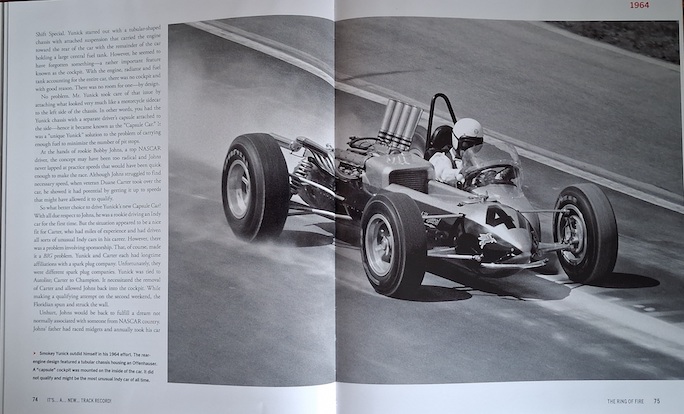
Smokey Yunick, 1964.
The author takes a forensic approach to dissecting the story of each race, covering cars and drivers, regulation changes, qualifying, the race itself and its aftermath. Few stones are left unturned and so the reader even learns about the make of the pace car and its driver, including, in 1969, the 1960 winner Jim Rathmann in a Chevrolet Camaro SS (“the first of a record-tying six times as Pace Car driver”).
If you read the book over a couple of sittings, as I did, there’s a danger that it will leave you almost punch drunk with facts and stats. Better to consume it in smaller doses, one year at a time (typically 20–30 pages) and to read slowly and carefully, with breaks to Google the cars that aren’t illustrated. And, oh yes, to savor the wonderful diversity of the illustrations which are included. Of course, I had expected to marvel at the longevity of the Indy Roadster, and in my snobby Eurocentric way to snigger at the Yanks from racing dinosaurs long after the last front-engined race car had contested a Grand Prix (Ferguson P99, 1961, since you ask). And to wonder why the home of the V8 stuck with grumbly old four pot Offenhausers for decades.
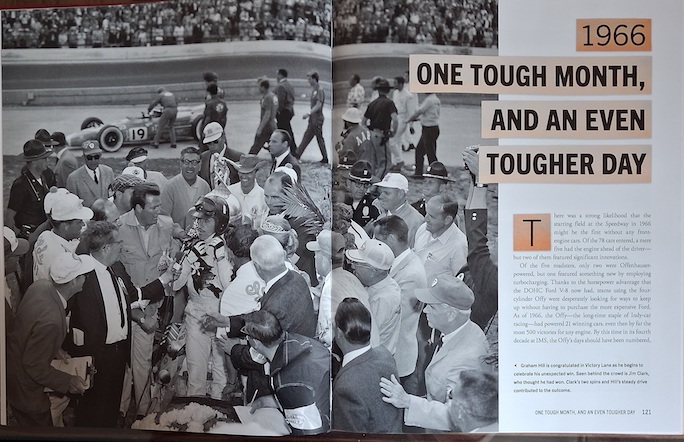
Graham Hill, rookie victor in 1966.
Of course, I knew that the Indy 500 was huge, one of the three blue riband events which make up the Triple Crown (so far only won by Graham Hill of Britain), but perhaps I hadn’t realized just what an occasion Indy was until I started to savor the expertly curated illustrations in this hefty, large-format book. Immense crowds in grandstands stretching to near infinity, tough guy drivers, crew cut team guys, jacket and tie bosses, and race cars of every hue and dimension. But for this reader there was also an intriguing subtext, which is the innate conservatism of an event held in America’s Mid-West.
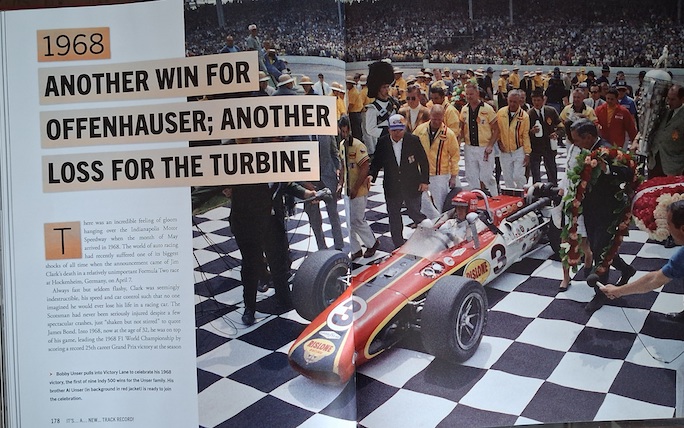
Bobby Unser, Victory Lane 1968.
The same teenager who read about Parnelli Jones’ traumatic 1967 was also listening to long-haired* psychedelic bands from the West Coast. But that acid rock iconoclasm might have been happening in another universe, judging by the crushingly conformist looks of the Indy folk portrayed in the book, nearly every single one of whom was white, incidentally. The book’s wordy title might evoke a lost track from Sergeant Pepper, but you’d search in vain to spot any countercultural Sixties zeitgeist at Indy. The soundtrack was Back Home in Indiana, not White Rabbit. I make these comments not as a criticism, but to reflect the fact that, to European eyes, the mores of the United States could manifest themselves in startlingly different ways.
Sixties’ motorsport went through bigger changes than at any other time in its history. While this happened on both sides of the Atlantic, there were differences in the pace and manner in which change was espoused. We learn how Jack Brabham’s ninth place in the 1961 race, in a Cooper Climax T54, had led the way for rear-engined race cars, but eyebrows might be raised on reading that the last front-engined car, a Mallard, competed as late as 1968, in Jim Hurtubise’s hands. The influx of European-based racers came as a seismic shock to the status quo, never more so than when the Colin Chapman/Jim Clark double act started to disrupt the Indy grandees in 1963 and triumphed in 1965 in the raucous Lotus 38. I was once told by Clive Chapman that when Classic Team Lotus restarted the 38’s quad cam Ford V8 (after its long years as a museum exhibit) it literally blew the plaster off the garage walls.
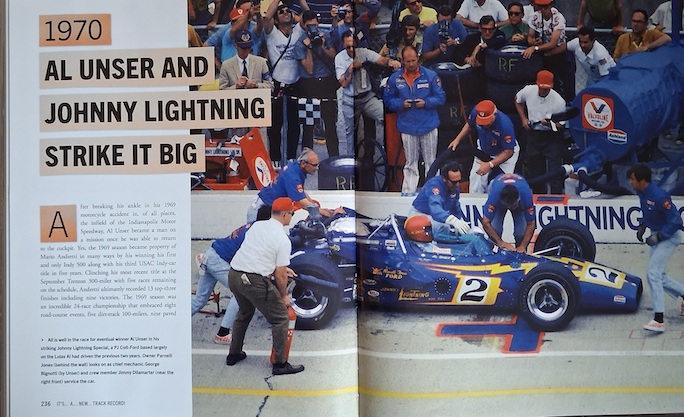
Al Unser, Johnny Lightning Special, 1970.
An aspect of Sixties’ Indy which I find hugely endearing is that, although the race was already steeped in tradition, a refreshingly laidback approach was taken in stipulating the specification of cars that could compete. In contrast to today, when you can only run what you brung if your race car has a Dallara badge on the front and a V6 Honda or Chevy in the back. I loved how Rick Shaffer doesn’t neglect the wild and the wacky diversity of race cars entered by the dreamers, visionaries, and complete no-hopers. I enjoyed reading how Mickey Thompson’s creativity resulted in cars that were often strangers to precedent or convention. And cripes, how about Smokey Yunick’s Offy-powered capsule cockpit fever dream of 1964? Or the oh so elegant Larry Shinoda-designed Watson Ford of ’65?
Formula One embraced sponsorship with the lightest of caresses, as it became obvious that bonuses from Shell oil and Champion sparkplugs weren’t going to pay the spiralling bills. Sponsorship was considered by many to be a grubby necessity, but nothing to brag about. What a contrast to Indianapolis’ full-on embrace of commerce, resulting in hugely photogenic cars with names that couldn’t fail to make you grin. In Europe we had to settle for Coopers the color of a November day, but at Indy there was eye-searing livery and such exuberant names as the Zink–Urschel Trackburner (1965), the Thermo-King Auto Air Conditioner (1969), and the STP Pylon Windshield Wiper Blade (1972).
The sine qua non of the Indy 500 is its sheer speed, of course. While Clay Regazzoni notoriously dismissed Indy as “easy, just a left, left, left,” nothing is easy when you’re drafting the car in front and entering Turn 1 at a speed Formula One cars never reached in Clay’s day. I felt that the book found its voice when even the sober-sounding author fails to disguise the excitement triggered by the massive escalation of speed in 1971/2. Before then, speeds had increased slowly, year on year, but between 1970 and 1972 the fastest race lap jumped by—snakes alive—20 mph. The alchemy of slicks, wings, and big power turbos were enough to make heads turn on both sides of the Atlantic. And it kept on keeping on after the era spanned by the book, peaking at the barely believable 237mph set by Arie Luyendyk in 1996.
The author doesn’t shrink from describing the many huge accidents that are the inevitable consequence of big fields of cars fighting for position at speeds most of us only experience in aircraft. In a wider context, he also touches on the deaths of F1 drivers like Jo Schlesser, Lorenzo Bandini, and Ludovico Scarfiotti. However, most curiously, he doesn’t mention the loss of Bruce McLaren in 1970, despite McLaren’s presence in the 500, including the 1972 win. This minor quibble apart, the author does full justice to the cast of larger than life characters who peopled the Speedway in the month of May. From the household names—Andretti, Foyt, Clark, Unser, Gurney—to the “nope, no bells ring” Bud Tingelstad, Chuck Rodee or Norm Hall, they’re all here.
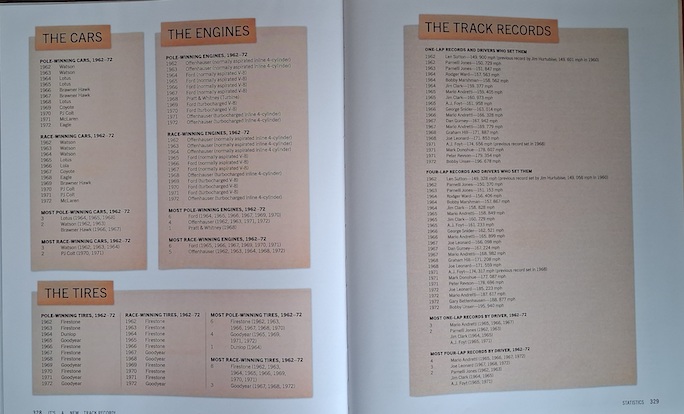
You want stats?
If you’re an Indy aficionado, more of this book will be familiar to you than it was to me, but it will still tell you stuff you didn’t know. And if you’re a Brit with a superficial interest, two things will happen. After reeling under the weight of new facts and figures you’ll start watching Sixties’ Indy 500s on YouTube. And testimonials don’t come much better than that, right?
- I read in Autosport that, in 1972, chief steward Harlan Fengler had ordered long-haired mechanics to either get their hair cut, tie it in a bow or wear a hairnet!
Copyright John Aston, 2026 (speedreaders.info)







 Phone / Mail / Email
 RSS Feed
 Facebook
 Twitter