

An Illustrated Guide to the McLaren F1
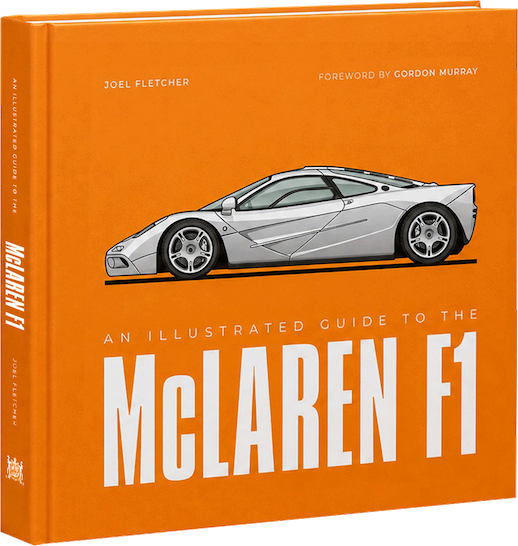 by Joel Fletcher
“This book began as a poster. For many years I had wanted to create a poster that visually documented every McLaren F1 road car chassis produced.
This book is an extension of the poster and acts as a visual guide to each road car.”
Indeed the genesis of this book is the series of poster prints that the author produced for Porter Press. Unusually for the publisher this book does not contain a single photograph, although it does boast of over 400 illustrations. In the Forward, the F1’s designer Professor Gordon Murray CBE remarks, “This book is pure genius and will surely become the definitive document of the art of the McLaren F1.” And the art is really what this book is about.
In essence it consists of entries relating to each of the chassis produced, 106 in total. These include:
- 6 original prototypes
- 64 road cars
- 28 GTR race cars
- 5 road-going Le Mans celebration cars (LM)
- 3 GT long-tailed cars (including the prototype)
Each chassis has at least one page devoted to it. The 64 road cars include build dates, (original) paint color, and VIN. Illustrations are mostly side elevations and occasional plan (top down) views. There are also summaries of ownership; that they are mostly incomplete is perhaps unsurprising in view of the high profiles of the typical F1 collector. More space is devoted to the track cars, with racing history summaries and, where appropriate, the different racing liveries.
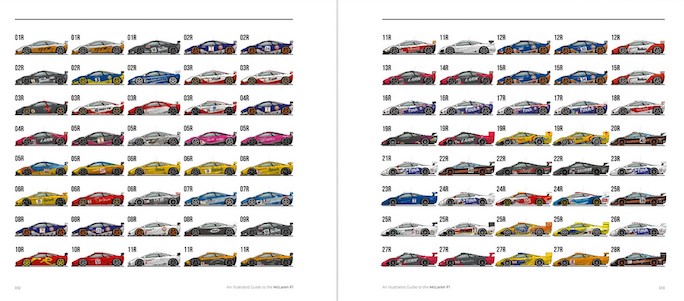
McLaren GTR liveries.
There is no index; if there was one, Brunei would likely constitute the largest entry—ten F1s were purchased by them. Interest is piqued by the chassis / page headings. The George Harrison F1 (025), The Mexican Drug Cartel F1 (039), The Elon Musk F1 (067) certainly draw you into the story. In actual fact all of the descriptions are worth reading. The Rowan Atkinson (Johnny English, Black Adder, Mr Bean actor) F1 chassis 061 generated what was allegedly the then-highest car insurance claim ever made (a reputed £910,000 in 2011) when contact with a tree resulted in engine and gearbox being separated from the rest of the car.
The book is right up to date. It includes the more than $34m paid for #R10 at the 2026 Monterey Car Week auction. R10 never actually raced although it had once been put into a tire wall on a demonstration run, by then-owner Pink Floyd drummer Nick Mason at the 2017 Goodwood Members Meeting (not the Revival as the author states—I was at the Members Meeting and saw Mason’s embarrassment first-hand).
What really sets this book apart from others is the research into the color schemes / liveries. When you put your deposit down for an F1 you had a choice of 31 colors, a rich palette but obviously not on the order of a Ford, GM, or Toyota. The race car section contains a number of contributions from Andy Blackmore who designed the liveries for the earlier GTRs.
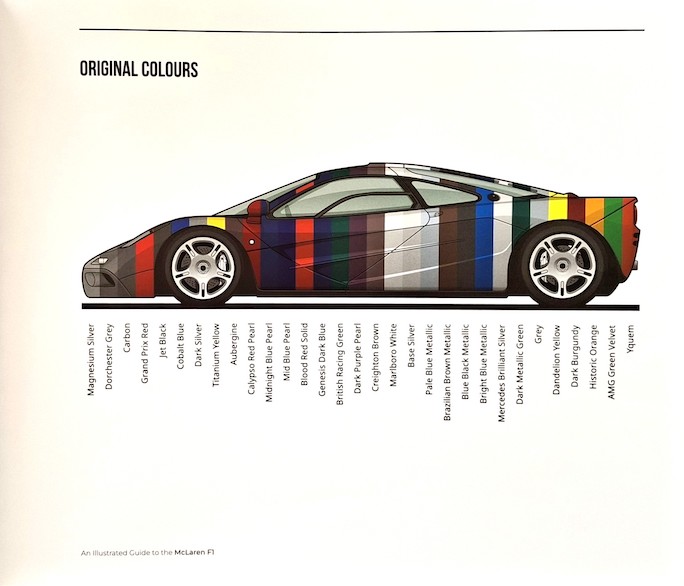
McLaren F1 color chart.
First and foremost this is an artwork book, as already mentioned. Technical information is slight. Only in passing is it mentioned that the F1 is a three-seater with the driver in the middle, although you might have noticed this in the occasional top-down view. You will be intrigued to know that the George Harrison F1 (025) features hidden symbols including an elephant.
This book certainly made me want to discover more about the F1. For example, when built in the mid-1990s they were provided with a Facom diagnostic toolkit as it was easier to send a technician to the car rather than return the car to the factory. The toolkit was linked to a Compaq LTE 5280 laptop which nowadays is likely rarer than an F1. Also, if you lost your F1 car key it might set you back $300k for a replacement. One thing I wasn’t able to find is an explanation of why there are gaps in the chassis numbers of the road cars. The last number is 075 although only 64 were built. The discrepancy is partially explained by adding three race cars being built from converted road chassis.

McLaren F1 and toolkit.
Everything is relative but at £45 the book is not an inexpensive purchase. On the other hand, Driving Ambition: The Official Inside Story of the McLaren F1 by Doug Nye with Ron Dennis and Gordon Murray and published by Virgin (first ed. 1999) is likely to set you back a steep multiple of that. Porter Press’ own 2-volume Ultimate McLaren F1 GTR, The Definitive History by Mark Cole (2020) starts at £450 for the standard edition. Meaning, if you are a McLaren F1 fan then this new book is on the more affordable side.
In summary, this book is similar in principle to The Ferrari 250 GTO Spotting Guide by Yan-Alexandre Damasiewicz. It is larger in format but has less detailed change and race histories (there were only 36 250 GTOs but 106 F1s). It is an enjoyable “taster” for a car that when it emerged in 1992 set a new standard for a supercar. The F1 was the fastest production car at the time with a record speed of 240 mph. It was also the last car significantly based on a road car design to win Le Mans.
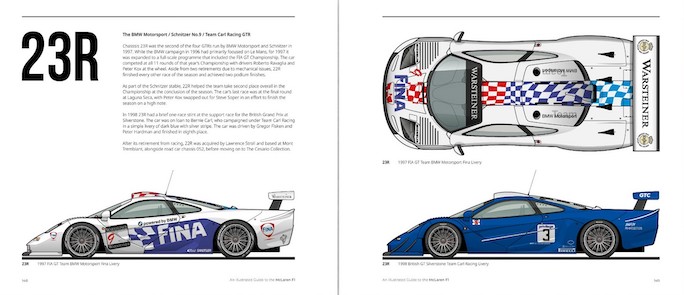
McLaren F1 based on the road car.
Joel Fletcher is a graphic designer from New Zealand with a lifelong passion for cars; he grew up going to car shows, reading car magazines, and drawing cars. That early obsession evolved into a career combining design and automotive culture.
Copyright 2026, Paul Lea (speedreaders.info)

















































 Phone / Mail / Email
 RSS Feed
 Facebook
 Twitter