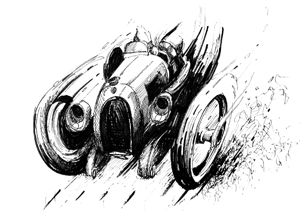

Chrome Dreams, Automobile Styling Since 1893
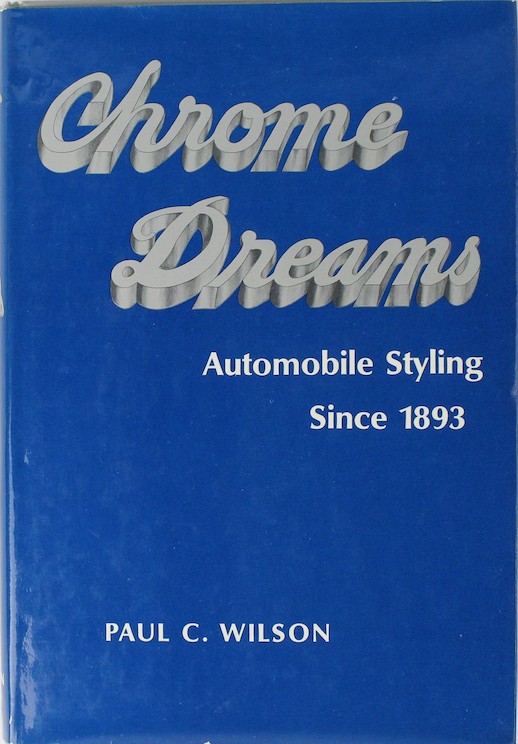 by Paul C. Wilson
“In 1902 the public suddenly began clamoring for tonneau bodies, just as they did for front hoods.”
This book was written and published some time ago, in fact half a century ago. Ostensibly it’s a survey of the history of automotive styling over the prior 70 or so years. Reading it in 2026, its shortcomings with a premise entirely too facile and unrealistic are apparent.
Although the author had attained both an M.A. and Ph.D, he was neither a historian or an automotive journalist, nor was he employed in any facet of the automotive industry. Rather Paul Wilson was an enthusiast who, at the time of writing this, his second book, was working on a couple of hobby cars per the dust jacket bio, an unlikely pairing of a 1902 Renault and a Jaguar XK120.
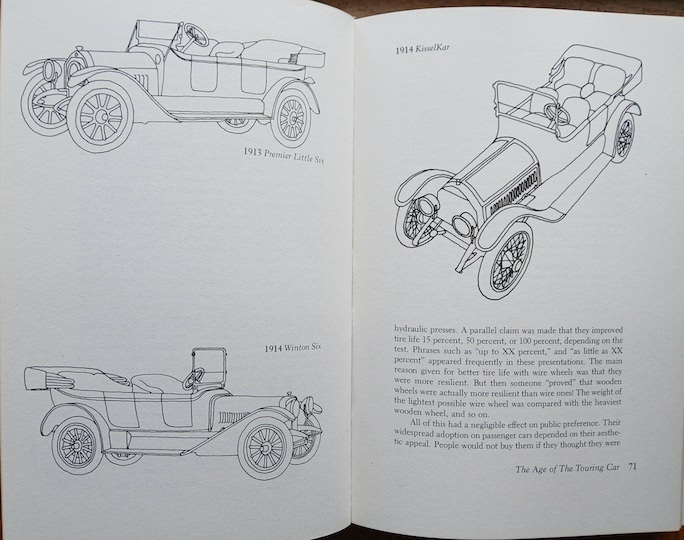
Left, top/bottom 1913 Premier Little Six/1914 Winton Six. Facing page 1914 Kissel Kar.
From the small type at the very bottom of the masthead page, we learn that Wilson also created the 316 line drawings of various automobiles that illustrate his book’s pages, though they were inked for publication by another. It’s likely he had much more expertise in the topic of his first book. It was titled Modern Rowing. Again, per the dust jacket bio, Paul Carroll Wilson had participated in that sport.
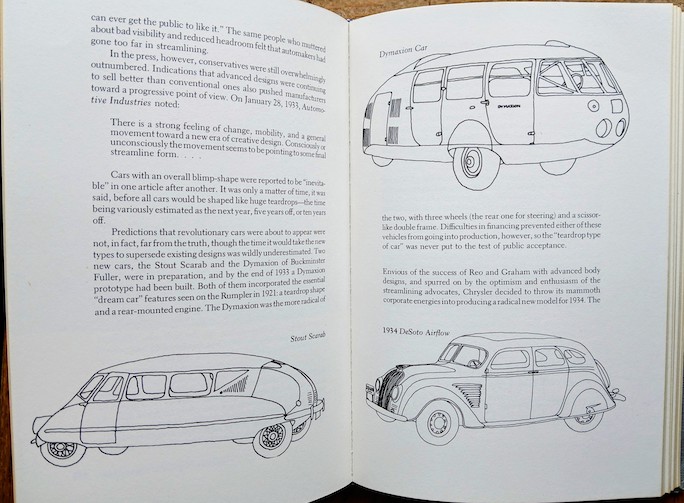
Left, Stout Scarab. Facing page top/bottom Dynamaxion Car/ 1934 DeSoto Airflow.
A caution to anyone trying to find more about this book or Wilson online: be sure to specify Paul Carroll Wilson (b. 1944) in your search because there are at least five different published authors writing under the name Paul C. Wilson.
While the book has no bibliography, Wilson selects citations from The Horseless Age issues of the latter 1800s through the early 1920s to “support” his contentions. As the timeline moves into the latter 1920s on, Automotive Industries becomes his source. Then for the decade mid-1950s to mid-1960s, various issues of Motor Trend are his main source of quotes.
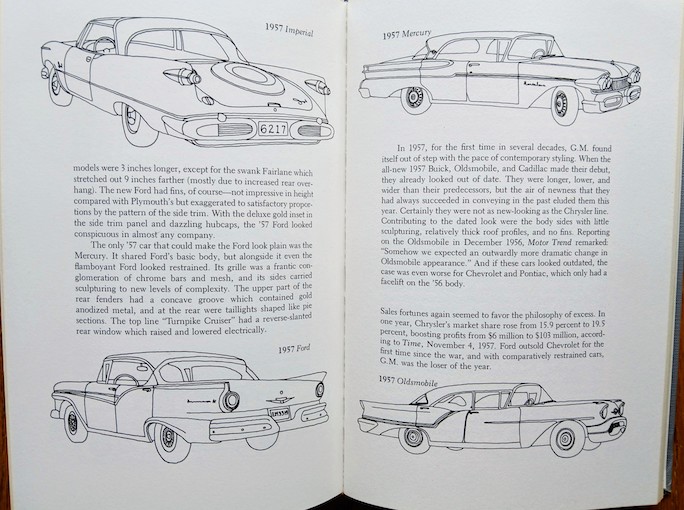
Left then right, top/bottom: 1957 Imperial/1957 Ford; 1957 Mercury/1957 Oldsmobile.
The trouble is, Wilson’s premise is flawed. With the entire US population a bit over 70,000 and with no more than 2,500 motorized vehicles operating in all of the US in 1902, it’s difficult to believe “the public suddenly clamored” for anything related to the automobile, as he wrote and we quote in the opening. Not only were motorized vehicles few and far between but they cost more than most citizens could afford even had there existed roads on which to drive them—which there were not.
Thus Wilson’s contentions really only apply to elite and wealthy big city dwellers. Autos were not sold widely in those early decades nor were sales dependent upon styling considerations unless the buyer was negotiating for a bespoke custom-bodied vehicle and those aren’t even mentioned or acknowledged by Wilson until deep into his third chapter, nearly halfway through the book. Moreover, Wilson makes no mention of the lack of roads or highways. So he’s not likely consulted or read John Butler’s The First Highways of America published by Krause Publications fully two years before his own book.
Although two publications offering genuine historical perspectives and article were and had been available, there’s no indication anywhere in Wilson’s book that he was aware of either, much less reading one or both. Automobile Quarterly had commenced publication Spring of 1962 while Special Interest Autos began publishing in 1970. Of course Wilson didn’t have access to two truly outstanding design histories, both of which earned multiple awards: A Century of Automotive Style (1996) by Mike Lamm and Dave Holls and Matthew Kilkenny’s Detroit Steel Artists (2002).
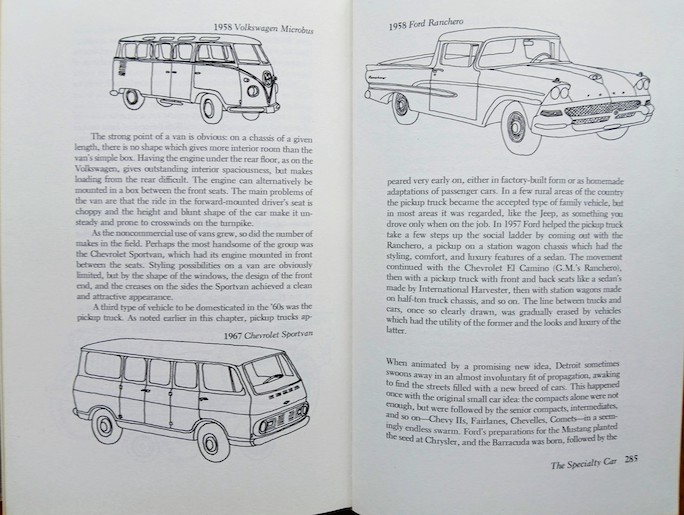
Left top/bottom, 1958 Volkswagen Microbus/1967 Chevrolet Sportvan. Facing page 1958 Ford Ranchero.
As the timeline of Wilson’s narrative reaches post WWII, what he writes is more realistic for by then manufacturers truly did have well-staffed styling departments. “By the early ‘50s family resemblances among cars of one corporation had come into sharp focus. By then, styling chiefs had had a chance to view the offerings of their competitors and form a coherent philosophy of styling development to guide the progress of all divisions” as he proceeds to survey cars offered by manufacturers up to the mid-1960s although he can’t resist including his personal criticisms and opinions of some.
So what’s the point or purpose in telling you about this Chrome Dreams book? For one, it’s a reminder to always read with a critical eye and questioning mind and not just blindly trust the author or writer really knows his or her subject. It’s also an example of using essentially single sources to prove a point—especially a personal opinion—by selecting passages to quote in such a way the words seem supportive of “your” position. And for writers it points up the need to make doubly certain what you write stands up to scrutiny and can be and is cross referenced.
Copyright 2026 Helen V Hutchings (speedreaders.info)


















 Phone / Mail / Email
 RSS Feed
 Facebook
 Twitter