
Senna: The Truth
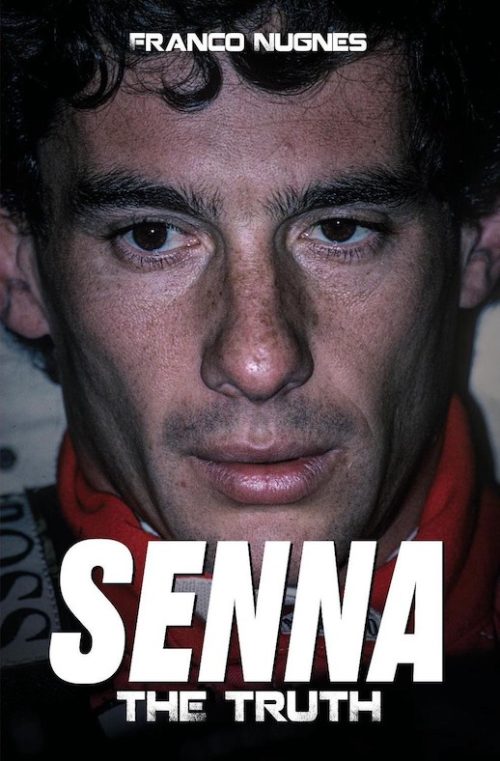 by Franco Nugnes
“Many books have been written about Senna, some very interesting, others very well written, too many unable to go beyond chronicle or beatification. We are confronted here with an academic text; those who choose not to dive in to these pages will never know what they have missed.”
—Carlo Cavicchi in ‘Autosprint’
I watched a lot of Formula Ford 1600 races in the 1980s. I’ve forgotten most of them, but I remember the May 1981 race at Mallory Park. I had never heard of the driver in pole position, but within half a lap I knew that I was watching a driver with extraordinary talent. He won at a canter, and his name was Ayrton Senna da Silva.
I last saw Senna in qualifying for the 1993 Grand Prix at Donington Park, where his commitment through the 170 mph Craner Curves was breathtaking. And you don’t need me to tell you what happened in next day’s wet race.
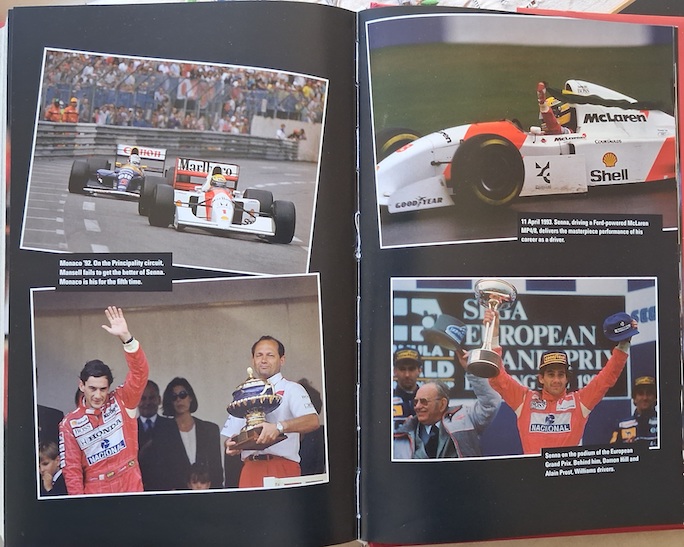
Glory Days – McLaren 1992/3.
There’s at least a score of books about Senna, including Richard Williams’ The Death of Senna (1996). At the time of his fatal crash in May 1994, Senna was already the most famous racing driver in the world, and his death at Imola ensured that we’re still talking about him 30 years later. There’s a comparison to be drawn with Princess Diana where, although the circumstances of her death were tragically straightforward, that hasn’t stopped a whole industry of speculation and conspiracy theories thriving ever since, simply because of who she was. And, just like Senna, she’s become a latter-day secular saint. Now we have another book about The Great Man and my job is to decide whether, a third of a century after his death, there can possibly be anything new to say.
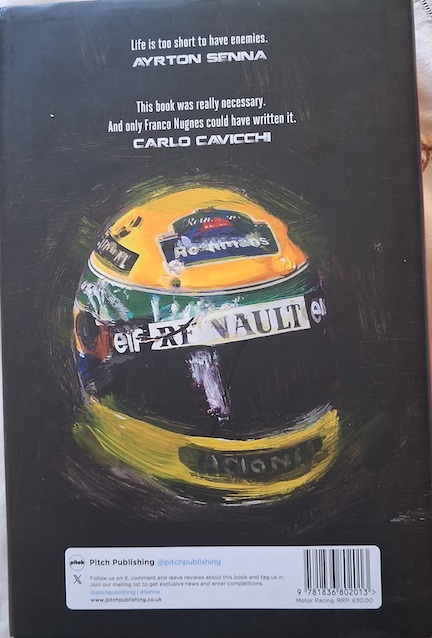
Back cover – Senna’s damaged helmet.
This 400-page book (nice pictures, not so nice paper) addresses not only Senna’s death, but also his ascent from unknown, via “coming man” status to multiple world champion. Author Franco Nugnes is an Italian journalist whose career includes a long tenure at motorsport bible Autosprint. His approach is to tell the Senna story by a mosaic of over thirty interviews with those who knew Senna, or who played a part in his story, both before and after 1 May 1994. They range from his photographer friend “and true confidant” Angelo Orsi to public prosecutor Maurizio Passerini, and Massimo Gambucci, Race Director at Imola. Most chapters are presented in a Q & A format, which perhaps suits a book whose essence is inquisitorial, but the translation from the original Italian can make reading the book feel like driving down a bumpy road.
The language is often florid and the repeated reference to Senna by his nickname “Magic” is an irritation. Each chapter begins with a quotation—with sources ranging from Demosthenes to Jim Morrison—and, while the reason for their inclusion was presumably to elevate the text, it can feel like the quotes have been shoehorned in to bestow spurious authority.
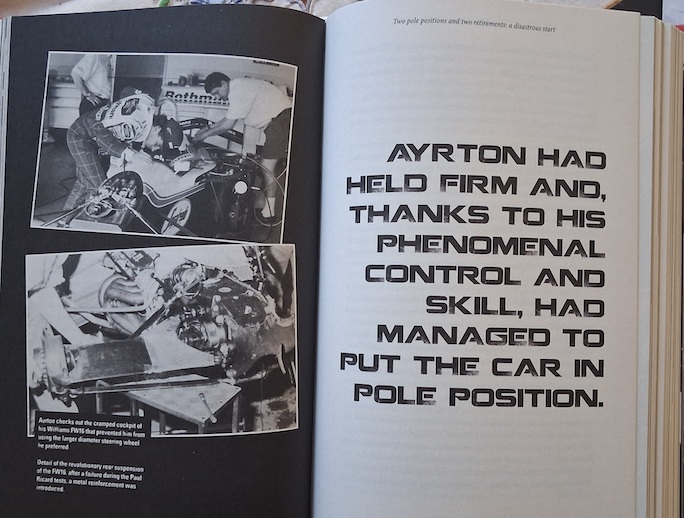
FW16 in 1994 (another) reminder of Senna’s genius.
The “Truth” of the book’s title is, to no great surprise, the revelation of the exact circumstances of, and the culpability for Senna’s death in the Williams FW 16. There can be TMI—some readers, especially those with a true crime TV habit, might appreciate the forensically detailed account of how Senna’s skull was pierced by a suspension component, and its grisly effects. I didn’t, because I already know enough: Senna crashed heavily at Tamburello and he died the same day from his injuries. Nugnes shows terrier-like determination in establishing not just the effect of the crash on car and driver but about its causation, and it’s the latter which will interest most readers.
Long story short, the Williams’ steering column broke, the team say because of the impact with the wall, but the majority view taken by Nugnes’ interviewees was that the column broke before the crash, and thus caused it. Further, that the only reason it broke was because the modification work on the column (to make the car more drivable by Senna) was carried out badly.
The book focuses on the culture clash between the quintessentially Anglo-Saxon Williams team and the Italian authorities. Ironically, for a country whose legal system was influenced by Roman law, the Brits tend to sneer at the Italian system where a criminal investigation is launched when a driver is killed at a race track. The author suggests that the British treat motorsports deaths less seriously because motor racing is inherently dangerous and therefore it’s just bad luck if somebody is killed in a race. Both views are cynically reductive and, despite the disdain that each country seems to exhibit for the other’s legal system, both of them actually take a broadly similar approach to sudden death. In England a coroner’s inquest is held to establish the cause of death and, in Italy, there is a criminal investigation to the same end. Neither process means that somebody is automatically at fault, and the function of the tribunal is to find out what happened.
But the British specialist press has often been hysterical in its criticism of the Italian judicial process, which they saw in action following the deaths (both in Lotus F1 cars) of Jochen Rindt and Ronnie Peterson at Monza.
There are lots of voices in this book, and too many of them portray Senna as someone worthy of post-mortem beatification. Take this oleaginous guff about Senna’s first Willams test at Donington: “Ayrton had shown an unquestionable natural speed, combined with a refined knowledge of technique, the result of a superfine sensitivity that had left the incredulous Williams open-mouthed.” Or this, about how Senna was underestimated even when he was signed for his first drive in Formula 1 with Toleman: “And even in England, where Senna dominated, he did not enjoy the attention his performances would have deserved.” What?? Along with everyone else who followed or reported upon UK racing (especially F3, then one of the most important single seater championships in the world), I was never in doubt that Senna was destined to excel in Formula One.
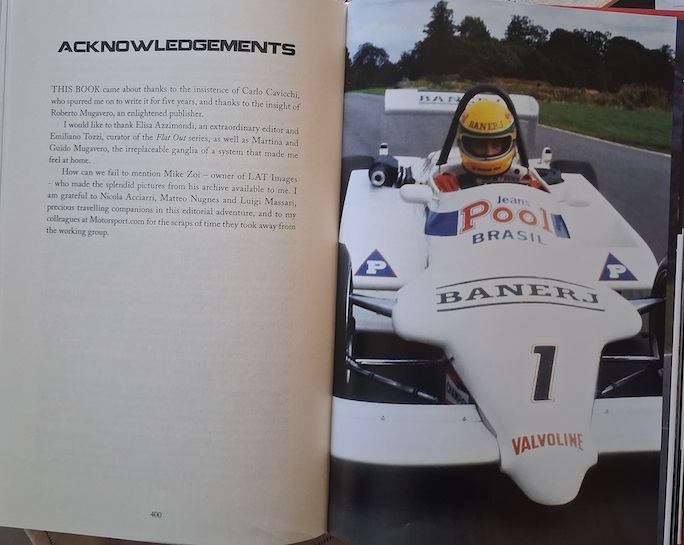
Senna in Formula 3 Ralt F3.
I would have liked to have heard some dissenting voices about Senna, and not the hagiographic chorus I had to endure over the book’s 400 pages. Some grit in the oyster would have balanced the adulation. I’d liked to have heard Mansell, Prost, Brundle, and Piquet’s recollections of the driver whose brilliance was often compromised by his ruthlessness. What would they make of this claim, I wonder: “Ayrton was vicious and aggressive, as well as extremely fast, but he had a sporting upbringing that dictated he should not go beyond certain limits.” Which was MIA when Senna broke the “gentleman’s agreement” that whoever led at the start of the San Marino Grand Prix in 1989 would not be challenged until after Tosa. And the same driver, Senna’s nemesis Prost, was deliberately rammed by Senna at Suzuka the next year. Senna was a sublimely gifted driver, but in the words of Monty Python, “He’s Not The Messiah, He’s A Very Naughty Boy” …
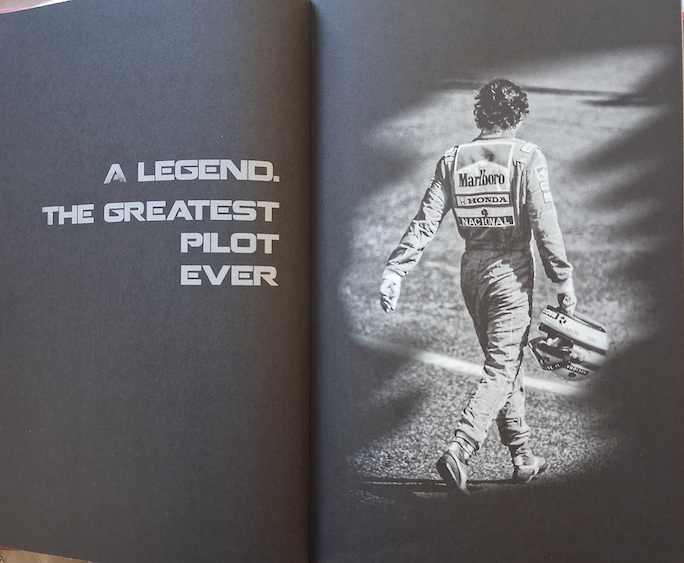
No shortage of hyperbole here.
I’ve been a steward for one of the British historic racing clubs for several years. In deciding the responsibility for on-track incidents, I have learnt that very few are deliberate, that minor mistakes can have serious consequences and major mistakes can have trivial consequences. That experience, and this book, has made me reflect further on the events at Imola on 1 May 1994. The death of Ayrton Senna still resonates for two reasons—it took place on live TV in front of a huge global audience, and it involved the death of the man who was already iconic, including in the literal sense. The degree of adulation of Senna in 1994 had already reached cargo cult intensity and, regardless of the reasons for the accident, it would have been impossible for Senna’s death to have gone as relatively unremarked as those of Riccardo Paletti and Elio de Angelis. It says more about Senna than it does about the accident that killed him, that 32 years after his death, this book was written. The cause of death was a breakage that should never have occurred. But let’s suppose that, instead of breaking at Tamburello, the steering column had broken on the exit of the pit lane. All the dramatis personae would have had precisely the same degree of involvement and culpability as they did for what actually transpired, but without the ghastly consequences. Suppose that Nigel Mansell had lasted a lap or two in the 1991 Portuguese Grand Prix after his wheel nut was inadequately secured, instead of falling off in the pit lane, to the amusement of all except the guy with the moustache. Let’s imagine that Mansell’s wheel had fallen off at the fast Orelha corner, with fatal consequences. We’d still be talking about it now, instead of remembering an incident which was the Keystone Cops made flesh. Is it right always to judge a mistake only by its consequences and not by its cause? I don’t know the answer to that question but it is to the credit of this book that I was compelled to consider it.
The amount of research undertaken by the author was immense and, whilst I raise an eyebrow at some of the more unqualified praise of its subject, judged purely as an investigative effort this book is a tour de force.
Copyright John Aston, 2026 (speedreaders.info)


 Phone / Mail / Email
 RSS Feed
 Facebook
 Twitter