
Drive: A Memoir
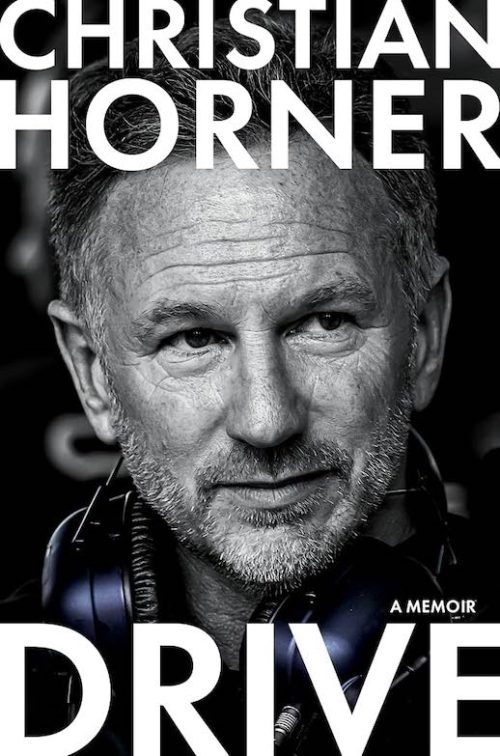 by Christian Horner
“Having facilitated my arrival, I got the feeling that Helmut felt owed. He … disliked me questioning his opinions. Not that I was fussed, because once I understood where his behaviour stemmed from, it no longer bothered me. In F3000, Arden International had been a much better team than Helmut’s RSM Marko. The fact that he didn’t like me expressing my opinions and ideas was his problem, not mine.”
According to Pitpass.com, Christian Edward Johnston Horner, amongst his many other accomplishments, was also the sixth Beatle. In case you missed the 60s, the fifth Beatle was George Martin, although Pete Best fans might disagree. Horner (b. 1973) was a good enough race driver to compete in Formula Three and Formula 3000, and having established his team boss credentials with Arden Motorsport, he became team principal of Red Bull Racing in 2005 and remained in that post until he was ousted in 2025. He has been on gardening leave since then, but has filled his time writing this memoir, perhaps to distract him from reading the gazillion online rumors about his future.
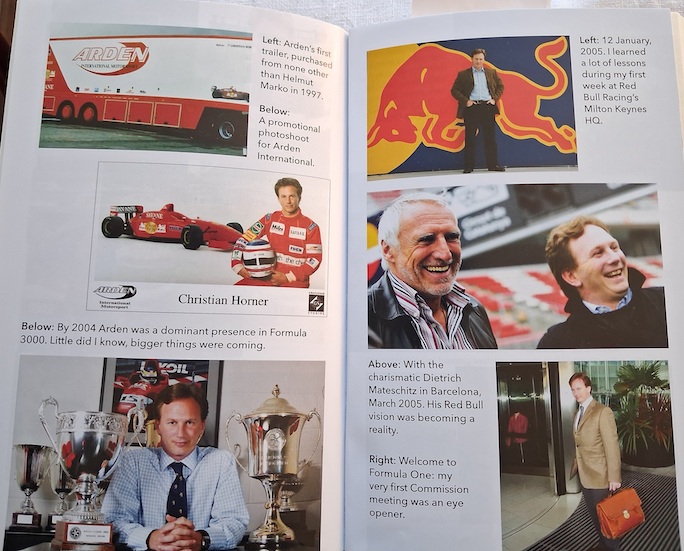
From Arden F3000 to Red Bull F1.
Can writing a best-selling memoir be added to Horner’s catalog of success? Don’t motorsport’s grand fromages normally engage a ghostwriter to do the grunt work in their bios? No ghost is credited, but one of the acknowledgments thanks “Matt Allen for his patience, insight and dedication in helping me tell this story.” I think it’s safe to assume that the man who helped Usain Bolt with his autobiography is also the guy who knocked Drive into shape.
In the UK Christian Horner is known as a Marmite [1] figure, meaning that people either love or hate him, no fence-sitting allowed. The outcome of the farcical Abu Dhabi Grand Prix of 2021, which robbed Lewis Hamilton of what would have been his eighth world championship, polarized views about Red Bull, and the focus of the abuse was their team principal. After scandalous allegations were made about his conduct by another member of the team, Horner left under a cloud in 2025, although his £60+ million payoff insulated his pain.
That’s the guy, so what about the book? It’s a punchy, easy to read account of Horner’s ascent from anonymity to his current status as the most famous former F1 boss alive. Its style is pacy journalese, emphasized by the use of almost randomly placed italics on every single page. Irritating isn’t it? And while the page count runs to over 300, the font is so damned big that the book would struggle to make 200 pages if it wasn’t easily legible from 6 feet away.
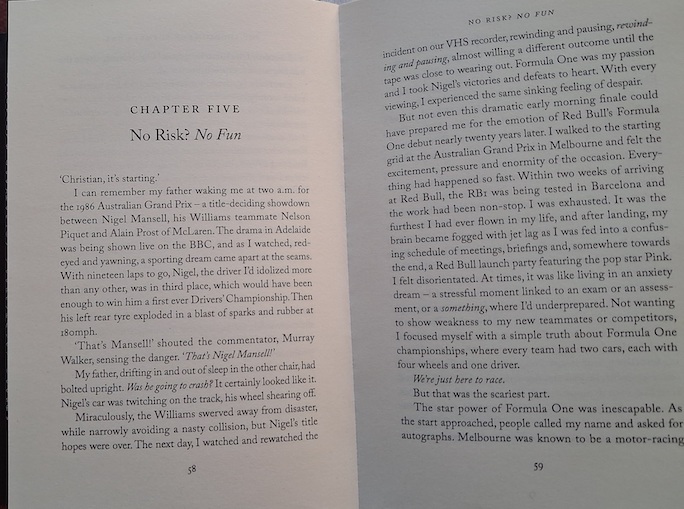
No Risk? No Fun — Red Bull mantra. And, note how italics are used with abandon!
Christian Horner’s story is one of extraordinary success, with Red Bull achieving multiple World Drivers’ and Constructors’ Championship victories. The fact that Horner achieved all this before he was 50, and having started with a Red Bull team that had no track record, is testament to his managerial skill and work ethic. Red Bull bought the Jaguar team in 2005 and inherited a demotivated and unsuccessful team whose principal legacy was to demonstrate that applying a corporate approach to a Formula 1 team doesn’t work well, if at all. See also Toyota, Porsche and Honda …
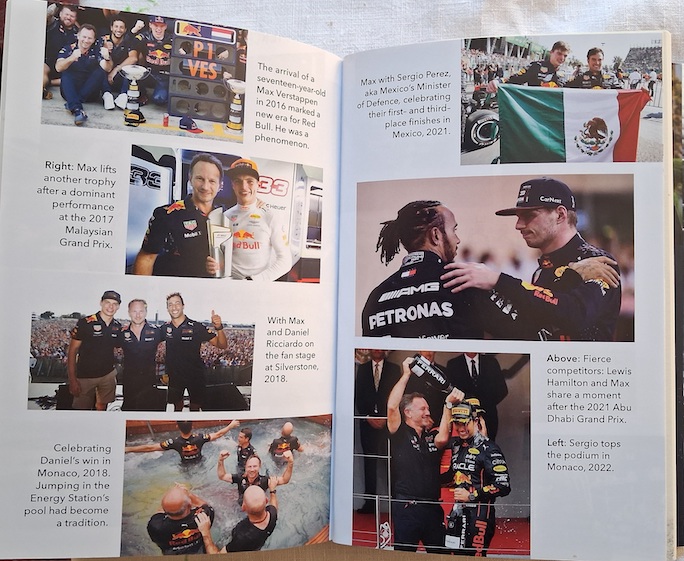
Glory Days—the pride before the fall.
As they never cease to remind us, Red Bull has an iconoclastic approach to the sport, but (like the similarly disruptive Hesketh in the Seventies), the frat boy japes and loud music fail to disguise a ferociously competitive F1 team. The transformation of the sclerotic Jaguar operation to a team that almost forget how to lose, especially during Vettel and Verstappen’s salad days, is testament to Horner’s ambition and drive. His account of those glory years might be familiar to most readers, but it’s still worth being reminded of the stranglehold Red Bull exerted on world championships between 2010–2013 and 2021–24. Not to mention the internecine warfare between teammates. “Multi 21,” remember? Mark Webber sure does …
Aristotle defined tragedy as the downfall of a great man through Hamartia—a flaw commonly manifested by hubris or a surfeit of ambition. In Coriolanus the eponymous hero taunts his enemies by boasting “Alone I did it,” just before being assassinated. Horner grew up near Shakespeare’s birthplace, and if he used any of his downtime to bone up on the Bard, Coriolanus’s words might have resonated with him. Because the reader of Drive isn’t left in any doubt about who was the real architect of Red Bull’s success, and Horner often struggles with giving credit where it is due. Take the brag in the opening quote, where Helmut Marko is dismissed because—in the previous century—Christian’s F3000 team had beaten Marko’s. It’s playground stuff, and if Marko ever reads those words, he might respond in kind, perhaps by comparing Horner’s race career with his own, which included winning Le Mans in a Porsche 917!
If you listen to the audio book of Drive, don’t be surprised if the spoken word is accompanied by the sound of axes being ground. Christian Horner uses this book to settle scores. Not only with arch villain Marko, but Adrian Newey and Toto Wolff, inter alios. Without Newey’s visionary designs, Red Bull would have been lame also-rans, but Newey left the team in 2024, tired of internal power struggles and the effect of scandals around Horner’s conduct. And this is what Horner had to say about his erstwhile friend during Red Bull’s troubled 2014 season, when Newey was considering an offer from Ferrari: “I had his back and I believe he had mine. But at the first sign of adversity, Adrian wanted to abandon ship. … Adrian wasn’t very good in a conflict situation.” I wonder if Ron Dennis had thought the same when Red Bull had tempted Newey away from McLaren in 2006? As for Toto Wolff, “I got the impression Toto took a very different approach. I first noticed it in the way he carried himself; in meetings and conversations, he rehashed ideas and statements I’d heard elsewhere. It occasionally reminded me of that Harvard Bar scene in Good Will Hunting.” In fairness, there is a grudging respect for most of his colleagues, but the book does show why Ron Dennis had famously welcomed Eddie Jordan “to the Piranha Club.”
I assume that non-disclosure agreements and other “lawfare” weaponry are the reason why the reader doesn’t learn anything new about the reasons Horner and Red Bull divorced. There are prescient words from his wife, (the surprisingly impressive) Geri Halliwell, spoken at the end of the 2023 season, after a spat with (you guessed it) Marko about some intemperate comments the latter had made about Sergio Perez: “In my mind, I was digging Helmut out of trouble. Helmut’s opinion was very different: I was a backstabber. … Geri spotted my frustrations [saying] ‘It’s funny, it’s like you get to the top of the mountain and then you realise there’s nothing there…’ She was right. What neither of us knew was that there was an avalanche coming”.
You might—ok you will—disagree with Horner’s claim that neither he nor race director Michael Massi had done anything wrong at Abu Dhabi ’21. But there can be no doubt that Horner was a formidably able team principal. We don’t at present know what his next role will be, but it’s safe to assume that a future biographer will need many more chapters than this book’s scant complement. This memoir will, I suspect, be a mere amuse gueule to the definitive biography—preferably “warts and all” and unauthorized.
- Marmite is a British institution, a black, strongly flavored yeast extract ideally spread on breakfast toast. Don’t trust anyone who doesn’t like it …
Copyright 2025, John Aston (speedreaders.info)


























 Phone / Mail / Email
 RSS Feed
 Facebook
 Twitter