
Landmarks in American Automotive Law
Legal Experts Examine 25 Influential Cases
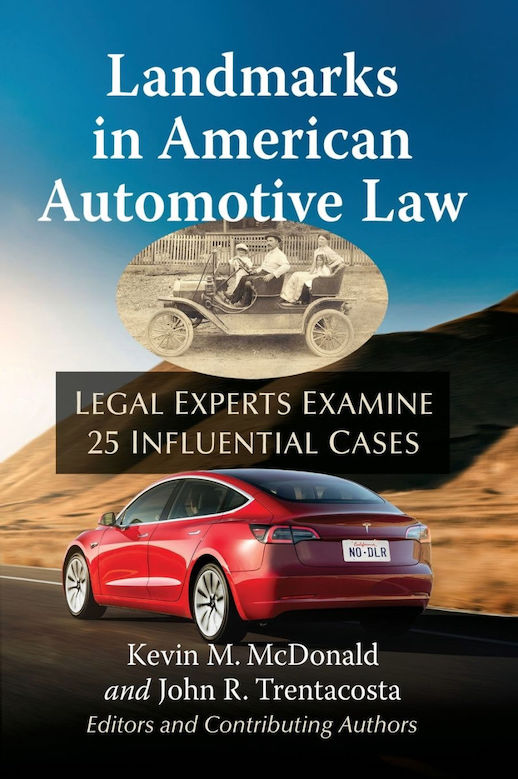 by Kevin M. McDonald and John R. Trentacosta
“Drawing on well over a hundred years of litigation, this book closes the gap in published resources by highlighting the biggest cases and showing how they changed not just the automotive industry, but more importantly, the direction of the law and society at large.”
Is there anyone reading these words who has any doubt that we are part of a litigious society? Although this book examines mostly cases litigated under American law in American courts, a number of the decisions have global impact.
Just how litigious are we? Lee Iacocca is said to have once remarked “There are more lawyers in just Washington, D.C. than in all of Japan. Japan has about as many lawyers as we have sumo-wrestlers.”
The automobile wasn’t yet even called an automobile but still very much in transition from horse-drawn carriage to horseless ones when an attorney (self-serving are the adjectival words that come to mind) named George Selden filed for a patent. Once granted he defended it in the courts winning until finally 16 years after his initial filing, Henry Ford took him on in the courts. And won!
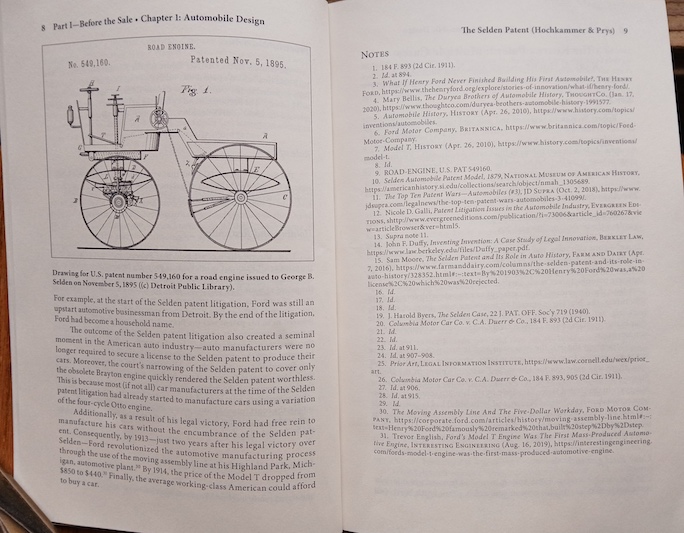
Selden’s drawing with which he secured his patent in 1895. Imagine if it hadn’t successfully been challenged in court by Henry Ford.
You can argue and discuss whether GM’s Corvair was or was not an unsafe vehicle. The point the various writers, all of whom possess law degrees, make in this book is what lasting effects Ralph Nader’s position had changing not just laws but how business is conducted—and not exclusively in the automotive industry, but in every product-producing industry—starting with Congress bringing into existence the National Traffic and Motor Vehicle Safety Act. Four years later, in 1970, it amended that act creating the National Highway Traffic Safety Administration (NHTSA). NHTSA in conjunction with the 1914-created Federal Trade Commission (FTC) “have continued to expand … adding new and overlapping protections for consumers.”
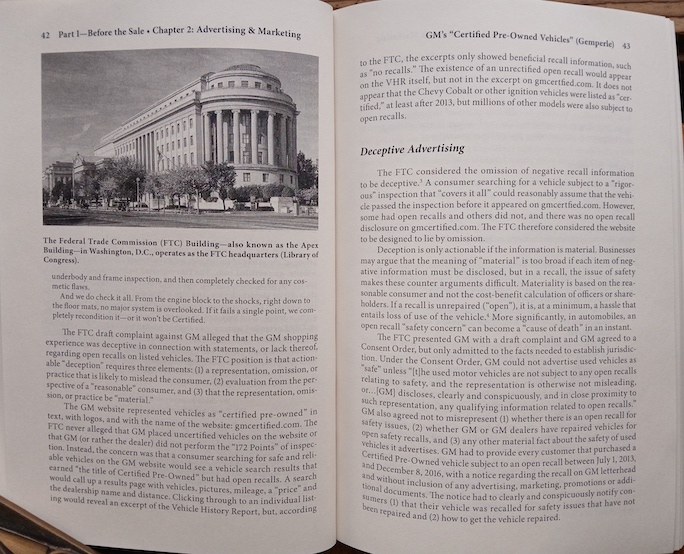
FTC building built in 1938 in Washington DC. Historically it is known as the Apex Building and listed on the National Register of Historic Places.
One particular chapter explores the topic of franchised dealers being the only entities able to sell vehicles directly to customers until Tesla, and subsequently other EV manufacturers, challenged that precept in the courts. Tantalizingly this chapter’s author, Connor Sabatino, writes, “If the dealership model is not economically efficient, that suggests state dealer laws are just a form of rent-seeking, regulatory-capture behavior by dealers, at the expense of both manufacturers and consumers” adding a few paragraphs later “By one measure, dealers are facing an existential crisis.”
Cover to cover this book may not be the most scintillating read as even the co-editors, who also are contributing writers, allude with: “The stories may not keep you reading until midnight, but we are hoping for at least 10:30 p.m.” Yet “the automobiles helps shape American law” in so very many ways and areas making a book such as this one long overdue.
Organized by sections covering “Before the Sale,” “The Sale,” “After the Sale,” ”Criminal Law,” and “Constitutional Law” with multiple chapters in each, there are at least 30 cases (in spite of subtitle indicating fewer) written about with each having monumental and lasting influence on the law and thus how businesses are conducted, products (not limited to just cars either) are made and sold, and more.
With each ensuing chapter, the cases/decisions related become more and more current day issues. One chapter discusses (and is so titled) “Class Action Lawsuits” noting “since enactment in 2005 of the Class Action Fairness Act, the great majority of consumer class actions now end up in federal rather than state courts.”
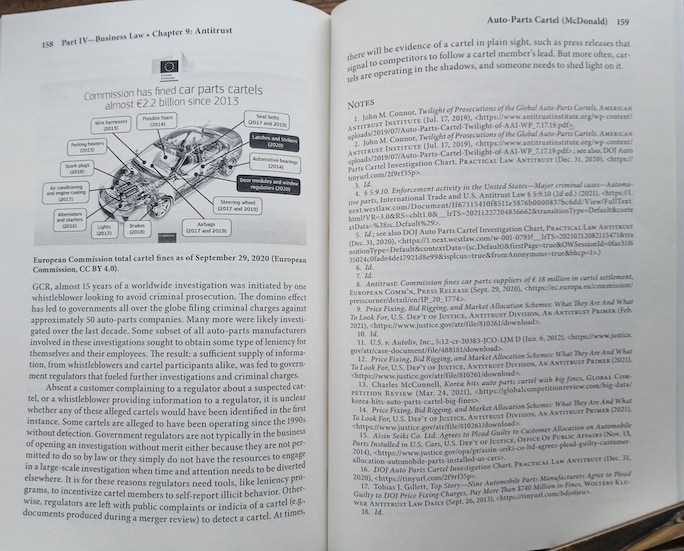
The drawing shows the “European Commission total cartel fines as of September 29, 2020.”
Then the concluding three chapters bring readers into current days with one chapter, as illustrated in the above graphic on left hand page, telling of the global efforts to limit part suppliers from setting themselves up as cartels in order to control volume of supply as well as pricing. The next to last chapter explores the on going legal debate whether Uber drivers are employees or independent contractors and the concluding chapter relates several different cases, instances where the U.S. Supreme Court was called upon to step in when one “State reach[ed] too far into the business conducted in other States. However the Constitution and the Supreme Court provide an abrupt limit to those regulatory actions.”
You’ll gain the most from this genuinely interesting book if you read it in small doses, perhaps a chapter at a time so you can best absorb the information and the ramifications of the various cases.
Copyright 2026 Helen V Hutchings (speedreaders.info)



















 Phone / Mail / Email
 RSS Feed
 Facebook
 Twitter