
Secret Projects of the Luftwaffe in Profile
by Daniel Uhr and Dan Sharp
“It is often stated that Germany worked on too many jet designs, particularly during the final year of the war, and that it would have been better to simply build more Me262s. There is also the view that German aircraft designers were merely making work for themselves to avoid being conscripted and sent to the Eastern Front.”
“The final year of the war” . . . you’d think by that time archly rational science types would have read the tea leaves and known the sky was falling. Author Dan Sharp examines several plausible explanations for why they kept beavering away, and one of the more intriguing explanations he fields is that it is exactly because they had their eye on the end of the war and what would come next that they kept on designing and developing so that the Western Allies would have the tools to defend against something the Germans feared the Allies were still blind to: that “the real threat [was] the Soviet Union.” Bet you haven’t read that in your other Secret Projects books.
But let’s not focus on the end of the war because this book’s 14-page Introduction really goes back to the late 1930s juxtaposing the British government’s reluctance to cough up sufficient funding to properly develop the turbojet its own firms had invented in the 1920s with the German’s enthusiastic uptake of the “potentially revolutionary engine.”
If you’ve read any of Sharp’s books you know he’s big on working from original sources and has covered this era and this type of aviation development widely, which is another way of saying that in the pursuit of any one subject he churns up a lot more material than he needs at the time but then, having filed it away, can use it later/elsewhere to establish connections or shed altogether new light on other topics and contexts. His work/material is widely cited by others.
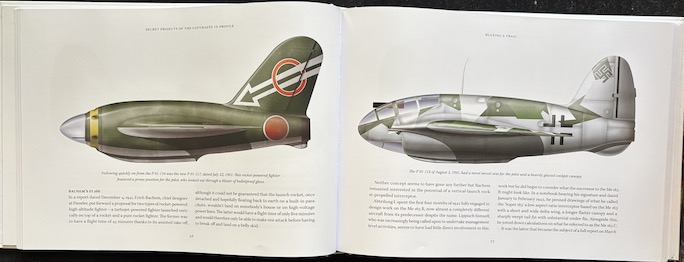
Penny for a thought . . . what might those markings on the left page be?? That there are aircraft with US, British, and Soviet markings shown here makes sense because they represent captured aircraft.
More relevant to the story, these two 1941 proposals are only 2 weeks apart so you can get a sense of how quickly designers and engineers revamped their thinking.
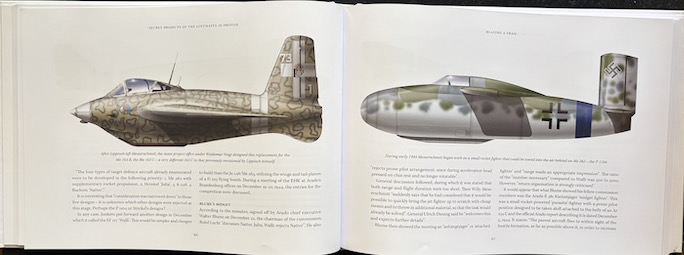
More mystery markings.
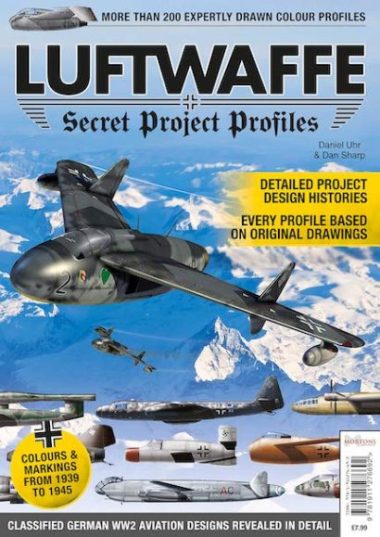 There are so many permutations of this book title, and so many similar-sounding and -looking books by Dan Sharp, with and without co-authors, that it is impossible not to ask if this is a wholly new-new book. Well, there was a basically similar 2018 book by Uhr and Sharp titled Luftwaffe Secret Project Profiles, but it was 90 pages shorter, in portrait format, and softcover. This one is landscape, hardcover, and is said to be “expanded and updated.” They are alike in that both present “over 200 detailed, full-color profiles of jet-propelled aircraft designs” but the new one definitely has a more sophisticated layout (cf. no crossing of the gutter) and with better separation of individual aircraft although it is still possible to get confused because the captions don’t say a whole lot. As to the “updated” bit, that’s hard to quantify but what can be observed is that this 2024 book incorporates findings Sharp first set forth in his 2022 book Messerschmitt Me262: Development and Politics, and illustrator Uhr has updated some of the drawings.
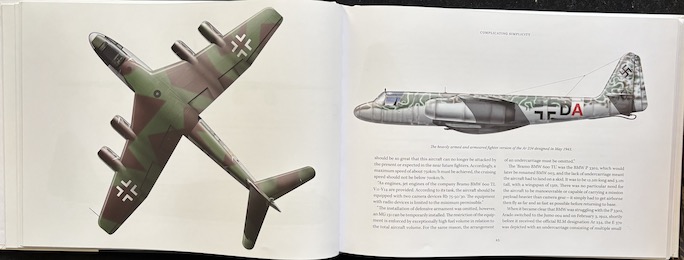
At first glance this might be the same aircraft on both pages; it’s not. The one on the left has no caption but it is a different view of an aircraft from the previous page—whose caption also doesn’t say anything about being continued on the next page. These are not insurmountable problems but they are needless complications.
Presenting the aircraft in chronological order (a “German Jet Development Timeline” 1935–45 in tabular form is appended) and by requirement/role does offer a more cohesive look at the developmental arc than dividing the topic by manufacturer. There is no Index and the Table of Contents does not list project names or numbers so if you don’t know, say, that there was such a thing as a Heinkel Julia or what an “unswept tail surface” does you may not appreciate right away how much this book has to offer.
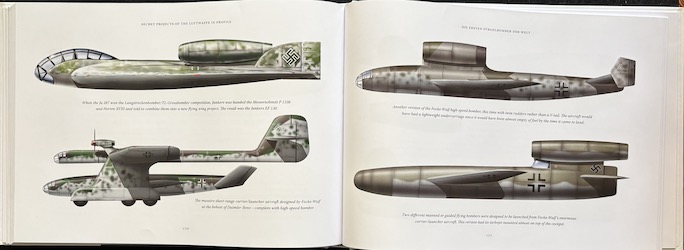
You can see here why the drawings could not possibly be to the same scale. For reasons not explained this chapter title is in German!
The new landscape format is obviously well suited to aircraft profiles. On the one hand it is obvious, which is probably why the book doesn’t bother to spell it out, but it may take quite a few pages to realize that the profiles are not all in the same scale, in fact a profile and a top-down view of the same apparatus will not be at the same scale. What would be useful, to modelers especially, is if dimensions were given. In many/most cases drawings lag their corresponding text by several pages so there’ll be a lot of turning pages back and forth. The book seems to have had no proofreader or editor.
Copyright 2025, Sabu Advani (speedreaders.info)
 RSS Feed - Comments

























































 Phone / Mail / Email
 RSS Feed
 Facebook
 Twitter