
Lamborghini – The Man Behind the Legend
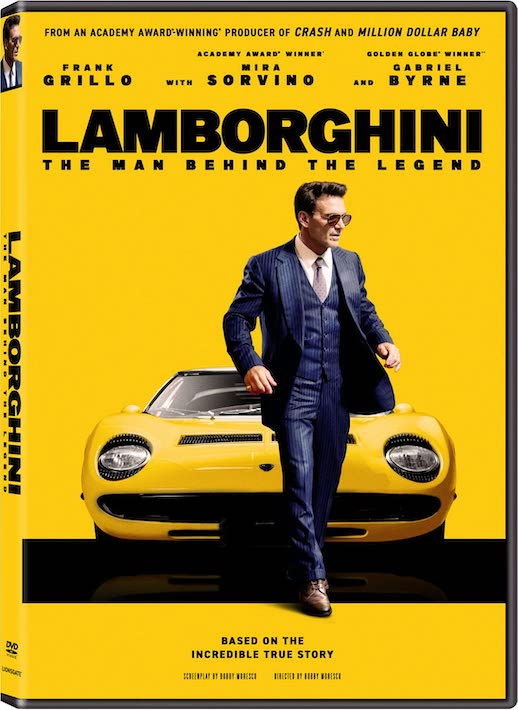 written and directed by Robert Moresco
Tonino Lamborghini: “Why do you still miss my mother?”
—
Ferruccio Lamborghini: “Because she was beautiful, like you.”
—
[One of the many reasons this film is Oscar-free]
This 2022 biopic popped up on Amazon Prime one wet afternoon and, faute de mieux, I succumbed. In mitigation, I was curious.
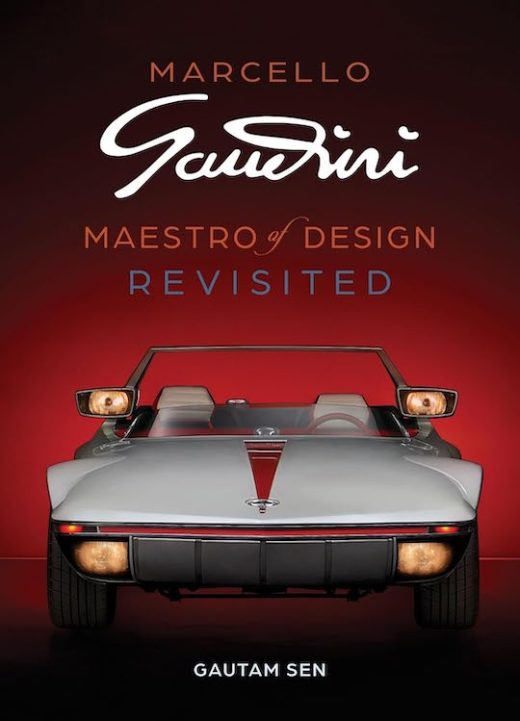
It was the first I’d heard of the movie—BASED ON THE INCREDIBLE TRUE STORY—and I’ve long carried a torch for Lamborghini. Or, more accurately, the Miura, because I think that the Marcello Gandini-designed masterpiece remains the most beautiful road car ever made. I knew something of the Sant’ Agata firm’s origin from my Master’s in car magazine research (gained while notionally studying for a degree in law), so I knew the basics. Italian tractor magnate gets angry with his Ferrari’s shonky build quality, hires chippy New Zealander Bob Wallace and, at a stroke, creates the supercar.
This is a hilariously terrible film.
Under Volkswagen-Audi’s ownership Lamborghini’s stock has never been higher, and it’s the rare Premier League footballer or rap star who doesn’t drive a Urus and/or a Revuelto. But this film made me think most of Doc Brown’s DeLorean, and you can read why later.
Written and directed by American screenwriter, producer, director, and actor Robert Moresco, the three-act movie tells the story of Ferruccio Lamborghini’s life, from young adulthood in postwar Italy to the sale of his eponymous company in the early 1970s. I’d not heard of Moresco (Crash? 10th and Wolf? Bent? Nope, me neither) so I had assumed that this was an Italian production. The fact that the soundtrack sounded dubbed (badly) bore this out, and it was only later that I realized the full horror: the actors were speaking in English but had been told to speak-a like-a this-a, because y’know, it’s what Italians do, right-a?
Mercifully, the film’s running time is a brief 97minutes and, such is the emphasis on establishing Ferruccio’s character (visionary engineer with eye for the ladies), that we don’t even get to see the first Lamborghini tractor until almost halfway through. Postwar Emilia Romagna is mainly rendered in an elegiac glow which might amuse Sophia Loren, who showed the penury and starvation of postwar Italy in Edoardo Ponti’s sublime The Life Ahead (2020). The indoor scenes, as is now customary for period films, mainly take place in Stygian gloom and the coincidence of thunderstorms with emotionally charged scenes evidences the director’s love of pathetic fallacy. [1]
The film’s focus is the genesis of the first Lamborghini, the rather lovely 350GTV, and there’s plenty of stilted dialog to endure between Ferruccio and his engineers on the car’s design, the engine’s carburation, and the advantages of aluminum. It’s widely known that the poor build quality of 1960s Ferraris was the reason that Lamborghini decided to make cars himself. There are some clunking conversations with Il Commendatore about the terrible clutch fitted on Ferruccio’s 250 California, ending with a scowling Enzo Ferrari shouting “Go back to your tractors, farmer!”
Incidentally, for those who enjoy spotting such things, there’s an Easter egg in the form of the advertisement on the Ferrari factory wall, in 1962. It depicts a Series 2 250 GTO (yup, I know, from 1964) surmounting the slogan “When you want to be somebody.” This is from Frank Sinatra’s well-known quotation from years later, the latter part of which reads, “You buy a Lamborghini when you are somebody.” The movie also has a dreamlike leitmotif, where Gabriel Byrne (E. Ferrari) and Frank Grillo (F. Lamborghini) stage an impromptu and entirely unconvincing race from a stoplight. Cue Italianate scowls and muttered oaths. And look, if my testosterone-drenched Countach had struggled to beat Maranello’s lamest pony, the Mondial, I’d have wanted my money back.
So, that DeLorean connection. In Back to the Future Marty McFly returns to 1955 from thirty years later in a modified DeLorean. In the Lamborghini film there’s a whole host of automotive anachronisms to savor, where stuff from the future inexplicably appears in the present. I snorted at the unlikely competition Ferruccio and brother Matteo encountered in a 1948 road race—a Mercedes 190SL and a Porsche 356 Speedster, both of which only appeared in 1955. I giggled at the yellow Dino 246 parked outside the Sant’ Agata factory in early 1964—that little Ferrari (in essence if not in name) had travelled back from 1969. How? Was it a localized rip in the space/time continuum, confined to Emilia Romagna? Hardly, because it then spread to Switzerland, where we see Enzo Ferrari (still scowling) at the 1964 Geneva show, and he’s standing in front of a silver 330 GTC, the Ferrari that didn’t appear until two years later. I thought vaudeville died?
Ferruccio Lamborghini deserves a more accurate obituary than this film. Not perhaps the opera that has yet to be written about Enzo Ferrari (inevitably entitled Le Mie Gioie Terribili) but something more fitting for the man who gave us the Miura. Notoriously, the Lamborghini logo is the fighting bull after which many of his cars were named. There’s no shortage of bull in this film, but it’s fresh out of fight.
- Pathetic fallacy: a literary device where the inanimate, such as weather, echoes human emotion. Thomas Hardy was a big fan; ask Tess of the d’Urbervilles.
Copyright 2025, John Aston (speedreaders.info)
 RSS Feed - Comments






 Phone / Mail / Email
 RSS Feed
 Facebook
 Twitter