
Custom Built by McFarlan
A History of the Carriage and Automobile Manufacturer, 1856–1928
 by Richard A. Stanley
”McFarlan’s yearly production was never more than a few hundred and its total output in nearly 20 years of production only around 2,400 . . . More than 40 years later, this author accounted for . . . a ratio of one survivor for about each 135 produced.”
Having earned a stellar reputation as a builder of prize-winning horse-drawn carriages, surreys, buggies, phaetons, road and spring wagons over the prior 50 years, it seemed a natural transition to motorize these conveyances as horseless carriages gained in popularity.
By the time John Becraft (JB) McFarlan and wife Lydia moved to Connersville, Indiana he was already a skilled carriage builder and repairer. In Connersville he found several small existing carriage makers that he acquired, combining them in 1856 into McFarlan Carriage Company. JB’s focus was building high-quality but reasonably priced conveyances. As his company’s reputation grew so too did his market with orders coming from places such as Denver, Colorado; Kansas City, Missouri; and even Australia.
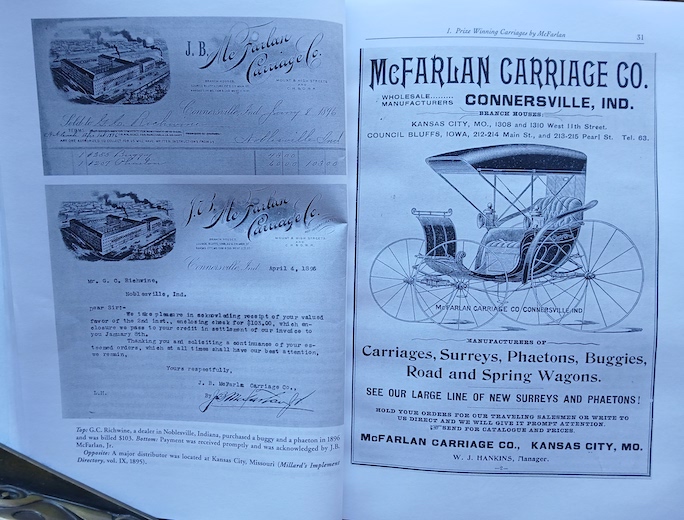
“John and Lydia were the parents of seven children,” four boys and three girls. Each of the lads worked with their dad at one time or other with two remaining active in the company and eventually joined by some of their own offspring. In 1909 JB’s grandson, Harry (Alfred Harry McFarlan) initiated the idea of motorizing, enlisting his grandfather’s approval and financial support. “Harry gained approval from the 86 year old family patriarch” but who sadly passed two weeks before the first experimental car was finished.
Drawing on its experiences and the contacts developed from long years in business, the McFarlan motorcar was conceived and built with its own fine coachwork and carefully selected components from suppliers, including engine. “The first McFarlans for sale . . . were considered 1910 models.” Traveling salesmen spread the word and in June of that first-ever McFarlan model year a West Coast dealer entered a display model at the California State Fair where it earned a gold medal along with buyers’ attention.
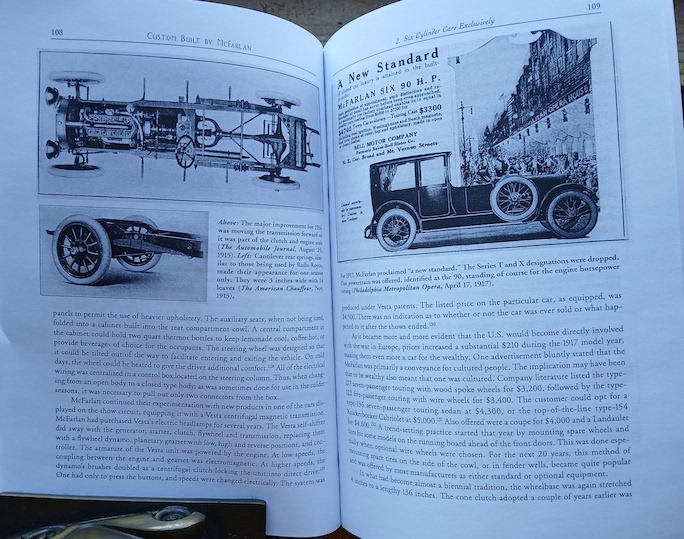
All 1912 McFarlan models featured compressed air self-starters as standard equipment. They were prompted to develop it in house following Cadillac’s February 1911 introduction of its self-starting unit. However, it subsequently proved to not be as satisfactory as hoped, so in 1915 customers were offered their “choice of the pneumatic system or a considerably lighter weight Westinghouse electric starter at no extra charge.”
For 1913 McFarlan’s came standard with electric lights; no more having to stop as dusk turned to darkness to light acetylene headlamps and kerosene side and tail lights. The following year McFarlan ceased its carriage-building operations entirely. For 1916 McFarlan introduced a tilt steering wheel and in 1917 the steering wheel could be electrically warmed for winter driving.
Location of the steering wheel was for a time an industry-wide debate. Pierce-Arrow, the longest hold-out, would retain right side steering until 1921. McFarlan opted to make all their vehicles left hand steer in 1914 and that year also offered the Gray Pneumatic gear shifting with steering wheel-mounted controls.
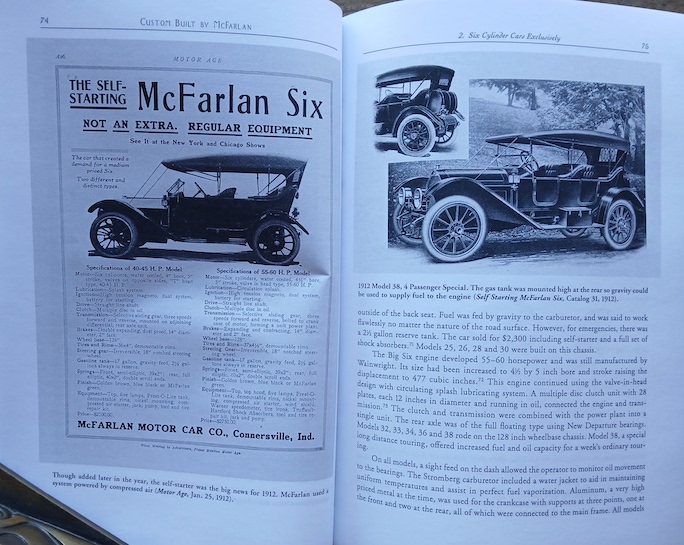
Note the inset image on right side page showing where the gas tank is mounted; high so gravity could feed the engine.
McFarlan established its custom body department in 1916 thus joining the more elite car makers by offering customers bespoke bodies, colors, and upholstery giving McFarlan “a recognition that they had not previously known.” By 1922 “the McFarlan was one of the highest priced and most exclusive automobiles in the country . . . [with] more than 200 men employed by the factory with an annual payroll in excess of $200,000.”
But three years on, Harry McFarlan’s health showed signs of failing and he repaired to Arizona to recuperate. As it turned out, he would never return to Indiana. Then the factory experienced a fire that disrupted production somewhat. As it had never been a high-volume producer, any interruption negatively impacted profitability. Too, business had already slowed due to the depressed economy of prevailing postwar conditions.
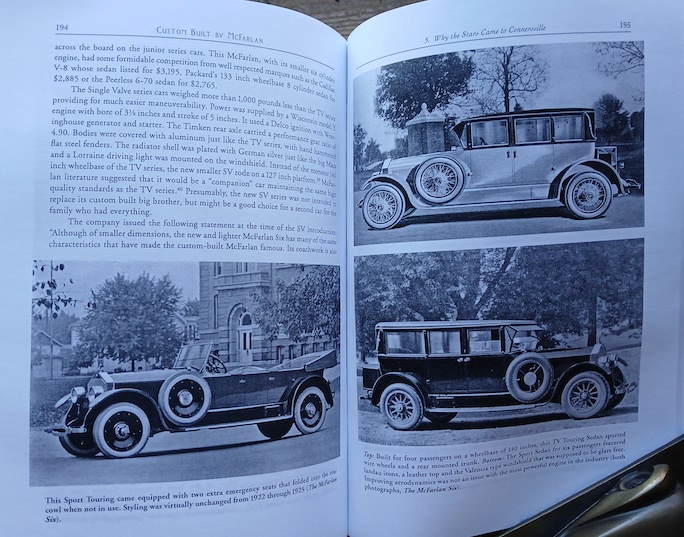
Some of the styles and models that attracted the rich, famous and Hollywood personalities.
1927 the McFarlan family, their company and family of employees marked 70 years manufacturing in Connersville. With Harry, still president in absentia, his trusted associate Burton Barrows, was in charge. Barrows was essentially a “one man band” serving as vice president, also treasurer, and general manager. Then on March 30, 1928 everything came to an abrupt standstill when Barrows died in a freak accident at the factory leaving no succession plan in place and no one to direct or keep the factory functioning. By August McFarlan was out of business, declaring bankruptcy. But it left behind numerous sought after and respected cars, a number of which Stanley tells of in his final chapter, “McFarlans that have Survived the Years.”
Augmenting the carmaker’s chronological history, Stanley has chapters expanding on McFarlan’s race and touring achievements, its professional vehicles built to order, and its custom-built bespoke vehicles, identifying some of the buyers.
Richard Stanley had been motivated to write more fulsomely about the McFarlans, their company and carriages and motorcars they created, produced and sold when he moved to Connerville following accepting a teaching position in that city. Subsequently he met and came to know quite well Connersville native Henry Blommel. Blommel had contributed to the privately published 1967 book What Was the McFarlan? by Keith Marvin and Alvin J. Arnheim. As Stanley sought to learn more, he consulted additional resources, interviewed people, and more as the bibliography and chapter notes and some of the photographs clearly show.
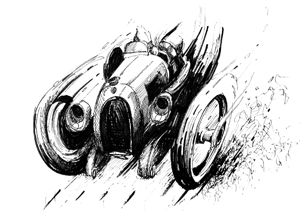
The wonderful cover art was created just for his book by Henry Blommel’s son John. It graced the cover of the first edition published as a hardcover by McFarland in 2012. Your reviewer’s copy is the 2022-published softcover.
That Richard Stanley succeeded in telling the McFarlan story more fully there is little doubt. His most readable text is enhanced too by the ubiquitous images he successfully sourced.
Copyright 2025 Helen V Hutchings (speedreaders.info)
 RSS Feed - Comments


 Phone / Mail / Email
 RSS Feed
 Facebook
 Twitter