
M18 Hell-Cat: 76mm Gun Motor Carriage in World War II
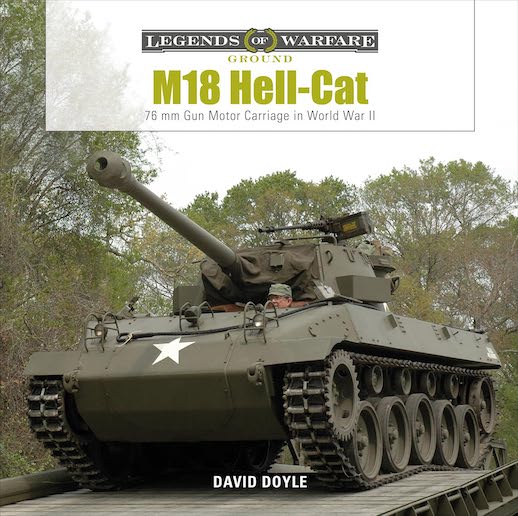 by David Doyle
This is not a new book as is indicated by its 2020 publication date although your reviewer discovered its existence only recently. It is still readily available, in Schiffer Publishing’s “Legends of Warfare, Ground” series which presently encompasses 40 different track layers, each in an individual book. So, if these are of interest to you, be sure to explore the other titles in the series. This particular title attracted me as I’m aware this track layer had been one of General Motors’ Buick Motor Division’s wartime builds.
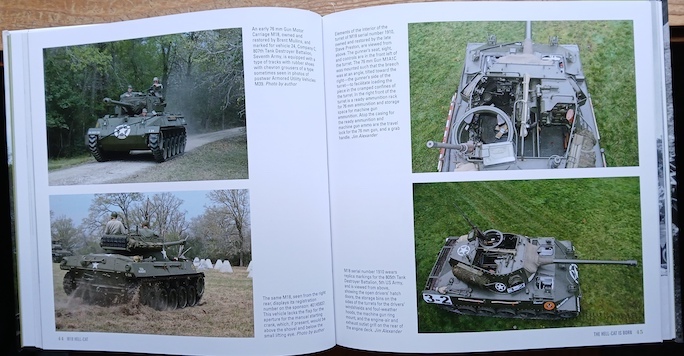
What I found between the covers were 146 nicely captioned images, a mix of factory, field, and wartime action shots. Thirty-five of them were sourced from General Motors archives, with other images provided by the [George] Patton Museum and the National Archives. And many are printed large on the pages making detail more easily discernible—especially in the shot-in-the-field black and whites.
When first conceived, these track layers were indeed named Hell-Cats but that word quickly morphed to Hellcat. Today either is considered correct. They were conceived to be—and did become—the fastest track layers in the Allied arsenal. The first design had utilized twin Buick engines which proved to have insufficient oomph after the contracting US Army had changed its mind and specified instead of a 57mm gun, Hellcats would be fitted with considerably heavier (as in double the weight) 76mm. Thus the most speed the twin Buick’s could muster was 38 mph. This book says that Continental rear-mounted R-975C-4 radial engines were utilized instead and top speed became the targeted 55+ mph whereas The Buick, A Complete History indicates it was “a radial-type aircraft engine—the Wright Whirlwind—[that] was tried.”
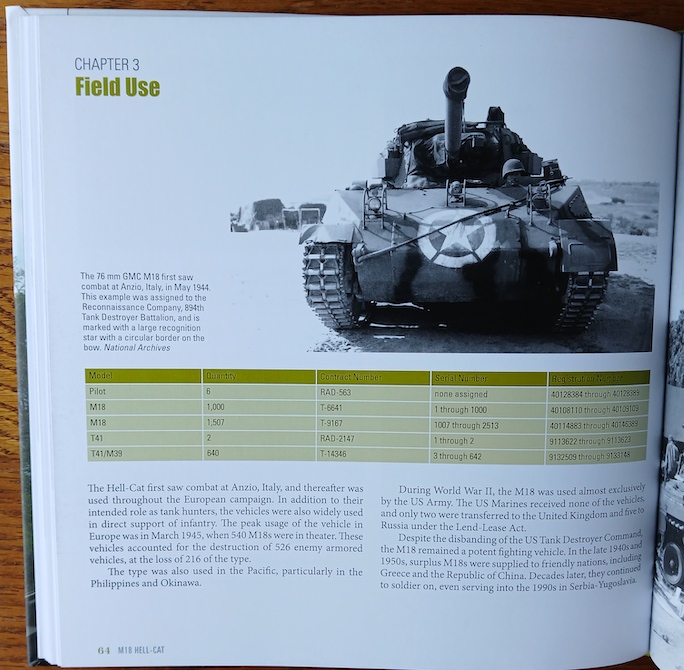 The chart on the page shown above is production number details. Of the total of 2,507 M18s built, 642 were returned early in 1944 and retrofitted becoming T41s. The retrofit consisted of removing the turret and making “other modifications to allow the vehicle to be used as a prime mover for towed artillery” or for reconnaissance use and increased seating to accommodate ten men. During development they were designated T41, in service “standardized as the M39. These vehicles saw limited use during World War II but more extensive afterward, including Korea, until finally being declared obsolete in February 1957.”
The useful service lives of M18s or M39s didn’t end there as “early Cold War period, the United States transferred quantities . . . to friendly governments . . . under the Military Assistance Program.. . . Decades later, they continued to soldier on, even serving into the 1990s in Serbia-Yugoslavia.” Too, there are several in private collections some of which, such as one shown here and also on the book’s cover, fully restored.
Author David Doyle has over 100 published books to his credit. Regular visitors to this site have learned of some of his other works. And you can learn more about him at his website.
Copyright 2025 Helen V Hutchings (speedreaders.info)













 Phone / Mail / Email
 RSS Feed
 Facebook
 Twitter