
Auto Racing in the Shadow of the Great War
Streamlined Specials and a New Generation of Drivers on American Speedways, 1915–1922
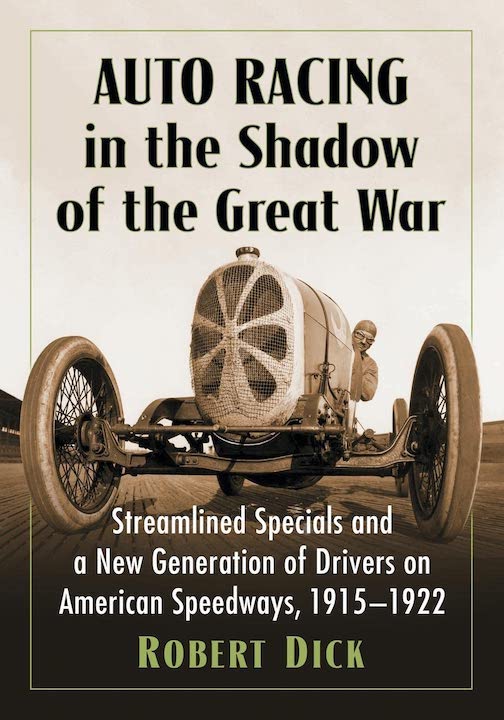 by Robert Dick
“By no means does this period deserve to be forgotten. It produced magnificent and breathtaking races on fabulous speedways, thrilling hundreds of thousands of spectators, It was during this period that Stutz, Frontenac, Duesenberg, Packard, Miller and Ballot developed legendary racing cars, which often started under odd names and mysterious public disguises.”
It’s now some five or more decades ago that the concept of motorsport as a topic warranting scholarly inquiry by historians engaged my thinking. Having any sort of meaningful interest in motorsport pretty much requires an awareness of its history, it’s just a matter of degree. In my case, I was then beginning to grasp the concepts of separate but related fields like automotive, cultural, public, and sport history. Of the latter, I actually had a professor who published a book on the 1936 Olympics. I realized (initially only vaguely) that Harold Seymour had written his dissertation on baseball (Cornell, 1956) only because it had come up in one of Richard Mandel’s classes. Sport history was beginning to edge its way well onto my radar screen. Although my graduate studies were focused primarily on military history and American international relations, my thinking was broadening.
Eventually, despite the utter lack of enthusiasm within the hallowed groves of Academe, I found myself plowing with growing interest into the rather obscure and generally abstruse niche topic of American motorsport history. This was serendipitous in that what may well have remained a short-lived diversion has held my interest for much of the past three decades, and this is why I say with some sense of context that books like Robert Dick’s elevate the field.
The subtitle of this one, his third, sharpens the focus: Streamlined Specials and a New Generation of Drivers on American Speedway, 1915–1922. This is an excellent monograph written by an author who has mastered the topic at hand.
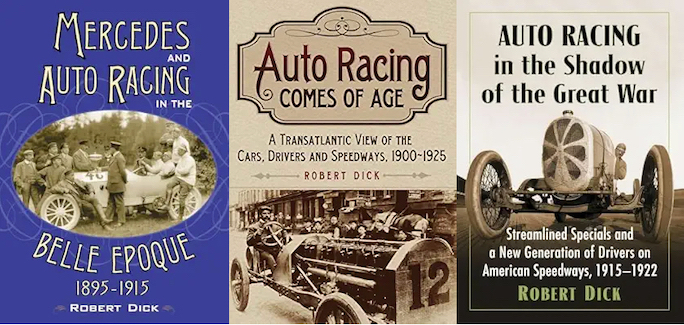
 Dick’s focus is on the formative years of motorsport during the early decades of the 20th century. His first two books explored Mercedes and Auto Racing in the Belle Epoque, 1895–1915 (McFarland, 2005) and then Auto Racing Comes of Age: A Transatlantic View of the Cars, Drivers and Speedways, 1900–1925 (McFarland, 2013). Both are standard works for any research into this era of motorsport.
While Dick brings with him an engineer’s close attention to things mechanical and technological, he also stays aware of the context, the zeitgeist if you will, within which the machines exist. This is a feat many of more technically inclined writers with an engineering background struggle with. An obsession with machines and all their myriad dimensions and specifications really is low-hanging fruit whereas the history of the times in which they occur and the times that preceded them is where the hard work of understanding any one thing in context happens. Even motorsports “politics” has its place here but it too is just one strand of many.
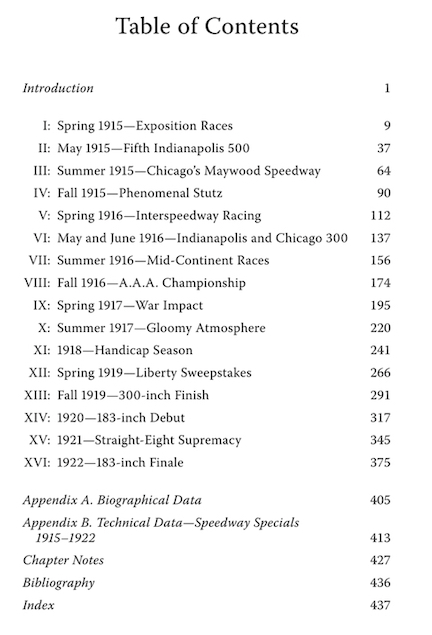
To his credit, Dick manages to handle the technical and the practical, including some of that which includes the various personalities of the era. Indeed, Dick has compiled one of the very best bibliographic listings of participants from this era that you will find. Calling it “impressive” is definitely warranted. And, being an engineer, Dick has an appendix dedicated to the “Speedway Specials of 1915–1922” which presents the usual nuts and bolts stuff but also good background on the various cars.
As good a motorsport history as this book is simply on its own merits, there is another dimension to it where it passes, at least in my view, into greatness: it bridges a very concerning and persistent—and growing—gap to the earliest, foundational era of motorsport. Almost without fail, those histories have motorsport coming to an end with the Grand Prix de l’Automobile Club de France of 1914 and then resuming with its 1921 edition, leaving a void spanning the years 1915 to 1921. Dick’s book slots exactly into that gap.
If you look at world history, the United States experienced different stresses in that period and thus motorsport scarcely missed a beat here even if wavered a tad. That said, Europeans did not have a particularly high opinion of American motorsport. Conversely, Americans bemoaned the sport’s Eurocentric flavor. All of which combines to make Dick’s treatment here an important contribution to a nuanced understanding of the sport. All his books offer pages of endnotes allowing the reader to see exactly where he got his information for what appears on the page.
This is a significant work of American motorsport history and fully deserves your attention. Highly recommended!
As an aside, in addition to producing these three excellent books Robert Dick is a stalwart contributor to TNF (The Nostalgia Forum) at Autosport.com, providing no end of pertinent items and observations resulting from his incredible research efforts.
Copyright 2025, H. Donald Capps (speedreaders.info).
Auto Racing in the Shadow of the Great War
Streamlined Specials and a New Generation of Drivers on American Speedways, 1915–1922
by Robert Dick
McFarland, 2019
446 pages, 153 photos, softcover
appendices, notes, bibliography, index
List Price: $49.95
ISBN 13: 978-1-4766-7272-4
 RSS Feed - Comments






 Phone / Mail / Email
 RSS Feed
 Facebook
 Twitter